







Three femtoseconds to observe a molecule as it changes
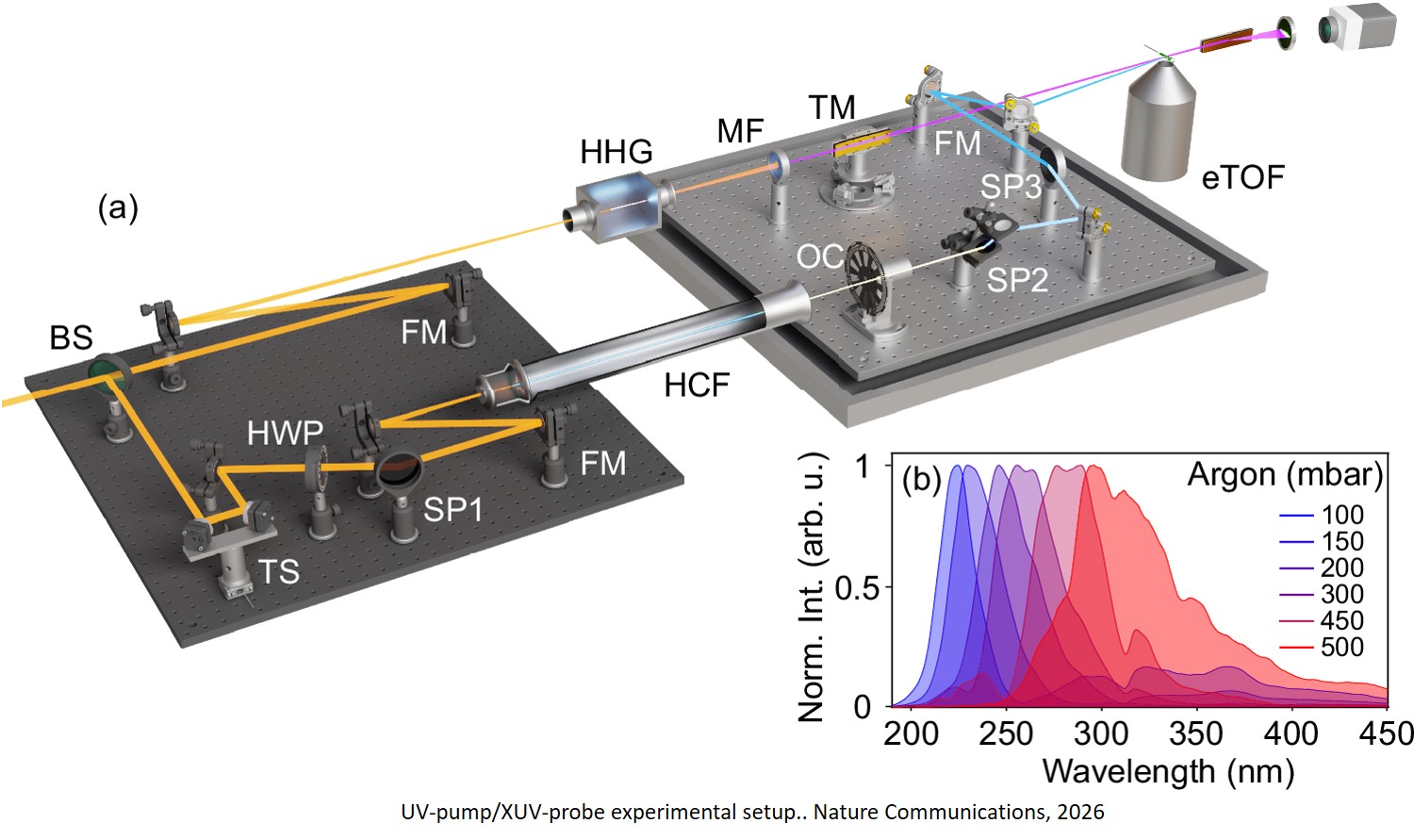
Observing a molecule in the very first instants after it has absorbed light and tracking the coordinated motion of electrons and nuclei with a temporal resolution of just three femtoseconds. This is the result achieved by an international research group, which has developed a new apparatus for studying ultrafast photochemical processes.
The experimental platform achieves a temporal resolution of approximately 3 femtoseconds - one femtosecond is one millionth of one billionth of a second - placing it among the world leaders in time-resolved photoelectron spectroscopy.
The result was published in Nature Communications.
To demonstrate the capabilities of the new method, the researchers studied acetylacetone, a molecule used as a model to understand how light can trigger ultrafast transformations. Thanks to the precision achieved, it was possible to distinguish two successive passages through a conical intersection, a crucial junction at which the molecule changes electronic state and is directed towards a specific transformation pathway. These are phenomena that previously available instruments were unable to separate in time.
“With this apparatus, we can follow a molecule in the very first instants after it absorbs light, with a level of detail that was not previously accessible. It is like vastly increasing the number of frames in a film: a seemingly single transformation finally reveals all its intermediate stages,” says the senior author.
The new apparatus uses two extremely short light pulses synchronised with exceptionally high precision. The first pulse, in the ultraviolet, is absorbed by the molecule and initiates its evolution. The second, in the extreme ultraviolet and lasting a few attoseconds, reaches the molecule after a controllable time interval and makes it possible to reconstruct its state at that precise moment.
By repeating the measurement at successive intervals, the researchers can track the redistribution of energy and the joint motion of electrons and nuclei. In the case of acetylacetone, the experiment made it possible to reconstruct the initial stages of the transformation triggered by light in unprecedented detail.
“What we observe is the moment when light sets the molecule in motion and reorganises its internal energy,” explain another author. “Being able to follow these stages directly means getting closer to the heart of photochemical processes, where a transformation truly takes shape.”
The ability to change the wavelength of the ultraviolet pulse makes the apparatus suitable for studying different molecules and electronic states. The method may therefore be applied to more complex systems, from molecules of biological interest to photoactive materials and processes linked to energy conversion.
The platform also opens up new prospects for attochemistry, the field of research that studies the possibility of observing and, in the future, controlling chemical transformations by acting on the motion of electrons before the slower motion of atoms begins.
https://www.nature.com/articles/s41467-026-76602-4
https://sciencemission.com/photoelectron-spectroscopy