

Fundamental insights on movement planning in the brain
3, 2, 1 – and go! When the signal sounds, all the runners push off from their starting blocks and set off sprinting. The reason why we are able to act within fractions of a second is because we plan movements in our brains in advance, before carrying them out.
At the interdisciplinary research center, a team of 15 researchers from the fields of biology, artificial intelligence, and neurotechnology have investigated in greater detail how the transition from mentally preparing a movement to actually executing it with one’s muscles is controlled at the neural level. In their article, published in the journal Cell Reports, the researchers now propose an improved model for understanding the neural processes involved in movement planning.
‘Thanks to this basic research, we now have a better understanding of the neural processes in the brain for controlling movements. In the long term, these findings could be used to develop treatments or aids for people with mobility impairments. For example, sensors could detect movement signals in the brain and transmit them to a smart prosthesis.’, says a co-senior author.
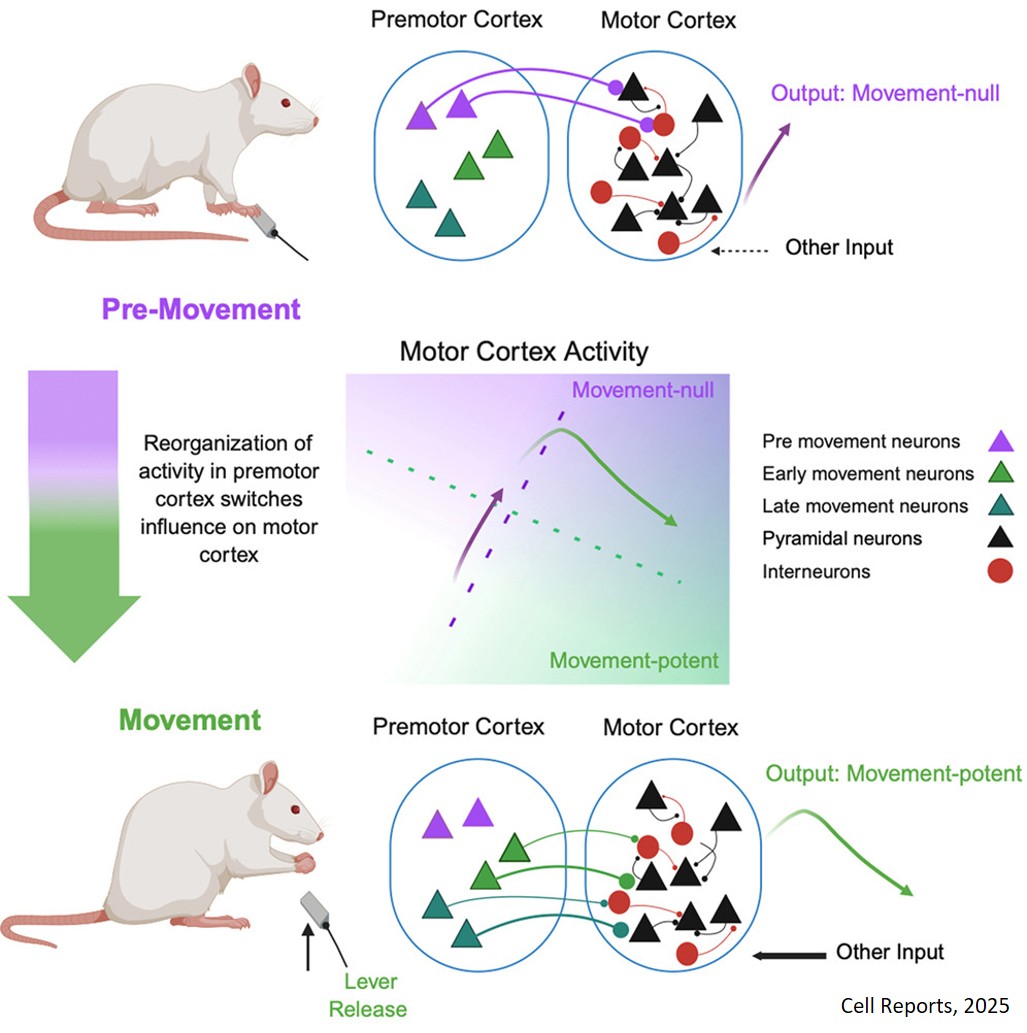
For the study, the researchers trained rats to move a lever with their hand until they felt a vibration and then to release it. As a reward, they received a drop of sugar water. Their neural activities were recorded during this experiment.
With regard to movement planning and execution, the rodent brain is similar to the human brain. Both contain two specific areas that become active when movements are planned and executed: the premotor and the primary motor cortex. ‘Up to now, it was unclear precisely how movement planning is coordinated between these two areas of the brain. Above all, we wondered why these two brain regions show activity even before the movement is executed and without any premature movement occurring’, explains one of the first authors of the study.
The research team has now succeeded in demonstrating how the commands are transmitted at the neural level: During movement planning, neurons in the premotor cortex communicate with both inhibitory and excitatory neurons in the primary motor cortex. The command to execute a movement can only be given once neural activity in the premotor cortex has shifted to neurons that communicate primarily with excitatory neurons in the primary motor cortex. Only then can an external signal – in the experiment, the vibration of the lever – trigger the execution of the movement.
The assumption that this shifting pattern of neural activity enables the precise execution of a planned movement is referred to by the research team as the switching population hypothesis. The researchers propose that this hypothesis should replace the two previously dominant hypotheses.
https://www.cell.com/cell-reports/fulltext/S2211-1247(26)00620-0
https://sciencemission.com/premotor-motor-cortex-interactions