

How repeated exposures may make allergies worse
Researchers found that sensory neurons retain a ‘memory’ of allergens that may help explain why allergies develop over time
A new preclinical study offers a potential explanation for two longstanding questions in allergy: why do allergies often emerge only after repeated exposure, and why do people with one allergy frequently develop others? The findings are published in Immunity.
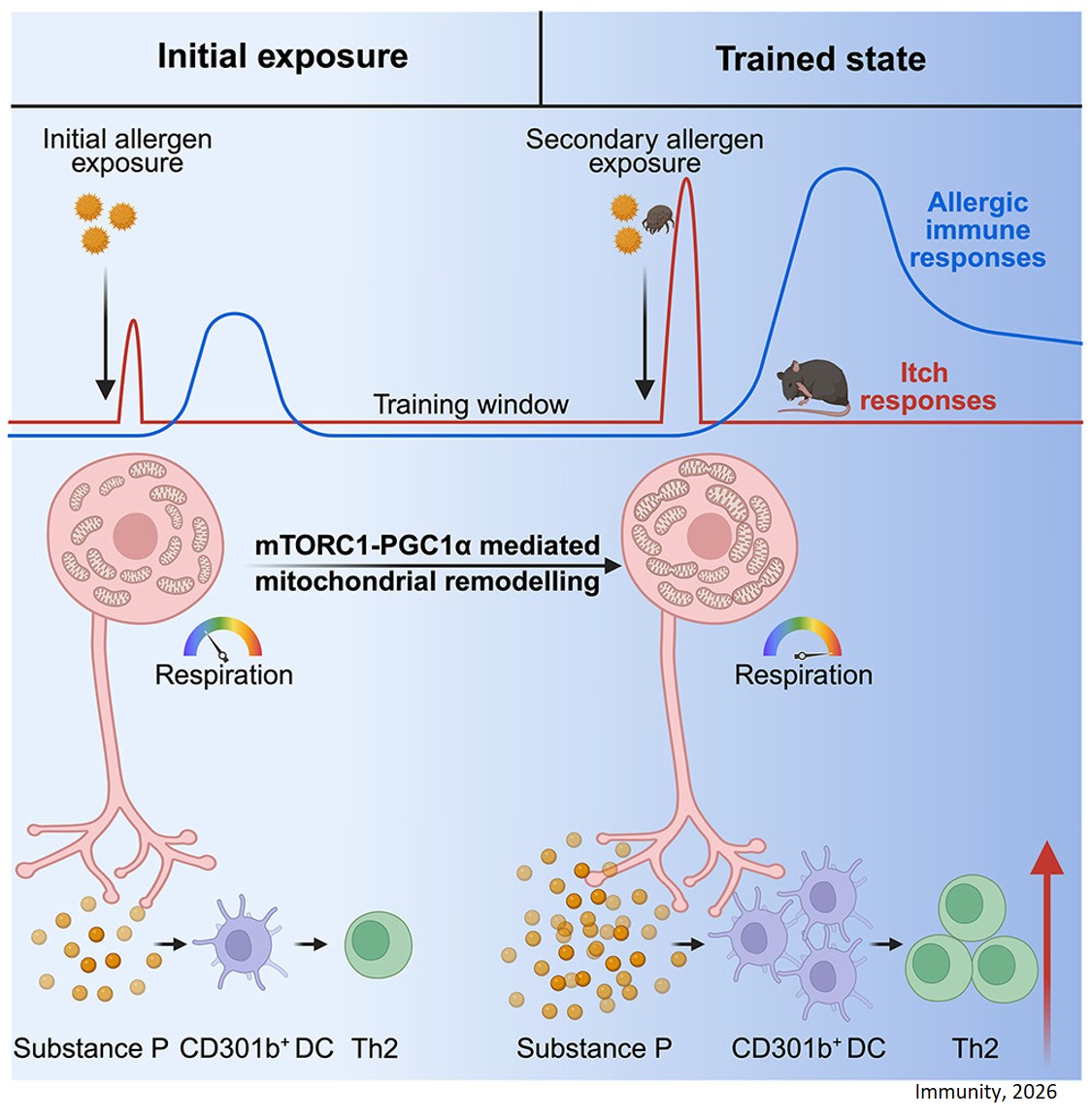
The team’s earlier work revealed that sensory neurons — the nerve cells that allow us to feel sensations such as itch and pain — can directly sense certain allergens and help start the allergic immune response. The new study shows that these neurons do not simply detect allergens in the moment but can retain a metabolically encoded record — or “memory” — of previous exposures that allows them to respond more strongly to later exposures, even after the original allergen is gone.
“Now that we know what may cause people to become allergic and pick up more sensitivities, we can design ways to stop it from happening,” said the senior author. “What is especially encouraging is that allergic memory in neurons faded with time in our models. We are now investigating whether we can deliberately reset this memory, which could ultimately offer a way to reduce the risk of developing allergies.”
The study grew from a familiar clinical observation – people tend to encounter the same pollen, pets, or foods repeatedly before developing an allergy.
“Neurons are known for their ability to form memories,” the author said. “We asked whether an initial allergen exposure might leave a trace – not enough on its own to trigger a full allergic response, but enough to prime the neurons to respond more strongly the next time.”
To test this idea, the researchers modeled recurrent allergen exposure in mice and found that an initial exposure activates a specific signaling pathway in neurons. The authors show that the protease allergen exposure induced sustained mechanistic target of rapamycin complex 1 (mTORC1) kinase signaling and transcriptional activator peroxisome proliferator-activated receptor gamma coactivator-1α (PGC-1α)-associated mitochondrial remodeling in sensory neurons, establishing a metabolically primed state with enhanced neuronal responsiveness.
Upon allergen re-exposure, primed state drove enhanced itch, CD301b+ dendritic cell migration, and Th2 cell differentiation. Disrupting neuronal mTORC1 signaling or mitochondrial stability abrogated this amplification while sparing primary responses. This pathway not only primes them to later respond to the same allergen, as the team hypothesized, but also to other allergens that share the same enzymatic activity but have different molecular structures.
This suggests that sensory neurons may remember a shared feature of allergens – the type of danger signal they produce – rather than their precise molecular identity. This cross-allergen response may help explain why developing sensitivity to one allergen can increase susceptibility to others.
https://www.cell.com/immunity/fulltext/S1074-7613(26)00349-3
https://sciencemission.com/mTORC1-kinase-signaling