




Growing salivary glands from pluripotent stem cells
Extreme dry mouth, caused by radiation for cancer treatment and autoimmune diseases such as Sjögren’s disease, radically affects quality of life for sufferers. It can hamper speaking, swallowing and eating, and for years has seemed an intractable problem.
Attempts to stimulate the salivary glands to produce more saliva or to create artificial saliva have been ineffective.
Now, a small team of researchers is working on a promising new strategy: creating salivary glands from human pluripotent stem cells (PSC) that could ostensibly be implanted into an individual’s mouth.
“Human pluripotent stem cells can be derived from easily accessible adult somatic cells, such as skin or blood cells, making them an attractive cell source for therapeutic applications,” says the senior author.
The study was published in the journal Nature Communications.
The senior author explains that they are guiding these stem cells through steps that are similar to how salivary glands form during human development. They gradually produce salivary gland epithelial progenitor cells (SGEPs), which organize themselves into tiny, three-dimensional structures called organoids, or mini organs.
“Our findings suggest that salivary gland organoids may hold promise for studying salivary gland development, disease progression and drug screening, as well as for development of cell therapies for salivary gland regeneration,” says the author.
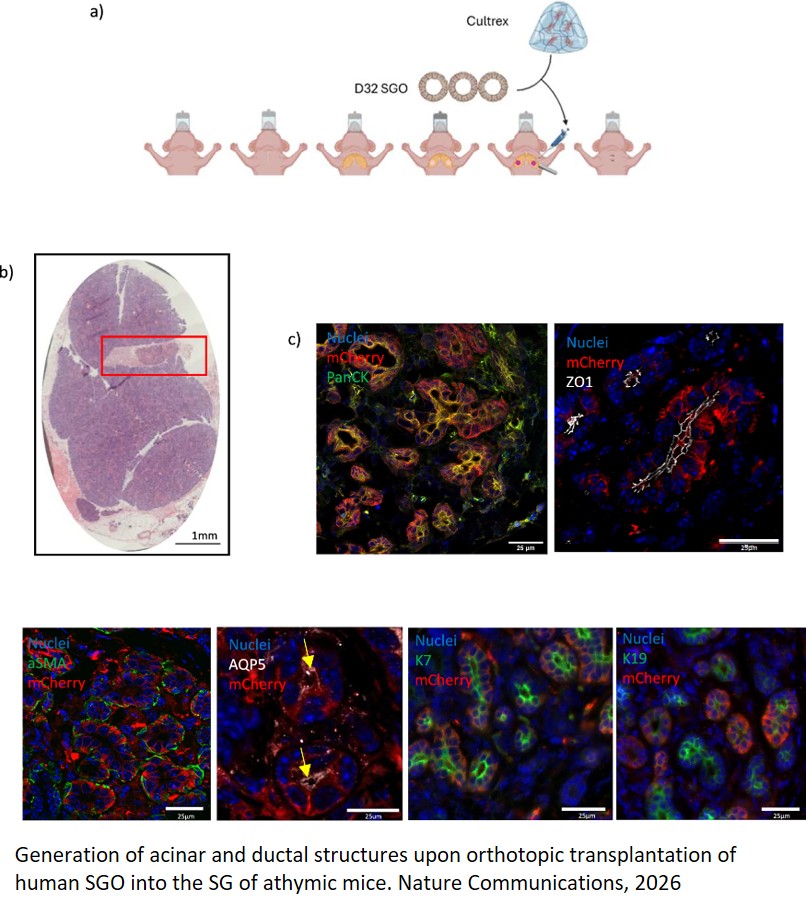
The research team transplanted the organoids into the submandibular salivary glands of immunodeficient mice, which allowed the human-derived tissue to be studied without immune rejection. The team then performed the immunostaining and analyzed how well the transplanted organoids integrated and differentiated within the host tissue.
They discovered that after more than 40 days in mice, the transplanted organoids not only survived but also integrated into the existing salivary gland tissue. Further analysis showed that the organoids contained cells that are present in more mature glands, including acinar cells, which produce saliva; ductal cells, which carry saliva to the mouth; and myoepithelial cells, which help squeeze saliva out of the glands.
“These newly formed glands looked similar to native salivary glands and even developed lumens, or the hollow spaces where saliva would normally flow,” the author says.
The team plans to further refine the differentiation process so that the cells comprising the organoids become more mature and their developmental fate can be more precisely controlled.
“Basically, our experiments so far showed that the transplanted organoids have the potential to survive in vivo,” the lead author says. “They integrated with the gland of the mouse and differentiated to include major salivary gland structures. This means they could, potentially, become a renewable source of replacement cells in patients in the future.”
The team is also working to determine the best stage of organoid development for transplantation and to improve the conditions in which the organoids grow. The goal is to help them produce more saliva and connect properly with the existing ducts that carry saliva to the mouth, as well as with the nerves that control salivary gland function.
“While using these cells in humans is a long way off, this research does suggest that one day scientists could repair salivary glands damaged by radiation therapy, restore saliva production in people with chronic dry mouth, study diseases of the salivary glands in the lab and test potential new drugs on human salivary tissue,” the senior author says.