











The Science Behind Why 8-oz Mason Jar Candles Burn Better
Discover the physics and engineering behind why 8-oz Mason jar candles burn cleaner, last longer, and deliver stronger scent throw than other candle formats.
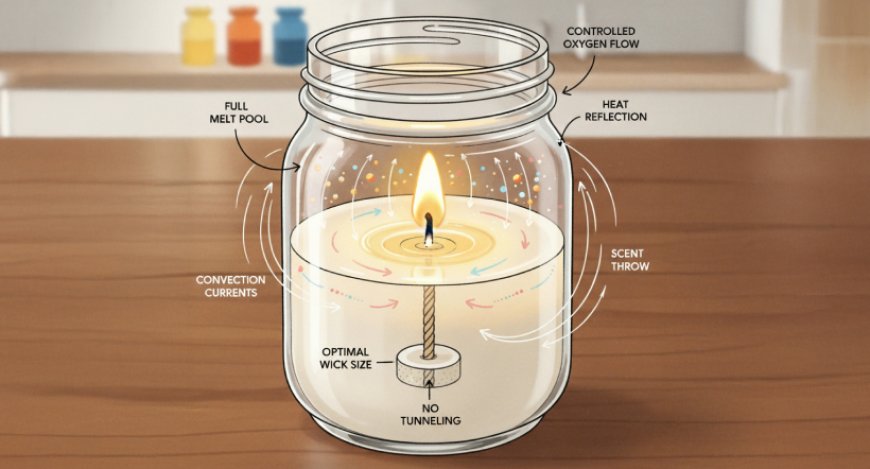
Have you ever wondered why some candles burn evenly from start to finish while others tunnel down the centre, leaving wasted wax along the sides? Or why certain candles fill a room with fragrance while others barely make an impression? The secret often lies not just in the wax or wick, but in the container itself. The 8-oz mason jar has become the gold standard in candle making, and there's solid science explaining why these candles consistently outperform others. Let's dive into the physics, chemistry, and engineering principles that make 8-oz mason jar candles burn better.
The Ideal Diameter-to-Height Ratio
At the heart of superior candle performance is geometry. The 8-oz mason jar typically measures approximately 2.75 to 3 inches in diameter and 3.5 inches in height. This creates a diameter-to-height ratio of roughly 1:1.2, which happens to be the sweet spot for optimal candle burning.
Why This Ratio Matters:
When a candle burns, it creates a melt pool—the liquid wax surrounding the flame. For a candle to burn efficiently, this melt pool needs to reach the edges of the container within 2-3 hours of burning. If the diameter is too wide relative to the wick size, the melt pool won't reach the edges, causing tunnelling. If it's too narrow, the candle may burn too hot, potentially causing smoking or rapid consumption.
The 8-oz mason jar's diameter is perfectly sized for standard medium wicks. A properly sized wick (such as a CD-12 or ECO-10) generates enough heat to create a complete melt pool across the 3-inch span without burning too aggressively. This geometric harmony is no accident—it's physics working in your favour.
The height-to-diameter ratio also affects oxygen flow. The 8-oz mason jar's proportions allow adequate air circulation around the flame without creating drafts that could cause uneven burning or excessive smoking. As the candle burns down, the jar's straight walls maintain consistent airflow patterns, unlike tapered containers, where airflow changes as the flame descends.
Thermal Dynamics and Heat Distribution
Glass is a poor conductor of heat, which initially might seem like a disadvantage. However, for candles, this property is actually beneficial when properly leveraged—and the 8-oz mason jar does exactly that.
The Thermal Envelope Effect:
The thick glass walls of the 8-oz mason jar (typically 3-4mm) create what engineers call a "thermal envelope." The glass absorbs and radiates heat slowly and evenly, maintaining a consistent temperature around the wax. This prevents the rapid temperature fluctuations that can cause candle performance issues.
When a candle burns in an 8-oz mason jar, the glass gradually warms to an optimal temperature range (typically 120-150°F on the interior surface). This warmth helps maintain the melt pool in a liquid state all the way to the edges, preventing premature wax solidification that causes tunnelling.
The uniform cylindrical shape ensures heat distribution is symmetrical. Unlike containers with varying widths or decorative ridges, the 8-oz mason jar's consistent wall thickness and smooth interior mean every part of the candle experiences similar thermal conditions. This uniformity is crucial for even burning.
Heat Retention Without Overheating:
The glass composition and thickness of the 8-oz mason jar strike a perfect balance. It retains enough heat to keep the melt pool liquid but doesn't trap so much heat that the candle burns too aggressively or creates safety concerns. The jar's exterior remains warm but not dangerously hot—typically comfortable to touch within minutes of extinguishing the flame.
The Physics of Fragrance Dispersion
Scent throw—the ability of a candle to fill a space with fragrance—is governed by principles of molecular diffusion and air convection. The 8-oz mason jar's design optimises both.
Surface Area and Evaporation:
When fragrance oils heat up in the melt pool, they evaporate into the air as volatile organic compounds. The rate of evaporation depends partly on surface area. The 8-oz mason jar's opening provides approximately 6-7 square inches of surface area—enough to allow substantial fragrance release without being so large that scent dissipates before dispersing into the room.
The jar's opening-to-volume ratio creates what perfumers call "controlled volatility." The fragrance molecules released from the melt pool accumulate briefly in the headspace above the wax before escaping into the room. This brief accumulation intensifies the scent concentration, resulting in stronger fragrance throw compared to wider, shallower containers where scent disperses too quickly.
Convection Currents:
As the candle burns, it creates natural convection currents—warm, fragrance-laden air rises from the candle while cooler air is drawn in from the sides. The 8-oz mason jar's dimensions facilitate efficient convection patterns that carry scent throughout a medium-sized room (150-250 square feet).
The jar's height creates enough vertical space for these convection currents to develop properly, while the opening allows effective air exchange. Containers that are too shallow disrupt these patterns, while those that are too tall and narrow can trap fragrance, reducing throw.
Material Science: Why Glass Matters
The glass composition of the 8-oz mason jar contributes significantly to burn performance through several mechanisms.
Non-Reactive Surface:
Unlike some metal containers or porous ceramics, glass doesn't react with fragrance oils or absorb them. Every bit of fragrance you add to your candle goes into the air, not into the container walls. This chemical inertness ensures consistent performance throughout the candle's life and prevents any off-odours from container degradation.
Thermal Shock Resistance:
Quality 8-oz mason jars are made from soda-lime glass with relatively high thermal shock resistance. This means they can withstand the temperature differential between the hot wax (around 140°F) and cooler exterior air without cracking. This durability is essential for consistent, safe burning.
The thick base of the 8-oz mason jar provides additional protection. As wax burns down to the final inch, heat concentration increases. The robust bottom prevents the glass from failing at this critical stage, allowing the candle to burn safely to completion.
Light Transmission:
The clear glass of the 8-oz mason jar allows users to monitor the melt pool and remaining wax. While this seems like merely an aesthetic feature, it actually serves a functional purpose—visual feedback helps users establish proper burning habits, such as allowing sufficient time for full melt pools to form.
Wick Performance Optimisation
The relationship between container and wick is crucial, and the 8-oz mason jar creates ideal conditions for optimal wick performance.
Wick Sizing Precision:
The candle industry has developed extensive data on wick performance in various container sizes. The 8-oz mason jar's standardised dimensions mean wick selection is highly predictable. Makers can rely on established guidelines (typically CD-10 to CD-14 for soy wax, ECO-10 to ECO-14 for paraffin) with confidence.
This predictability reduces the trial-and-error phase of candle development. The wick's flame height, melt pool progression, and burn rate are all well-documented for this container size, allowing makers to achieve optimal performance more quickly and reliably.
Flame Stability:
The 8-oz mason jar's dimensions create a protected environment for the flame. The walls shield against minor air currents that could cause flickering, while the opening allows enough air exchange to prevent oxygen depletion. This balance results in a steady, consistent flame that burns at the optimal temperature for both wax consumption and fragrance release.
As the candle burns down, the increasing depth of the jar provides even more protection for the flame. However, the diameter is wide enough that the flame never becomes oxygen-starved—a problem that can occur in tall, narrow containers.
Wax Pool Dynamics
The behaviour of melted wax significantly impacts burn quality, and the 8-oz mason jar's geometry optimises melt pool formation and maintenance.
Capillary Action and Wax Flow:
As wax melts, it needs to flow smoothly toward the wick to sustain the flame. The 8-oz mason jar's flat bottom and straight walls create minimal resistance to this flow. There are no corners, ridges, or irregular surfaces where wax could pool unevenly or become trapped.
The slight taper at the jar's opening (most 8-oz mason jars have a very gentle inward curve near the top) actually helps prevent wax from climbing the walls—a phenomenon that can occur in perfectly straight cylinders due to capillary action. This subtle design feature keeps more wax in the active burning zone.
Surface Tension Balance:
Liquid wax has surface tension that affects how it spreads across the container. The 8-oz mason jar's dimensions work with this surface tension rather than against it. The melt pool naturally wants to spread to about a 3-inch diameter, given typical wax formulations and burning temperatures—exactly matching the jar's dimensions.
This natural tendency toward a full melt pool means less fighting against the wax's physical properties. Contrast this with very wide containers, where achieving a full melt pool requires either much larger wicks (creating other problems) or wax additives to modify surface tension.
The Compound Effect
What makes the 8-oz mason jar truly exceptional isn't any single feature but rather how all these scientific principles work together synergistically.
The diameter enables proper wick sizing, which creates the right flame size, which generates appropriate heat, which maintains the optimal melt pool, which enables complete wax consumption and maximum fragrance release. The glass material works with the thermal dynamics, which complement the geometric proportions, which facilitate the convection patterns that distribute scent effectively.
This compound effect means that even minor deviations from these proportions can disrupt the entire system. A slightly wider jar might prevent full melt pools. A taller jar might trap fragrance. Thinner glass might not retain enough heat. The 8-oz mason jar hits the convergence point where all variables align.
Practical Implications for Performance
Understanding the science translates into real-world benefits:
Longer Effective Burn Time: Because 8-oz mason jar candles burn more completely with less waste, the actual usable burn time is higher relative to wax volume compared to less optimal containers.
Consistent Performance: The scientific principles at work in the 8-oz mason jar don't change over time. The first burn and the last burn follow the same physical laws, resulting in consistent performance throughout the candle's life.
Reduced Troubleshooting: When the container itself is optimised, many common candle problems simply don't occur. Makers spend less time addressing issues like tunnelling, poor scent throw, or sooting because the physics are working in their favour from the start.
Better Customer Experience: End users don't need to understand the science—they just know their candle burns evenly, smells great, and lasts as long as promised. This positive experience drives repeat purchases and brand loyalty.
Conclusion
The 8-oz mason jar's superior candle performance isn't luck or marketing hype—it's the result of favourable geometry, thermal dynamics, material properties, and physical principles all working in harmony. From the molecular level of fragrance diffusion to the macroscopic level of convection currents, every aspect of how this container interacts with burning wax has been unintentionally optimised over decades of use.
For candle makers, understanding this science provides confidence in container selection and explains why this format consistently delivers results. For consumers, it explains why their favourite candles often come in this familiar jar. Sometimes the best solutions in design aren't the newest or most innovative—they're the ones where function and form align so perfectly that the science makes success inevitable.
The 8-oz mason jar proves that when you work with physics rather than against it, better burning isn't just possible—it's predictable.