


AI to detect suicide-related behavior at emergency rooms
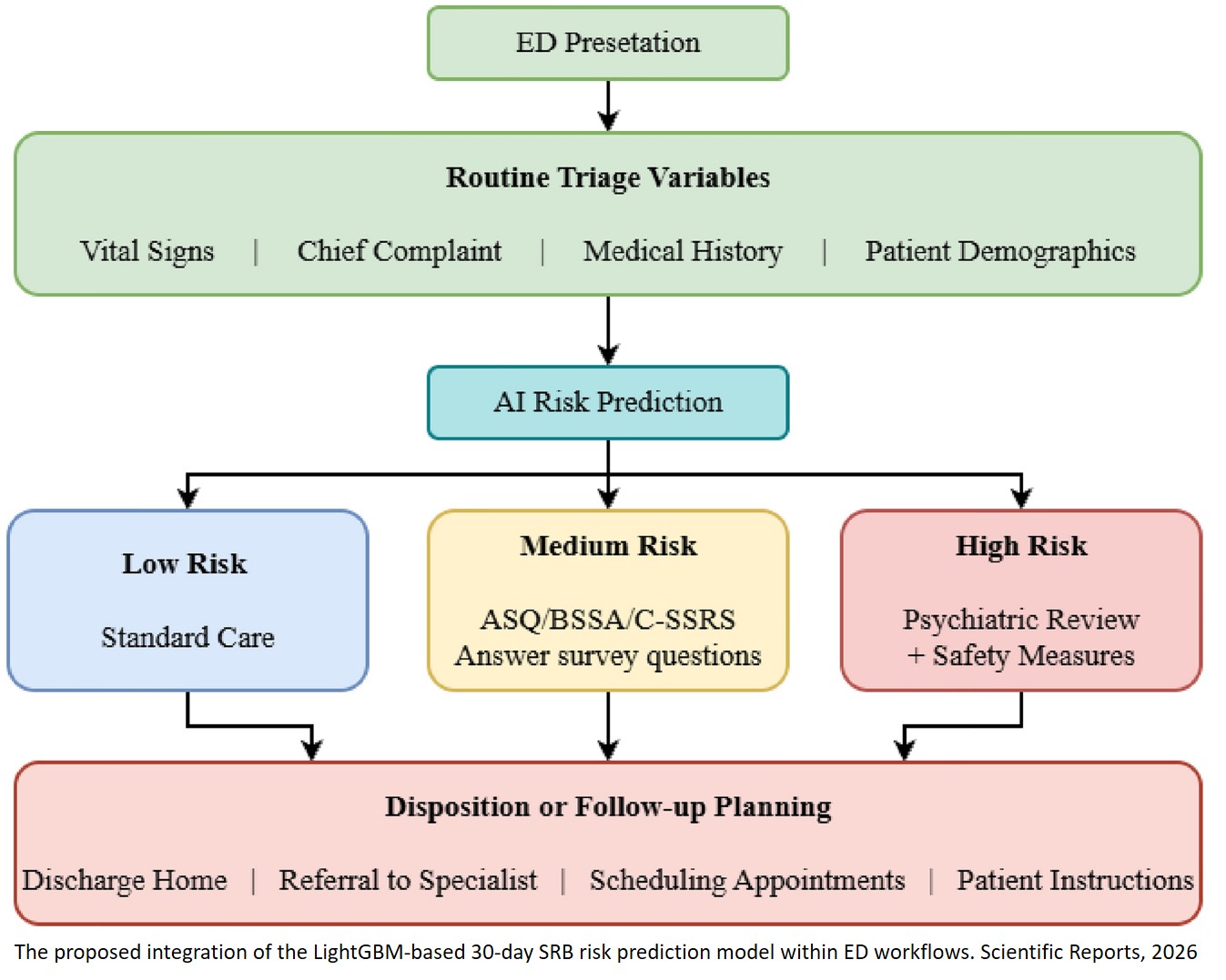
Researchers have published a promising approach to early detection of people at risk of suicide-related behaviour (SRB) in the journal Scientific Reports.
The study describes using an AI algorithm, routine patient intake data, and light-weight computing to estimate SRB risk following admission to a hospital emergency room (ER). The AI model was built with historical open-source patient data from the USA. It is intended to assist ER staff rather than replace them.
Resource constraints in South Africa are a major reason to develop an AI model such as this, says the lead researcher.
Late at night and over weekends, some South African hospital emergency rooms can see one ER staff member with 30 or more patients to triage, the author adds.
During busy ER shifts, an objective, consistent measure to help staff rapidly screen patients could be helpful for early detection of SRB risk.
“The AI model will flag that a patient is at risk and provide reasons. A health care professional still needs to take the final decision however, the clinician must do a severity scaling to determine if the person is really suicidal or not,” says the author.
The current two screening methods for SRB used in South African ERs require much time and effort from clinicians, says Prof Nompumelelo Ndlovu.
When anyone first arrives at an ER, the first priority is to stabilize them medically, a co-author adds.
Even for conscious patients admitted to the ER, the standard mini-mental status examination for SRB risk can take 15 minutes and varies between patients, she says. A full mental status examination and history taking for one patient at high risk of SRB could consume a day or more from a mental health professional at the hospital.
“Not everyone who goes into a medical institution has mental health issues. What we are trying to do, is to find those people who do not even say it out loud,” says the author.
The study’s AI model identified patient age, pain, and a prior mood disorder recorded at the same hospital as the major reasons for flagging a patient for SRB risk. Vital signs such as temperature and blood pressure follow on that, with prior substance-use and anxiety diagnoses playing smaller roles.
“The USA patient admission information we used to build this model is similar to what you would get in South Africa,” says the author.
“It includes demographics, age, gender, vital signs, temperature, heart rate, respiratory rate, oxygen saturations, and systolic and diastolic blood pressure. From that information, we calculate physiological features like the patient’s shock index and pulse pressure,” the author adds.
“Another aspect is the patient’s prior history at the same hospital. The model checks if the patient has been at the same hospital before and what the problem was. If there was some kind of substance abuse, anxiety or depression documented with ICD-9 or ICD-10 codes on a previous visit, then the model takes that into account. Night and weekend admissions are also included, as well as notes from medical staff about self-harm on previous visits.”
Because the AI model is built on existing electronic patient admissions data, ER staff would not need to do additional data capture for future system implementations. However, in hospitals with paper-based records, the requirement for digitised patient records in a database would be a barrier.
A major reason for building the AI model on routine patient admissions data, is data governance, says another co-author.
“The question is always ‘who owns the confidential patient data and where is it stored?’ Routine admission data belongs to the patient, and it is stored within the hospital’s systems already,” the author adds. “As opposed to asking a cloud storage vendor to put the data in their server, which generates a lot of data governance issues.”
With this AI model, a number of factors influence how many patients it will flag correctly for SRB risk. The factors include the size of the dataset; the dynamics of the patient population at the hospital from which data was selected; how few patient records in the training dataset recorded SRB risk; the value of the SRB risk decision threshold; and the AI algorithm selected for analysis.
The same factors also influence how many patients truly at risk for SRB the model misses.
Per 1000 emergency department visits, using the 41,202-patient dataset of the study, the model correctly predicted 866 patients as not at risk of a documented SRB outcome in the 30 days after admission to ER (true negatives).
Per 1000 visits, the model incorrectly predicted or missed 13 cases as not at risk of SRB, although an SRB-related outcome was documented within the 30 days after admission to ER (false negatives).
Per 1000 visits, the model flagged 121 patients as potentially at risk of SRB, and requiring further screening by clinicians (true positives plus false positives), a resource-intensive task.
Of the 121 visits per 1000 the model predicted SRB risk for, 23 had a documented SRB-related outcome that was recorded within the 30 days following the ER admission (true positives).
Of the 121 visits per 1000 flagged for SRB risk, 98 flagged cases did not have any SRB-related outcome documented with ICD-9 or ICD-10 codes in the same hospital’s records, in the 30 days after admission to the ER (false positives).
The study’s model did not include job loss, bereavement, drug, or alcohol-related observations from medical staff, but can be included in future versions, says the author.
Future models will use bigger data sets, potentially different AI algorithms, and adjusted techniques to improve the performance of the model, adds a study co-author.
Future versions of the model will also require the ‘patient risk threshold’ to be adjusted for each hospital, says the author, since patient populations vary.
In addition, the AI model’s current output - confusion matrices and SHAP (SHapley Additive exPlanations) plots - is hard to understand.
Says the lead: "A SHAP plot shows how a model made a decision about one patient. We are busy designing a user interface that clinicians can interact with and get answers they can understand.”
https://www.nature.com/articles/s41598-026-64073-y
https://sciencemission.com/predicting-suicide-related-behaviour