

Aging brains pile up damaged synaptic proteins in microglia
As we age, we begin to lose the connections that wire up our brains—and neuroscientists aren’t sure why.
It is increasingly clear, though, that the loss of synapses—the flexible and adaptive relay stations central to our brains’ ability to think, learn, and remember—is central to the rise of cognitive decline and dementia in old age.
Now, researchers have discovered clues that may tie synapse loss to another hallmark of brain aging: the declining ability of brain cells to break down and recycle damaged proteins.
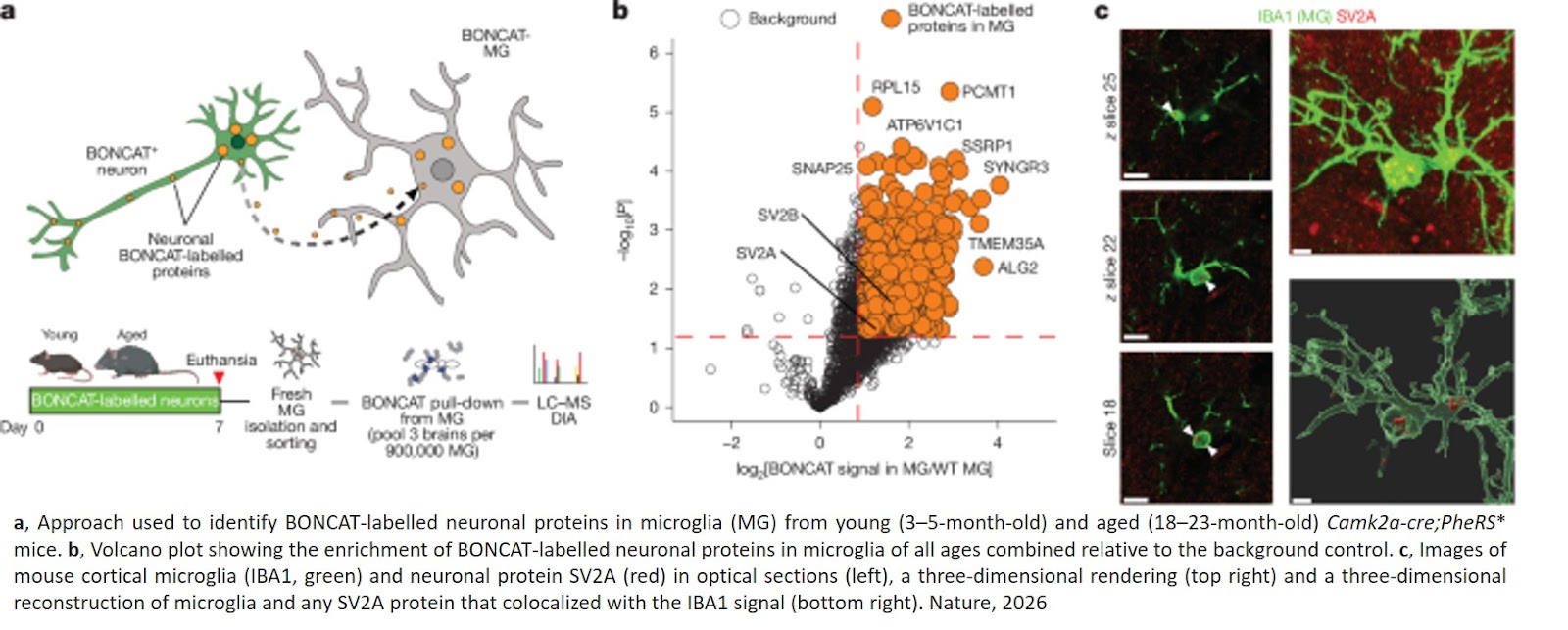
Published in Nature, the study shows that synaptic proteins are particularly susceptible to this age-related garbage-disposal problem: In old age, synaptic proteins break down much more slowly, they become more likely to pile up into the tangled clumps of protein characteristic of neurodegenerative disease, and they are more likely to make their way into microglia, immune cells that prune away damaged synapses.
Those findings are the latest in a series of discoveries that suggest new links between the brain’s waste management systems, microglia, and neurodegeneration—and they could yield new insights into human brain aging and neurodegeneration, said the study’s lead author.
“We know that cognitive function and synapse density both decrease in aging human brains. We also see that microglia grow more dysfunctional with age. If microglia are taking in synapses’ damaged proteins, that could be overwhelming microglia and causing them to become dysfunctional. Overall, it would be a detrimental effect to brain health,” said the study’s senior author.
Using engineered tracking proteins the team developed a two-step tagging process.
First, they genetically modified an enzyme that helps add an amino acid, a building block of proteins, to proteins as they’re being built. Second, they created a new amino acid—one not found in nature—with a special tag. The modified enzyme is designed to attach only to that tagged amino acid, then ferry it to freshly built proteins, thereby tagging them.
The team used this process to measure the lifespan of neuronal proteins, asking how long new proteins typically last in the brain before getting broken down and recycled for parts.
The researchers could also ask how these protein life-cycles might change at different phases of a mouse’s lifespan: in young adulthood (four weeks), middle age (12 months), and old age (24 months).
They discovered that, compared with young and middle-aged mice, old mice took twice as long on average to break down proteins for recycling—a sign that protein balancing systems were in significant decline.
Proteins were also more likely to clump up into plaque-like aggregates in older mice, the team found, which could be linked to the accumulation of such cellular garbage in many neurodegenerative disorders.
These two findings might be linked, the author hypothesized: Perhaps proteins take a long time to recycle precisely because they’re aggregating into a form that’s harder to chew up and dispose of.
The research also shed light on the question of why synapses are among the first casualties of neurodegenerative disorders.
The study found that—for reasons not yet understood—synaptic proteins are more likely to degrade slowly in old age than other neuronal proteins. And these long-lasting synaptic proteins were also more likely than other proteins to spill over into microglia, whose role in synapse pruning is thought to be a key antecedent of Alzheimer’s disease and neurodegeneration.
Within microglia, many synaptic proteins wound up in lysosomes, the machines within cells that break down proteins and other materials.
That’s consistent with a growing line of work that’s linked lysosome dysfunction to neurodegenerative disease.
Taken altogether, the findings may contribute to an emerging view that neurodegenerative disease is closely linked to failing waste management in the brain: When cells can no longer effectively break down damaged proteins, the proteins form heaps of garbage that build up in neurons and microglia, potentially disrupting their proper function.
One open question is why synaptic proteins appear to be particularly susceptible to this breakdown, and whether this helps explain why synapses are among the first victims of neurodegenerative disease.
“We didn’t set out to understand the synapse specifically, but rather the mechanisms behind the decline in general neuron health and function with age,” the author said. “We just so happened to arrive at synaptic proteins being particularly vulnerable to slowed breakdown and aggregation.”
Another question for future research, the author said, would be to determine what effect damaged neuronal proteins have on microglial function and health and—since microglia play an important role in pruning synapses that are damaged or no longer needed—what the consequences may be for synapse loss and cognitive decline.
The study may also lay foundations for something of more immediate clinical relevance: using their tagging method to track neuronal proteins as they travel outside the brain, providing a valuable warning sign when protein recycling begins to go awry.
“If we can leverage our system to study neuron-derived proteins in the blood during aging and disease, we could potentially identify new biomarkers of brain health,” the author said—potentially helping doctors identify Alzheimer’s and other diseases earlier than before.
https://www.nature.com/articles/s41586-025-09987-9
https://sciencemission.com/microglial-accumulation