


Brain’s language network remains intact in old age
As people age, many cognitive functions tend to decline. Brain scanning studies have revealed corresponding changes in the function of a brain network that is involved in many of these cognitive functions, including working memory and problem-solving.
When it comes to language skills, however, the picture is different. Unless impaired by a stroke or dementia, most older people retain their language skills and may even improve them as they steadily gain vocabulary throughout their lives.
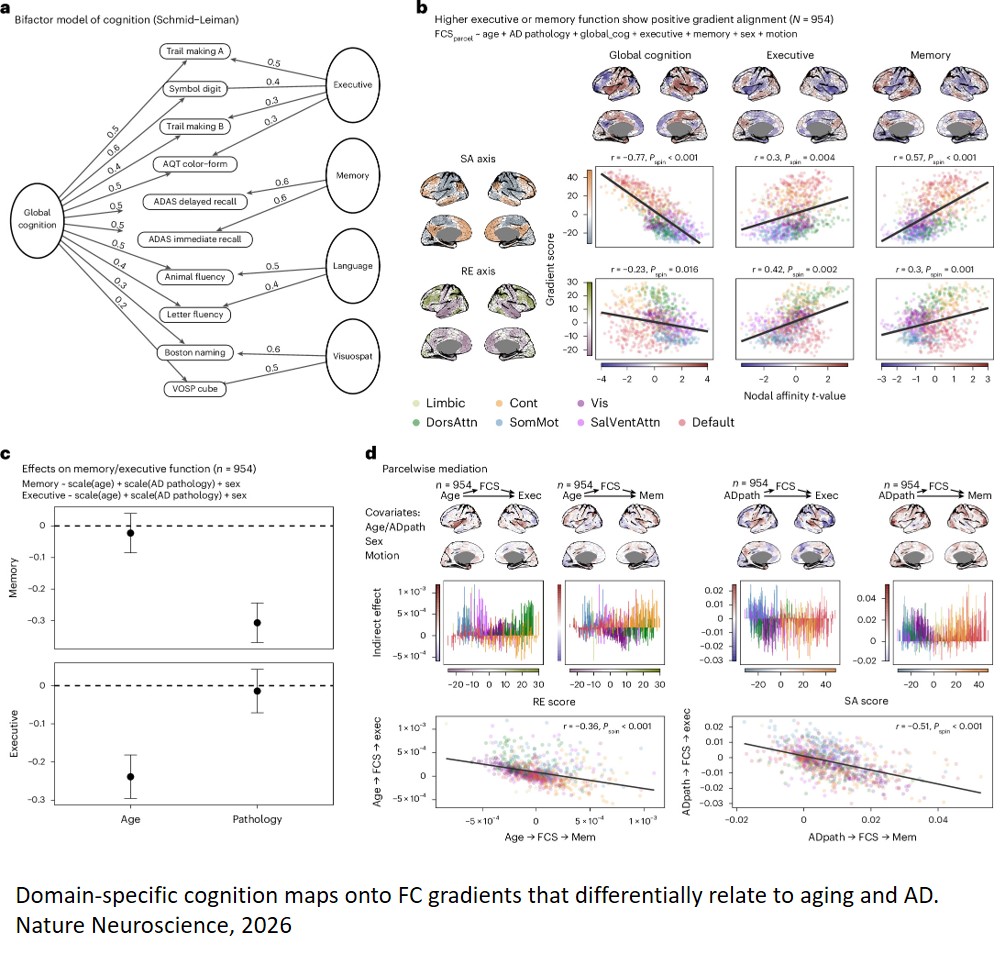
A new brain imaging study now reveals the neural activity underlying this observation. The researchers found that in older adults, activity of the language processing network is nearly identical to that seen in the brains of younger adults during language tasks.
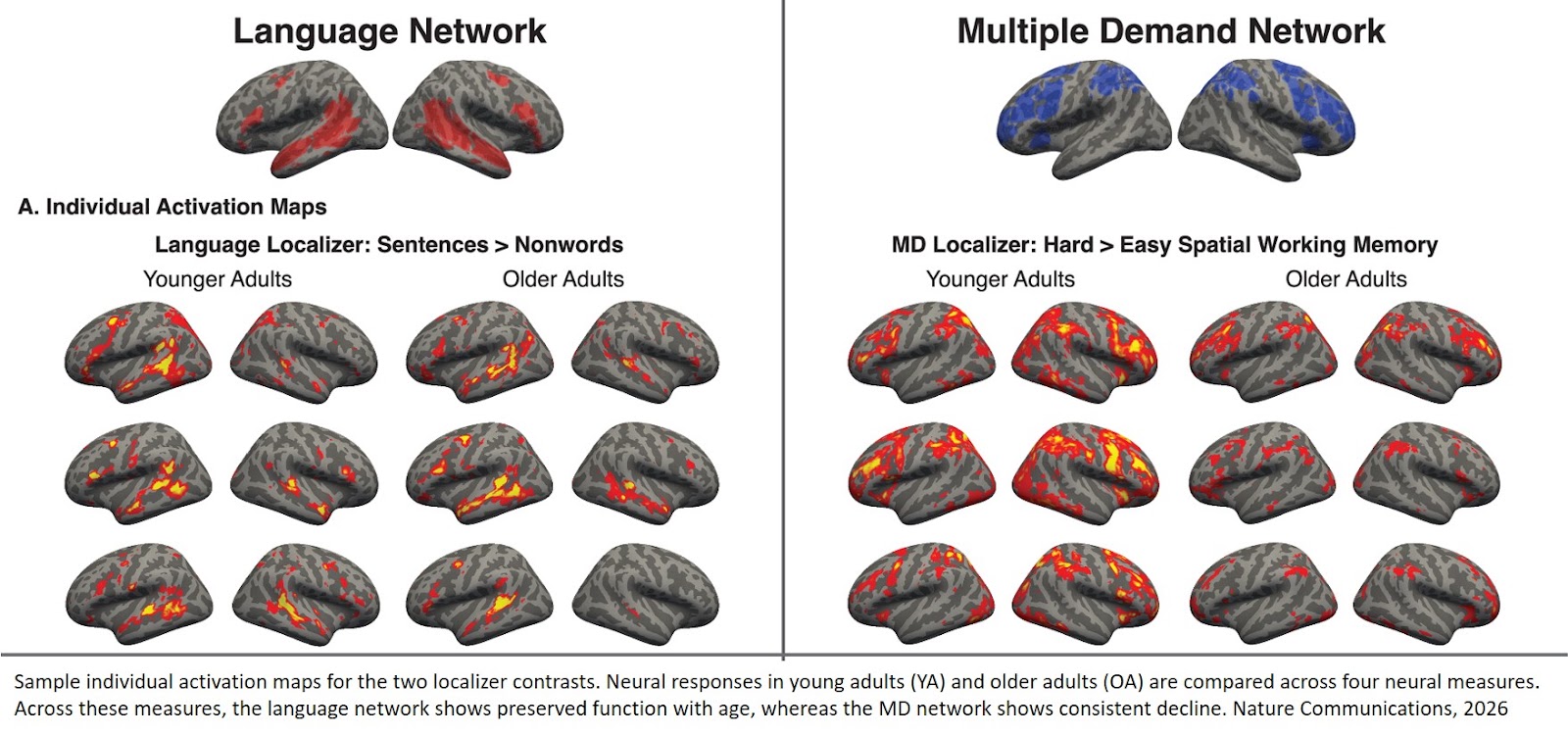
In contrast, the researchers found that activation patterns in the multiple demand network, a brain system involved in executive control tasks such as decision-making, were very different in older and younger adults.
“In the language network, we couldn’t find any differences between older and younger groups. In contrast, the executive system showed decline across almost all of the measures. The network synchronization declined in older adults, the extent of activation was reduced, and the magnitude of activation was reduced as well,” says one of the lead authors of the new study.
The findings suggest that parts of the brain that are specialized for specific functions, such as language processing, may be more resilient to aging than the multiple demand network, a more general-purpose network that has greater flexibility in its function, the researchers say.
To study the effects of aging on the brain, the researchers looked at two groups of people, ages 17-39 and 41-80. Based on previous studies, they expected that the multiple demand network, which includes several regions in the frontal and parietal lobes of the brain, would look different in the brains of older people.
“It’s well known that executive functions, such as attention, working memory, and cognitive control, tend to decline with age. And it’s also known that in opposition to that, language skills typically tend to remain quite stable or even improve with age,” the author says. “These two types of functions really go in opposite directions in healthy aging. In terms of behavior, that’s quite well-established, and we wanted to see if that was also the case in the brain.”
In previous studies of the multiple demand network, scientists have found that as people age network activity becomes less synchronized. Some neuroscientists have hypothesized that this may also happen in the language network, but studies haven’t found definitive evidence for this.
The researchers were able to look at both networks by designing tasks that elicit responses primarily in either the language network or the multiple demand network. This allowed them to identify, for each participant, the brain areas that belong to each network.
During a spatial memory task — remembering the location of squares in a grid — the researchers confirmed that the multiple demand network showed altered activity in older adults. Compared to the younger subjects, their networks were smaller and less well-synchronized, and the overall activation level was weaker.
To identify the language network, the researchers had participants listen to stories and read sentences. They found that in both groups, brain activity in response to language showed similar levels and spatial distribution across the network.
They also found that younger and older subjects showed similar brain responses when they encountered an unfamiliar word or an unusual grammatical construction.
“We have previously used similar kinds of materials to show that young adults show strong sensitivity to these points of linguistic difficulty: activity in the language areas goes up. Here we found that in older adults, you also see this sensitivity, which suggests that there’s nothing fundamentally different about how they process language,” the author says.
The researchers also showed that in older people, the language network did not show any signs of becoming less synchronized. Additionally, the network did not show signs that it was blurring together with the multiple demand network, as some neuroscientists have hypothesized might happen.
While this study did not evaluate language ability, other studies have shown that not only do language skills not decline with age, for some people, their language processing improves in older age. This might be because vocabulary and reading skill can continually grow over time, the researchers say.
“Vocabulary keeps increasing as long as people have been measuring, which makes sense. People get exposed to more and more language, and older people sometimes start reading more, so they get an extra boost — it’s like a large language model trained on increasingly more data,” the author says.
Given these findings, one possible generalization is that parts of the brain that are specialized for particular functions such as language may be less susceptible to age-related decline than the multiple demand network. That network is unique in its ability to give the human brain the flexibility to learn new skills and adapt to new situations.
“The multiple demand network is a different system in the sense that it’s not accumulating knowledge over time. It’s more like a flexible resource that you can deploy in all sorts of ways. And somehow that’s the thing that is more vulnerable to aging,” the author says. “Why it’s so vulnerable — that is a very good question.”