
Cell death's 'beautiful' rings!
Researchers have revealed that cells use a previously unknown feat of molecular craftsmanship to help protect their larger host organisms.
The building blocks required for this work are found across the tree of life, meaning this finding could help better understand and support plant resilience and human immune response, the researchers said.
"This is going to be interesting to a broad biological field," said senior leader of the project. "We feel that this will raise some very exciting follow up work in medicine and agriculture."
The research was published in the journal Nature.
One of the ways individual cells can protect their host organism from disease is by sacrificing themselves to prevent the spread of pathogens. This programmed cell death is an effective but delicate operation, the author said. It can stop a disease from advancing if enough compromised cells are eliminated. But an overzealous response can claim healthy cells, which would also harm the larger host organism.
"Cell death may sound like a bad thing, but in plants and mammals, it's a marker of resistance," the author said. "We need to have this defense, but it is also important to have this defense in a limited area and that's what this study is talking about."
Over the past several decades, researchers have identified the genes and proteins in plants that initiate the cellular self-destruct sequence. During that time, they also found shared elements of this "resistome" at work in mammalian.
Plant nucleotide-binding leucine-rich repeat (NLR) immune receptors detect pathogen effectors and activate immunity. Coiled-coil NLRs (CNLs) form resistosomes as Ca2+-permeable channels in the plasma membrane (PM). However, the mechanism by which resistosomes activate cell death remains unclear.
Still, scientists are working hard to map out the processes' complete molecular choreography to understand how cells coordinate cell death without it becoming overkill. Recent studies in immunology revealed a key new move, that proteins involved in the process come together to form channels that can shuttle calcium ions. By themselves, however, these channels weren't sufficient to initiate cell death. Now, the team have revealed an important next step.
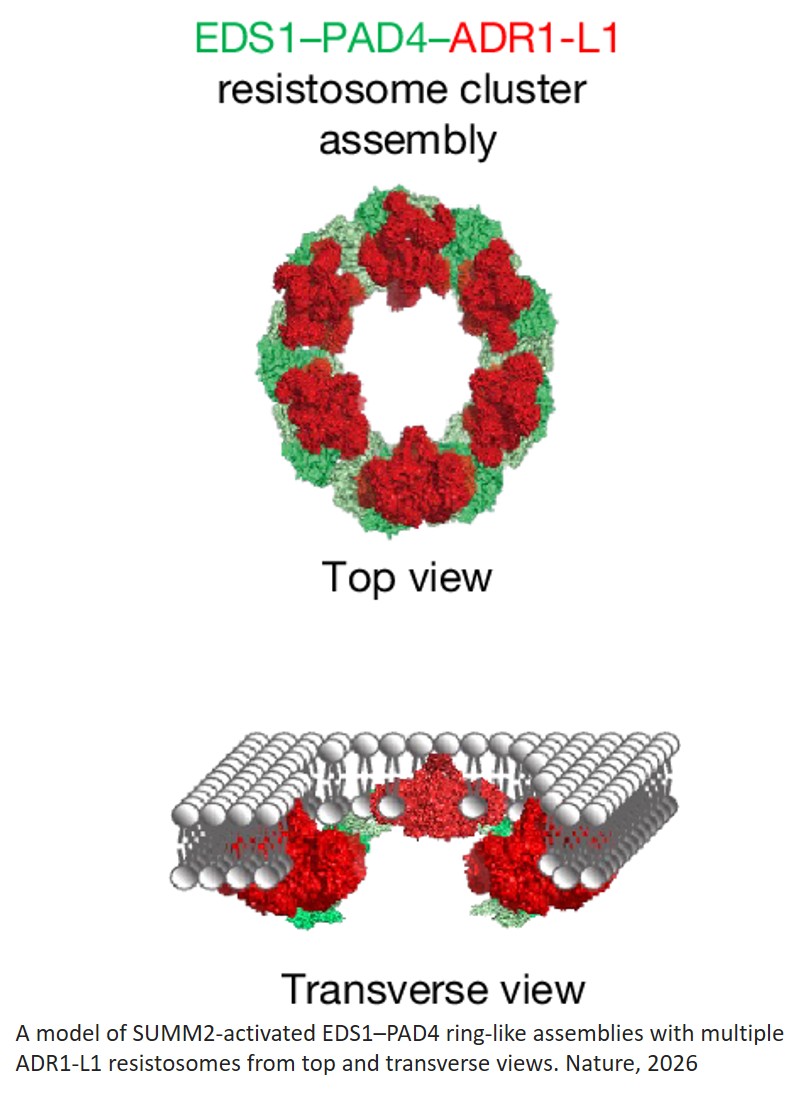
"For the first time, we've shown how the channels organize into a beautiful ring structure on the cell membrane," the author said.
The ring, which resembles a wreath or a necklace, the author said, is a combination of proteins that bind to a cell membrane and six channels that orient themselves to run through the membrane. The team made this discovery working with Arabidopsis and Nicotiana bethamaian, popular plant model systems, and a high resolution total internal reflection fluorescence microscope.
The authors show that the CNL SUPPRESSOR OF mkk1 mkk2 2 (SUMM2), unlike canonical CNLs that use a MADA motif to penetrate the PM, tethers to the PM through N-myristoylation, a common feature among many CNLs.
PM targeting via N-myristoylation is essential for SUMM2-induced cell death. Upon activation, SUMM2 promotes the association of the lipase-like proteins ENHANCED DISEASE SUSCEPTIBILITY 1 (EDS1) and PHYTOALEXIN DEFICIENT 4 (PAD4) with the helper NLR-ACTIVATED DISEASE RESISTANCE 1-LIKE 1 (ADR1-L1).
Active SUMM2 induces the clustering of multiple ADR1-L1 resistosomes into a ring-like assembly colocalized with the EDS1–PAD4 complex, and the EDS1–PAD4–ADR1 module is essential for SUMM2-activated cell death.
The finding invites new questions about what exactly the rings do and how they do it. The team's current hypothesis is that the rings enable communication with nearby cells, sending inflammation signals that can help initiate cell death in a targeted way.
"The next thing that we're doing is looking at what kinds of things could be leaking out through this structure, and also what supports the ring structure formation," the author said. "We haven't answered all the questions, but we have advanced the field."
While these next steps are already yielding interesting results, the researchers remained excited about the new study's potential to help others who are exploring fundamental biological questions and potential applications. For example, the discovery could open up new avenues for scientists working to make plants more resilient and to treat conditions where cell death runs amok in humans.
"We know there are a lot of unknowns with this ring hanging on the ceiling of cells, but we know it is absolutely required to have the perfect amount of cell death, to have the perfect immune response," the author said. "We truly believe this work will lay the foundation to launch a wave of exciting research for continued discovery."
https://www.nature.com/articles/s41586-026-10215-1
https://sciencemission.com/NLR-resistosome