











Electronic skin for prosthetics to sense temperature and pressure
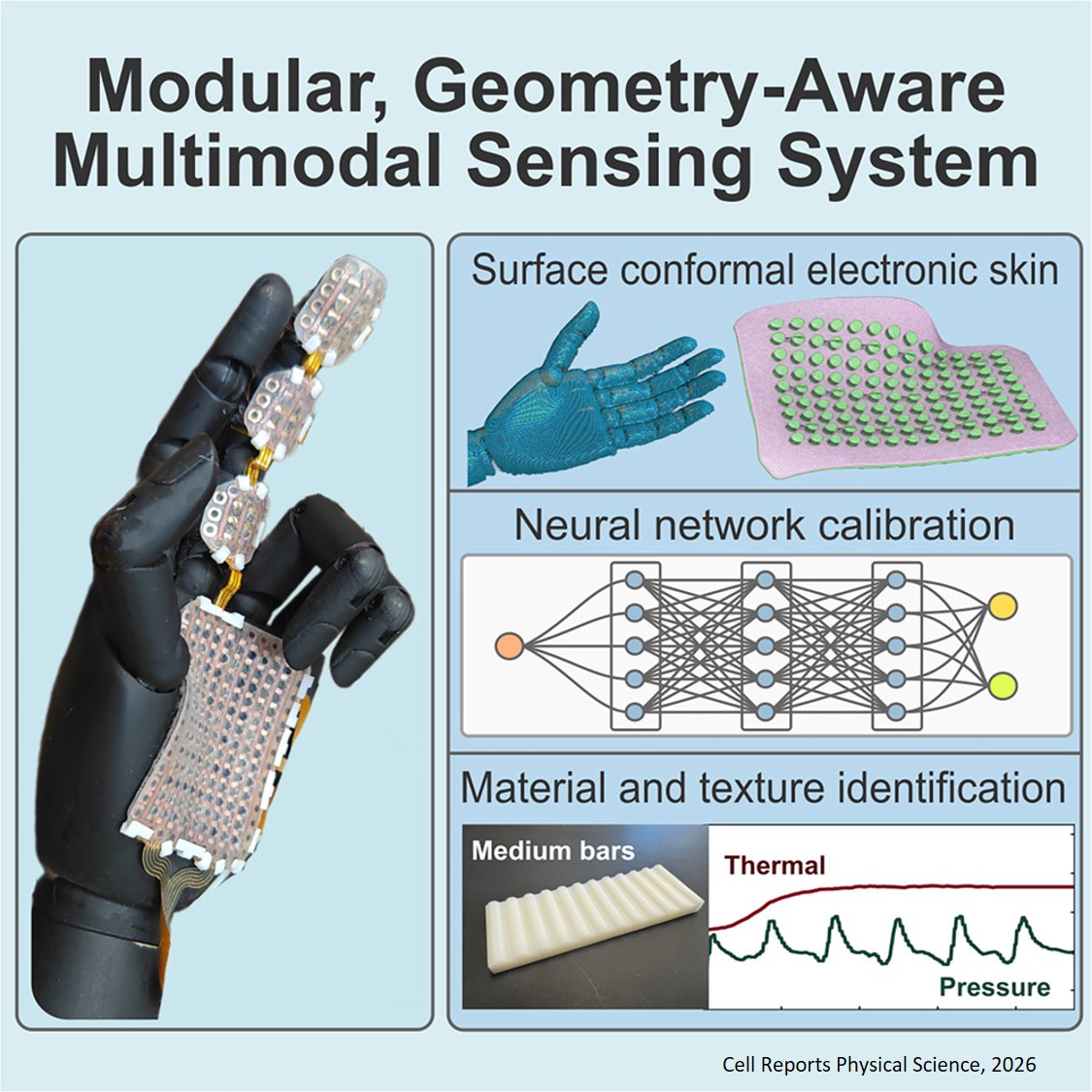
An electronic skin with a sensing system that can detect pressure and temperature could someday be used to help amputees gain feeling in their prosthetics.
The work published in the journal Cell Reports Physical Science, can sense at ten times a finer scale than current commercial glove sensors.
“This approach democratizes the production of medical-grade e-skins, making advanced tactile feedback viable for widespread clinical adoption,” said the first author on the paper. “This work lays a crucial foundation for a full bionic skin with both sensing and haptic stimulation functions on prosthetics.”
Haptic stimulation replicates the sense of touch. Providing even partial sensation for amputees could greatly improve their ability to perform tasks. While there are electronic skins available now, they are expensive and have low sensing resolution. They also often don’t fit people well and only cover small regions. In fact, the more that e-skins are made to a custom shape, the worse they perform in sensing ability. Furthermore, the large amount of data generated from the sensing arrays mean that they don’t work well in real-time.
“Often these devices are forced to compromise between comfort and mechanical reliability,” said the author.
The researchers developed a customizable sensing system for prosthetics that conforms to the freeform shape of limbs and better mimics real human skin in its sensing abilities. The sensor modules they created are thin-layered sandwiches that incorporate temperature and pressure sensors. The elements allow human-like tactile sensing, enabling reliable identification of surface texture and material properties.
The researchers used a “scan-model-print” manufacturing method that allows for high-density sensing at the same time as the personalized, 3D fabrication.
“The scanner basically scans the prosthetic and then, based on the geometry, we map our sensors as a multimodal sensing system with that geometry,” said the corresponding author on the paper. “This enables our sensing system to have seamless coverage over the freeform region on the prosthetics.”
The sensors are accurate and reliable and can measure both pressure and temperature at a high density across a flat or curved surface. Rather than requiring adhesives, modules of sensors snap together like Legos.
“Our main manufacturing method using 3D printing and laser cutting is relatively simple, so it could be relatively low cost and convenient,” said the author.
The researchers are also working on an actuator that will eventually convert the sensing signals of the e-skin to let an amputee know what they’re touching. That would entail converting the sensing signals to stimulation and signaling of nearby nerves.
https://www.cell.com/cell-reports-physical-science/fulltext/S2666-3864(26)00364-4
https://sciencemission.com/material-identification-in-prosthetics