







Microplastics cause fatty liver disease
Microplastics appear capable of significantly impairing the function of phagocytes in the liver, at least in mice. In turn, this disrupts the metabolism of this vital organ and increases the build-up of fat inside it. These are the key findings, details of which have now been published in the journal Nature Metabolism.
Phagocytes, literally “eating cells”, or “macrophages” to give them their scientific name, are immune cells that reside in virtually every organ of the body. They play an important protective role, looking out for bacteria, diseased cells and traces of foreign matter, engulfing them and breaking them down into their component parts. In addition, they help the organs they live in to function properly.
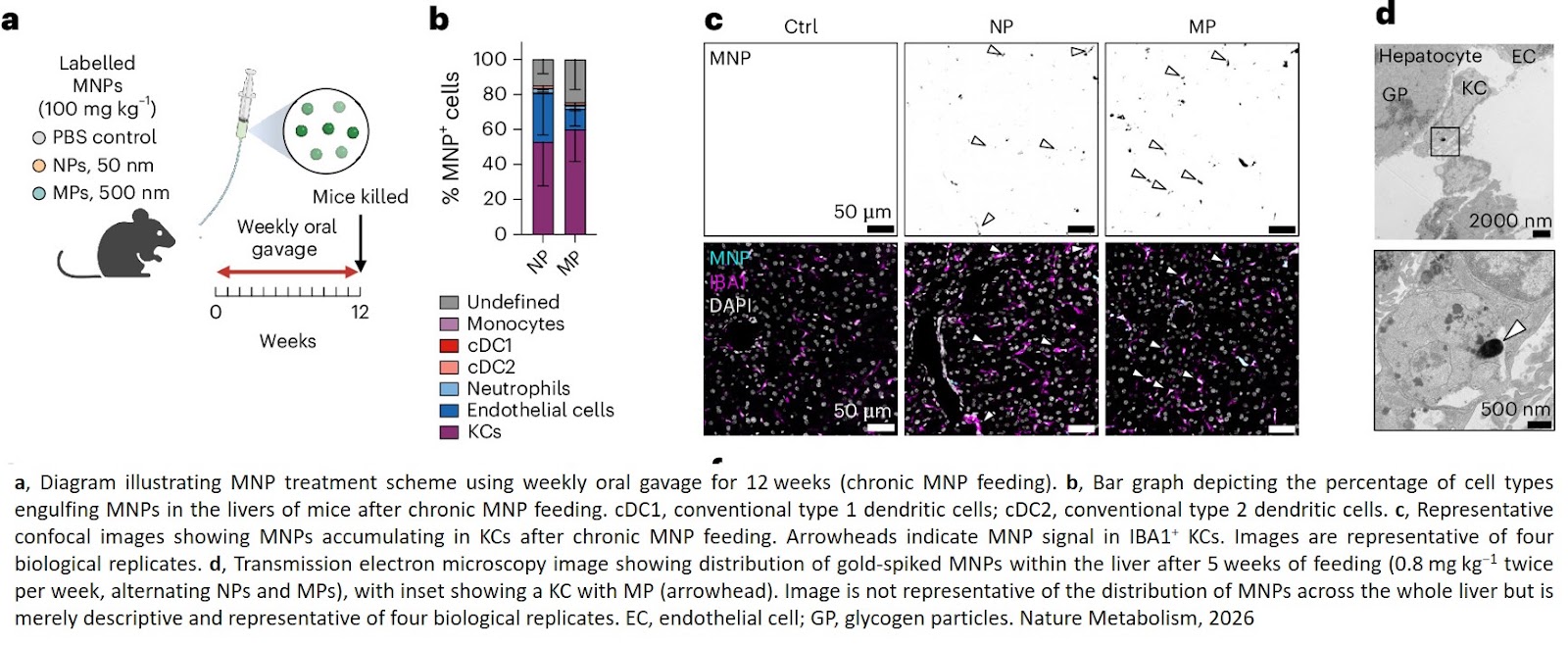
“From working with cell cultures, we’ve known for several years that macrophages also take up microplastics,” explains the senior author. “We wanted to know whether that’s also the case in a living organism and, if so, what effect it has.” The researchers focus on a specific group of macrophages known as Kupffer cells. These reside in the sinusoids, the smallest blood vessels of the liver, where they monitor the blood arriving from the gut. Plastic particles that humans or animals swallow and that enter the bloodstream via the gut therefore have to pass by them.
And we are talking about quite a lot of particles: Experts estimate that adults ingest up to five grams of plastic a week, which is about the weight of a credit card. With young mice tipping the scale at a mere 20 grams, the researchers scaled down the dose accordingly. “We administered microplastics to the animals orally once a week,” says the author. The individual particles were about the same diameter as an average bacterium.
Twelve weeks later, the researchers examined the animals. “We were able to show that the Kupffer cells had taken up large amounts of microplastics,” explains another author. Macrophages usually digest what they engulf and recycle its component parts. Plastic, however, cannot be broken down and instead clogs up the macrophages’ “stomachs”, the so-called lysosomes. “On the one hand, this means they can no longer take up pathogens or defective cells,” the author explains. “On the other hand, they lack important building blocks that they need for their metabolism.”
The macrophages react by producing more apolipoproteins, proteins that normally help to transport fats in the body. Here, they act as a kind of molecular stress signal. “The surrounding liver cells detect this signal and respond by storing more fat,” the author says. In other words, the disruption to the macrophages’ function in turn leads to a metabolic imbalance in the liver.
Plastic particles that are a similar size to bacteria appear to be particularly harmful to the liver. When the researchers instead gave the mice particles that were ten times smaller, they observed different effects: The “clogging” of the macrophages was now much less pronounced, and liver metabolism remained largely unchanged. Instead, the plastic nanoparticles accumulated in the brown adipose tissue (“brown fat”). Unlike its white counterpart, brown adipose tissue does not primarily store fat but “burns” it to generate heat.
In the mice, the nanoplastics activated the brown adipose tissue and stimulated this heat production. The researchers now want to investigate this effect in more detail.