
Resistance training activates the muscle repair machinery
Researchers have now uncovered how human skeletal muscle responds to resistance exercise at the molecular level. Their findings provide new insights that could help optimize training programs for athletes, improve rehabilitation strategies, and counteract age-related muscle loss. Resistance training is essential for maintaining healthy skeletal muscle throughout life. The World Health Organization now recommends moderate muscle-strengthening activities at least twice a week, even for older adults, to help prevent the loss of muscle strength. The new study is published in the latest issue of Nature Communications.
Regular physical activity is crucial for healthy ageing. However, endurance exercise alone is not sufficient to maintain muscle mass. High-intensity resistance exercise is required to increase or preserve skeletal muscle. Such exercise also places considerable mechanical stress on muscle fibers, causing microscopic damage to the contractile machinery responsible for force generation. Until now, little has been known about how skeletal muscle repairs this damage and adapts to repeated resistance training. An interdisciplinary team of exercise physiologists, cell biologists, and proteomics experts has now provided important new insights into these underlying mechanisms.
To investigate these processes, the researchers collected muscle biopsies from healthy volunteers before and after a bout of high-intensity resistance exercise. They also examined how a prolonged period of reduced training and complete cessation of resistance exercise affected these molecular adaptations. Using state-of-the-art proteomics approaches, the team identified dynamic changes within the contractile apparatus of skeletal muscle.
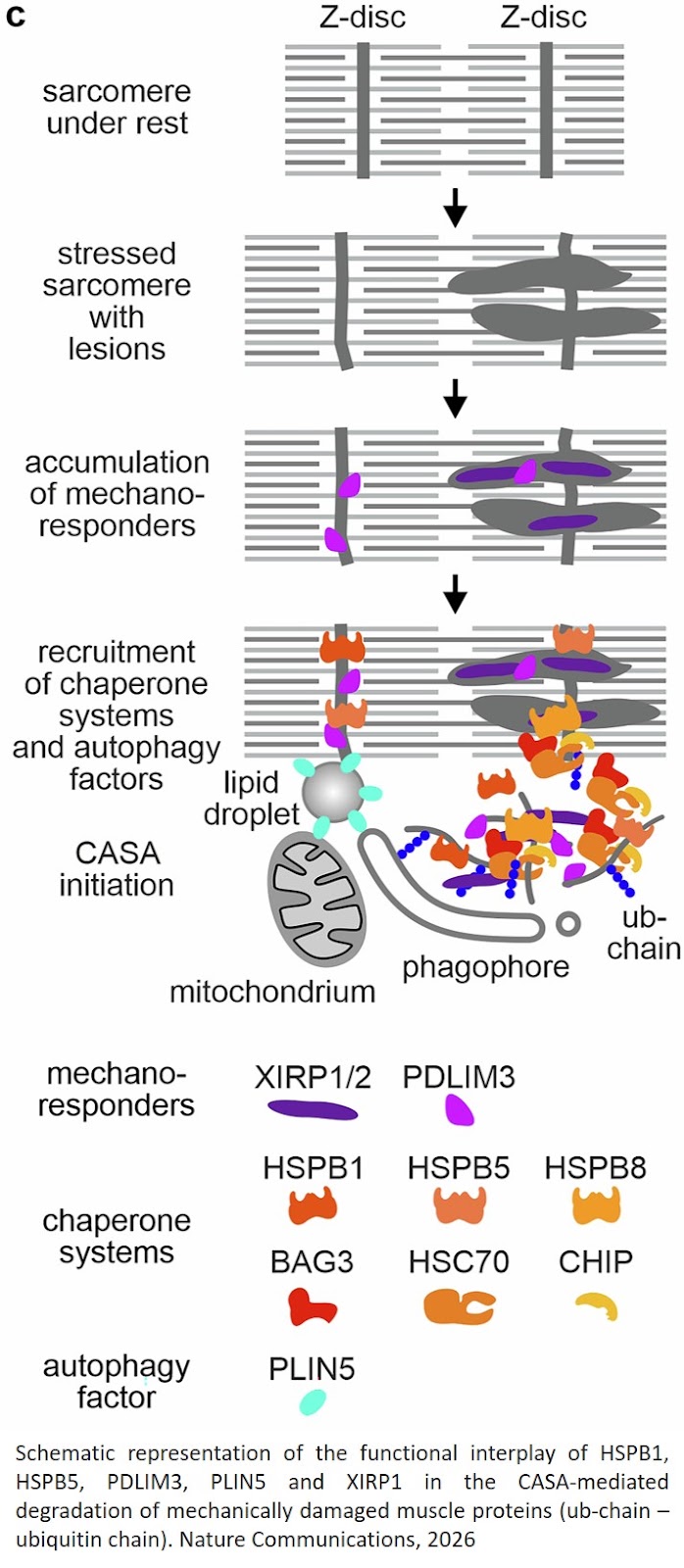
The researchers found that resistance training activates a specialized repair system that recognizes damaged muscle components and targets them for removal. At the same time, this repair machinery promotes the synthesis of new contractile proteins, replacing those that have been damaged. This coordinated process preserves and reinforces the muscle's contractile apparatus. The study identifies previously unknown components of this muscle repair network and reveals how they are regulated in response to resistance training.
"Our analytical approaches allowed us to identify proteins that are recruited to the contractile apparatus after resistance exercise, where they perform essential protective and repair functions," explains a proteomics expert.
"Using cultured muscle cells, we demonstrated that these repair proteins first recognize damaged muscle structures and then remove them through a cellular degradation pathway known as autophagy. This clears the way for muscle repair and adaptation to resistance training," says the senior author.
The authors collected the human muscle biopsies and performed the initial analyses of exercise-induced damage to the contractile apparatus.
The authors show that acute, repeated and interrupted resistance exercise (RE) induce dynamic changes of the protein landscape associated with the sarcomeric cytoskeleton. These changes correlate with changes in phosphorylation indicative of adaptation and deadaptation signaling footprints.
Regulation mainly affects the protein network linked to the muscle maintenance protein BAG3, which includes mechanosensory proteins, small heat shock proteins, and a lipid droplet associated protein. All network components exhibit altered phosphorylation and increased cytoskeletal association after damaging RE.
"Our findings reveal how training intensity and training history influence both muscle damage and the activation of the repair machinery," says the author. "This knowledge will help us optimize the sequencing of training sessions for athletes as well as rehabilitation programs for patients in clinical settings."
The authors are already incorporating these findings into the education of exercise scientists and into evidence-based training strategies for elite athletes.
https://www.nature.com/articles/s41467-026-75501-y
https://sciencemission.com/resistance-exercise--induced-damage