



Rewiring ribosomes to specialize in one protein
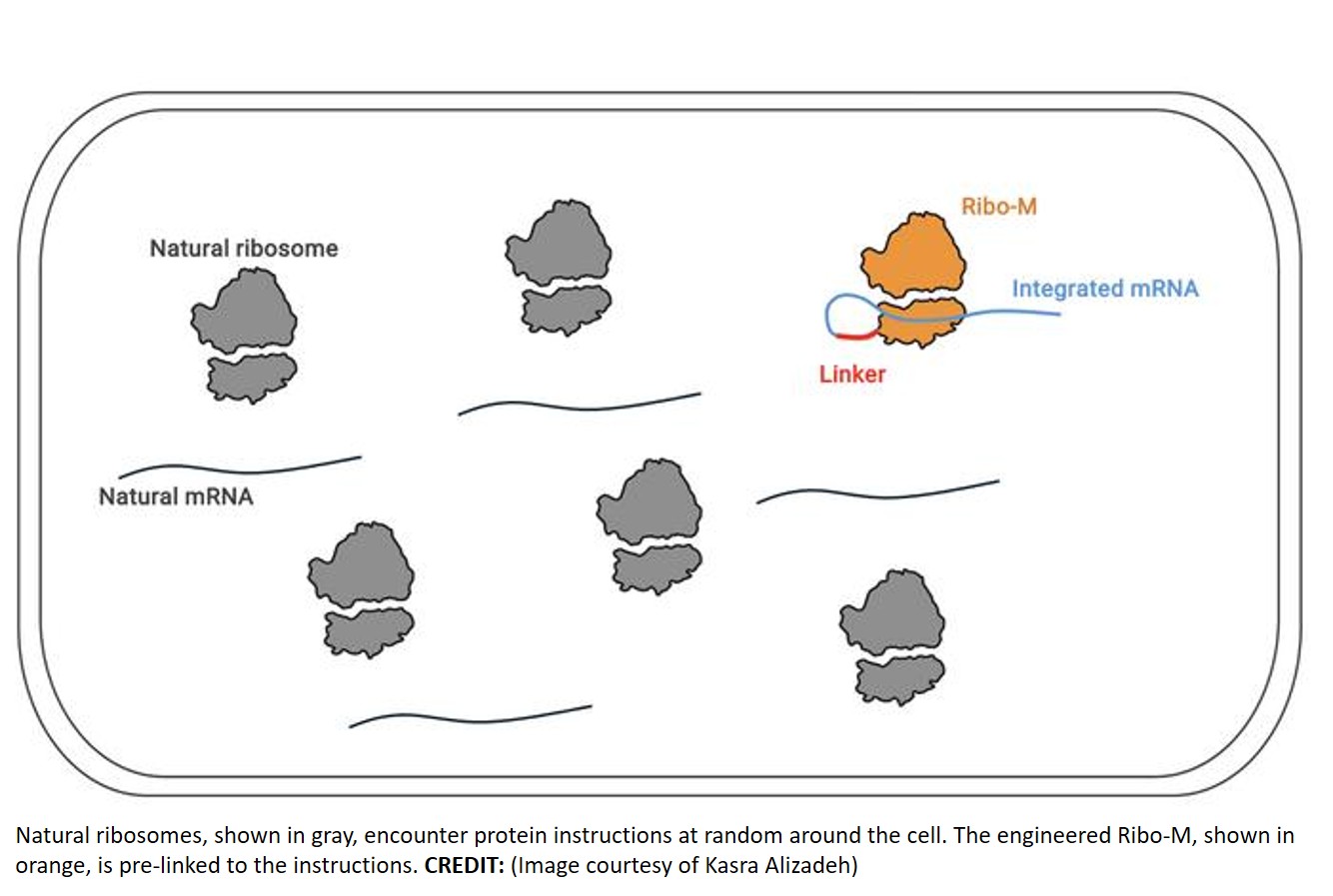
Every cell relies on ribosomes, the molecular machines that read genetic instructions and use them to assemble proteins. A cell needs thousands of types of proteins at any one time, so ribosomes must be generalists, capable of using instructions to produce any protein.
Researchers have engineered a different kind of ribosome: one dedicated to making a single type of protein. The study, published in Nature, introduces a new platform for synthetic biology that is currently in the development stage. But it could someday be used to create designer peptide-based drugs, the authors said.
The platform, called Ribo-M, physically links a ribosome to messenger RNA, the genetic instructions for making a specific protein.
“Natural ribosomes need to look around the cell to find the blueprint or the recipe for any of the hundreds of proteins to synthesize,” said a study author..
That’s highly effective for normal cellular life, but it can be limiting for biotechnology applications that require cells to produce unusual proteins, therapeutic molecules or other engineered products.
“We decided to overcome this problem by incorporating the message into the ribosome itself,” said the corresponding author of the study.
“Our engineered ribosomes are specialized,” the author said. “They always carry with them the recipe for one specific protein and only focus on making that protein without having to waste time looking around.”
The project required years of trial and error. The team generated tens of thousands of ribosome variants and screened thousands of bacterial colonies in search of a functional design, the author said.
Once they found one, the researchers demonstrated that Ribo-M could successfully produce several different proteins, including a protein that creates green fluorescence, an antibiotic-resistance protein and a light-producing enzyme. The researchers say they have created a new framework for engineering protein production.
“A good analogy is with physicians,” the senior author said. “You have a general physician, who has to know a little bit about every single disease. But if you need to have brain surgery, you better go to the one who has specialized in this particular task.”
Like a specialist trained for a specific job, specialized ribosomes could be optimized to produce proteins with properties not found in nature. One possibility is training ribosomes to incorporate nonstandard amino acids, which would allow scientists to build proteins with more stability or new capabilities.
“We can teach the ribosome to incorporate non-canonical amino acids into a protein,” the author said. “One day, such a ribosome will be able, for example, to make therapeutic antibodies that survive longer in the body.”
The current version of Ribo-M remains a proof of concept, however.
“This is a prototype. This is not even the Wright brothers’ airplane. This is the bicycle with wings,” the author said.
But the concept could eventually be used to make peptide-based medicines. For example, semaglutide, the active ingredient in drugs such as Ozempic, is currently produced through complex manufacturing processes. In the future, specialized ribosomes could be engineered to help cells produce such molecules more efficiently, creating a scalable platform for designer drugs, enzymes and other proteins.
“This is just the beginning of a long list of opportunities that our invention can unlock,” the auhtor said. “These specialized ribosomes can serve as an exclusive protein synthesis platform, which can be fine-tuned by synthetic biologists for the production of designer drugs, enzymes and other proteins.”
Beyond practical applications, the work may also help scientists understand one of biology’s biggest unanswered questions: how the first protein-making systems emerged on Earth.
Because the engineered ribosome combines protein-making machinery and genetic instructions in a single unit, it offers a model for how primitive systems might have functioned before cells contained large numbers of free-floating ribosomes and messenger RNAs.