



Secreted phospholipase confers neuroprotection and cognitive resilience during aging
As humans age, both protective and harmful biological processes shape brain health. When the balance shifts in favor of harmful processes, age-related changes in the brain can accelerate, including synapse loss, disruptions in lipid metabolism and chronic inflammation.
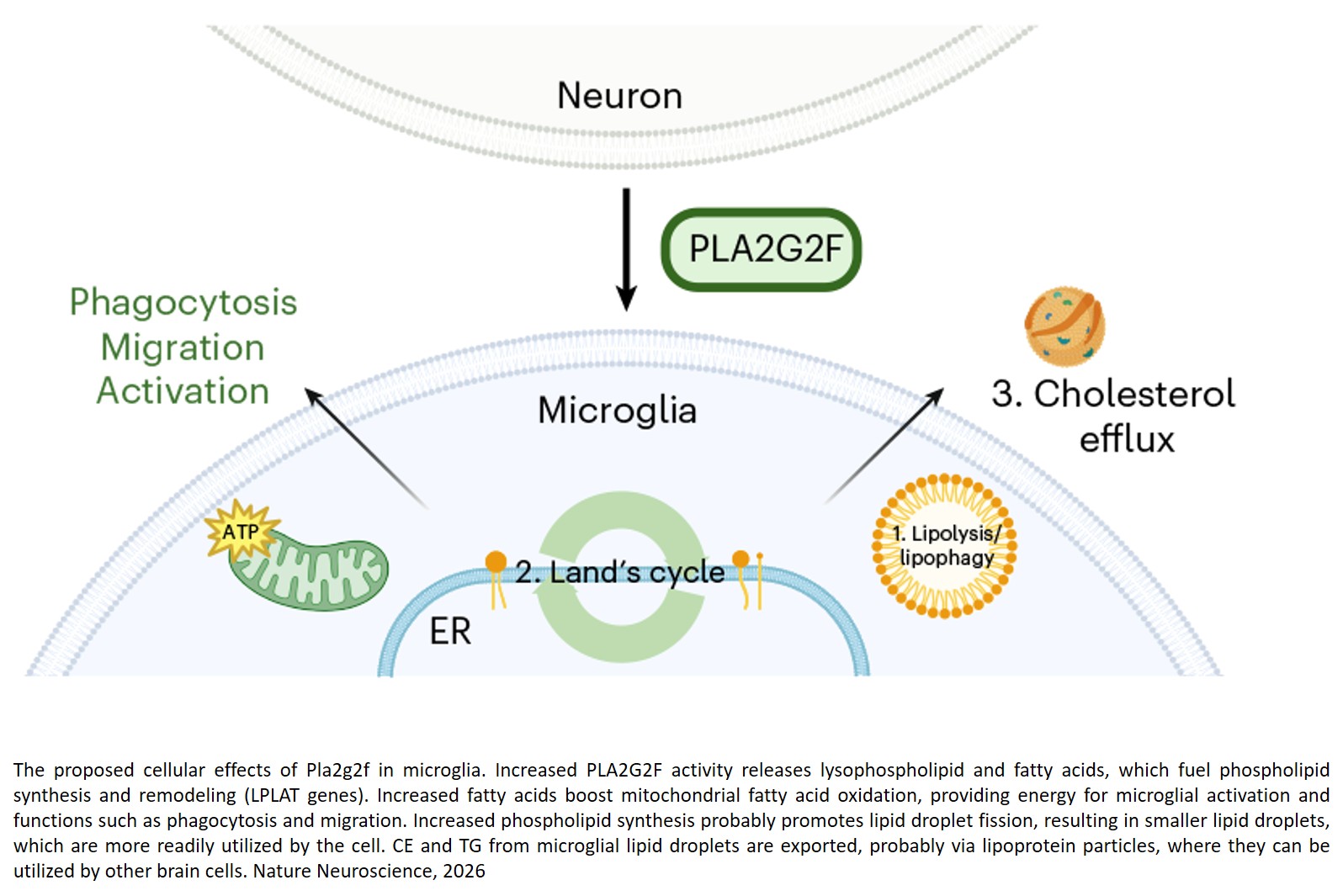
One contributor to neuroinflammation appears to be the buildup of lipid droplets inside microglia, the brain's immune cells. As lipid droplets accumulate, microglia become less effective at clearing waste, maintaining synapses and supporting neurons.
These harmful changes can speed up cognitive decline and increase a person’s risk of conditions like mild cognitive impairment and Alzheimer's disease. That’s why it’s so important for scientists to study the biological mechanisms that may help offset them.
In this paper, the authors sought to identify the protective factors that contribute to cognitive resilience during aging.
Scientists have long recognized that synapse loss in the hippocampus, a brain region critical for memory, is a defining feature of age-related cognitive decline. To better understand this process, the authors designed a study to identify genes that are activated in response to synapse loss in the hippocampus of mice.
They discovered a gene called Pla2g2f, which produces a secreted enzyme known as a phospholipase. Before this study, its role in the brain was not known.
The researchers found that Pla2g2f levels increase in the hippocampus during aging and under conditions of brain inflammation. This included older adults who showed signs of Alzheimer's disease pathology in their brains but remained cognitively resilient.
To understand the gene's function, they used genetic and viral tools to either decrease or increase Pla2g2f levels in the brains of aging mice. When Pla2g2f was reduced, multiple features of brain aging became worse, including synapse loss, inflammation, impaired maturation of new brain cells, disruptions in lipid metabolism, accumulation of lipid droplets in neurons and microglia and memory impairment.
In contrast, increasing Pla2g2f levels protected against many of these changes and helped preserve memory. Remarkably, boosting Pla2g2f in middle-aged mice before they developed substantial cognitive decline altered the trajectory of age-related memory loss.
They also found that Pla2g2f influenced biological processes beyond synapse maintenance. In human microglia, increasing Pla2g2f activity reduced the accumulation of lipid droplets and cholesterol esters, two features commonly observed in microglia in Alzheimer's disease.
Aging is the greatest risk factor for Alzheimer's disease. The findings suggest that increasing Pla2g2f activity during aging could potentially help maintain cognitive resilience and delay or prevent the onset of mild cognitive impairment and Alzheimer's disease.
Additional studies are needed to determine whether this approach can be safely translated into therapies for patients. The researchers are actively exploring potential ways to safely increase Pla2g2f levels in the aging brain and in Alzheimer's disease as a possible therapeutic strategy.
https://www.nature.com/articles/s41593-026-02465-z
https://sciencemission.com/aging-sensitive-secreted-phospholipase