





Tabletop blast device to study traumatic brain injury
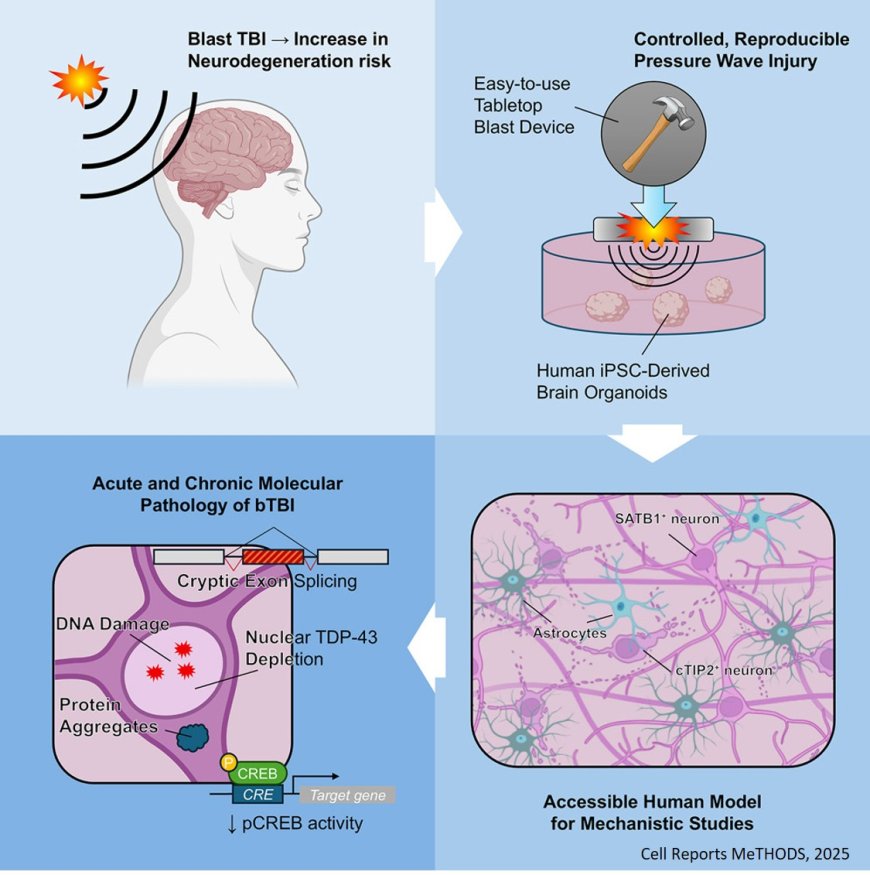
Researchers have developed and tested a cost-effective, easy-to-use tabletop device that can generate pressure waves, mimicking the impact of blasts that can cause neurodegeneration. Their study was recently published in the journal Cell Reports Methods. The results will help better study the development and progression of neurodegenerative diseases in the lab.
They hope to create a foundation for the in vitro study of traumatic brain injury (TBI), a risk factor for neurodegenerative diseases. By better understanding the processes that contribute to these conditions, They also hope to identify mechanisms that could be targeted for therapeutic intervention.
While animal models of TBI are commonly used, emerging research suggests that induced pluripotent stem cell (iPSC)-derived brain organoids offer a promising human-specific alternative. Widespread use has been limited, because the equipment required is expensive and specialized.
Traumatic brain injury is a major cause of death and disability, affecting more than 65 million people around the world annually. Epidemiological and experimental evidence suggest that impact or blast TBI is one of the leading environmental risk factors for neurodegeneration. A single moderate-to-severe TBI quadruples a person’s risk of developing dementia.
TBI can affect people of all ages, but some groups — military service members, veterans, and the elderly — have a greater risk of experiencing TBI and suffering long-term negative health outcomes.
The results will help the Lab study the development and progression of neurodegenerative diseases.
The experimental model offers new way to look at TBI-related neurodegenerative disease.
The design, realization, and calibration of the shock-loading device took about one month, and required some scaling down. While the lab performs shock-loading experiments on a daily basis, its resident apparatus was too massive for biology experiments. So, they created a miniaturized 3m-long water-filled shock tube apparatus and benchtop simulator for TBI study.
The resulting blast simulator uses low-cost, accessible components — PVC pipe, aluminum, and popsicle sticks — which can deliver reproducible pressure waves to 3D organoids for assessment. The pressure-loading simulator is portable and easy to use, generating high pressure pulses that mimic the pressure load experienced during a blast injury TBI.
In their prototype, test organoids were exposed to a blast wave for less than 1 millisecond — 100 times faster than the blink of an eye. That brief exposure was sufficient to induce severe damage to several cellular structures, which could lead to functional decline and neurodegeneration. The type of injury the team modeled is similar to a blast from an IED or a fired weapon.
The device has already given the team insight into the impact of blast injuries, including that deep-layer cortical neurons are more susceptible to blast exposure than upper-layer neurons. With the results of such testing, the authors will now be able to better assess for DNA damage after traumatic brain injury.
https://www.cell.com/cell-reports-methods/fulltext/S2667-2375(25)00249-8