



In young boys androgens promote growth of a type of brain tumor
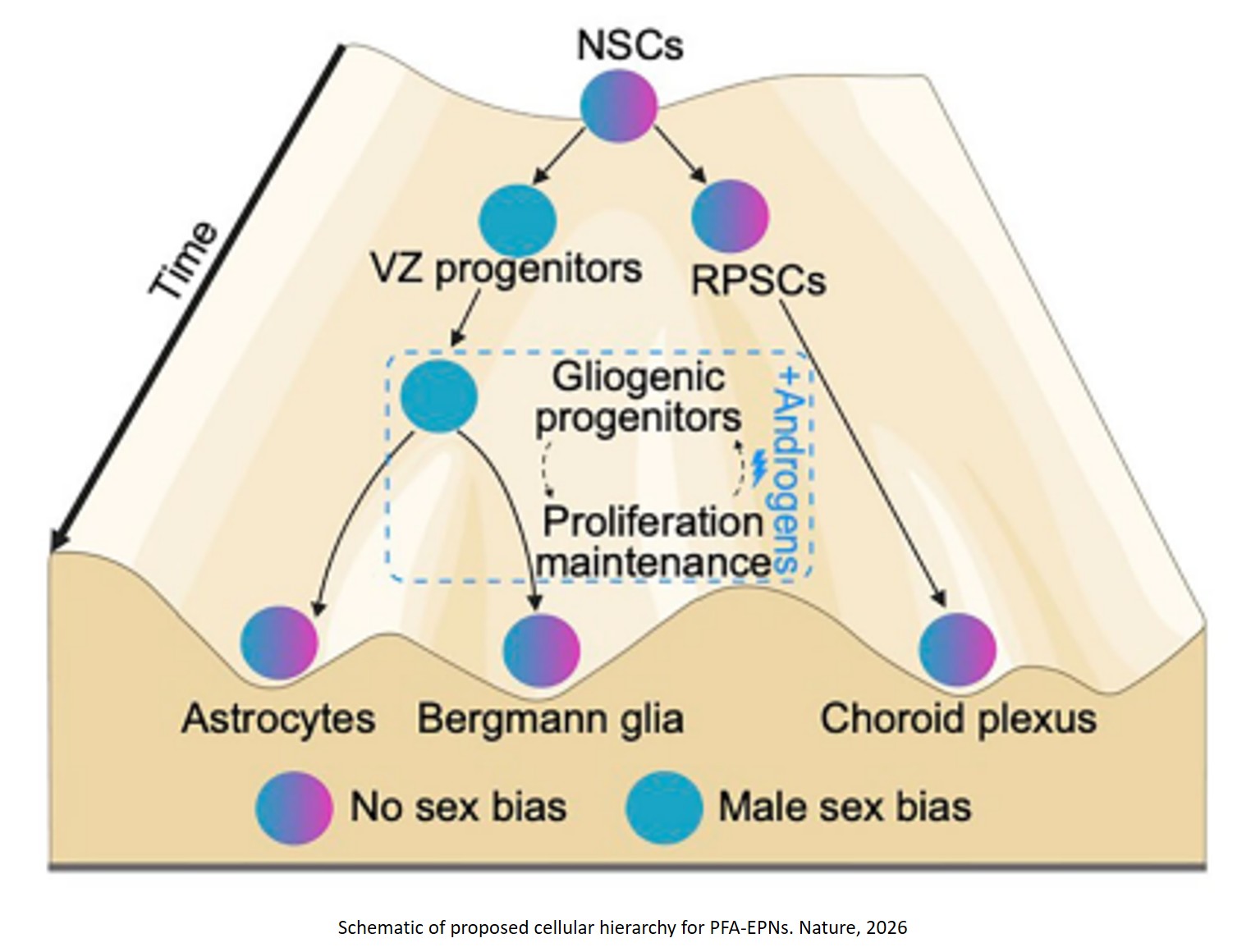
An international team has discovered what drives the growth of a lethal pediatric brain tumor called Posterior Fossa Type A (PFA) ependymoma.
The researchers report in the journal Nature that androgens, commonly known as male hormones, promote the growth of PFA ependymomas but not other brain tumors. Importantly, blocking androgen signaling reduces tumor proliferation. The findings open the possibility of a novel treatment approach for this currently untreatable childhood cancer.
“What drives PFA ependymoma’s growth has remained a mystery for quite some time,” said a co-first author. “As opposed to other lethal brain tumors, this cancer lacks clear genetic drivers, which has delayed the development of effective therapies. In the current work, we studied the tumor from a different angle.”
Previous studies have shown that most PFA ependymoma patients are male and that their survival is lower than females’. Yet the mechanisms underlying these sex differences remain unknown. It is also known that, in populations at the same early developmental stage, female brain cells appear to be further along in their development than those from males.
“Sex differences play an important role in cancer growth,” the author said. “We decided to study whether sex differences could explain why boys are more vulnerable than girls to PFA ependymoma. Understanding how sex‑specific factors contribute to PFA tumor progression and therapeutic response could potentially help us develop better treatments to improve survival and quality of life for affected children.”
Working with animal models and cancer cells grown in the lab, the team investigated whether the sex differences that have been observed in the susceptibility to PFA ependymoma depended on the sex chromosomes – XX for females and XY for males – or on sex hormones – androgens in males and estradiol or progesterone in females.
“We found that, as it occurs in normal brain cells, PFA ependymoma cells are less developed in males than in female patients,” the author said. “This difference is driven by androgens, which keep these tumor cells in a less-developed, growth‑prone state. We did not observe any differences attributable to chromosomal factors, and female sex hormones did not change PFA cell growth compared with controls.”
The authors showed that androgen signalling, rather than sex chromosomes, prolongs hindbrain differentiation in male mice.
Further studies supported this observation by showing that androgen supplementation promotes the growth of PFA ependymoma and enhances their less-developed properties but not that of other brain tumors. Conversely, androgen blockade diminishes both the stem-like potential and the proliferation of PFA ependymoma.
“Our study provides a biological basis for understanding the long-recognized sex differences in PFA ependymoma.” said a co-corresponding author.
“We reveal a previously unknown link between early hormone exposure and tumor formation, and we suggest that anti-androgen therapies could be a promising treatment option for this devastating disease,” said the co-corresponding author.
“Our findings have potential clinical implications as they suggest that androgen‑blocking therapies may represent a rational direction for future targeted treatment strategies,” said another co-corresponding author.