

Newly discovered cell helps shape blood vessel growth in the heart
Researchers have discovered a new cell type that may help regulate blood vessel growth in the heart during development and in response to injury, according to a new study. Working with zebrafish, they found that the new cell type helps stabilize the vascular network that supplies oxygen to growing cardiac muscle.
The findings, published in Nature Communications, could provide novel insights into how the human heart builds its blood-vessel network and guide future efforts to promote heart regeneration after injury.
“Our ultimate goal is to repair the damaged human heart,” says the senior author. “Being able to rebuild vessels at the right time and in the right location is key to the process.”
The authors found that in response to injury, a specific progenitor cell population within the zebrafish epicardium gives rise to the different cell types involved in regenerating heart muscle and coronary blood vessels.
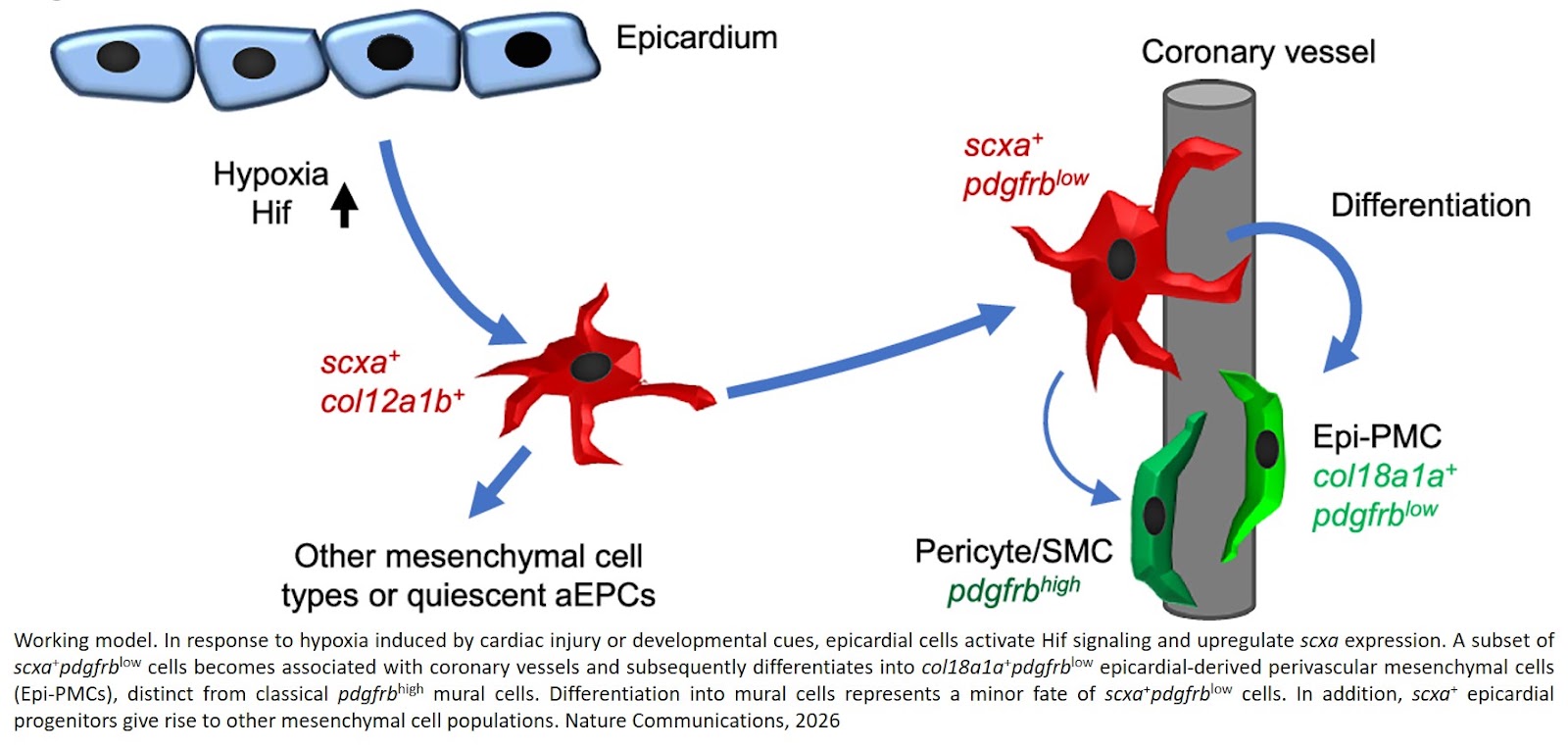
But what directs the precursor cells to specialize? To find out, the team catalogued the genes that are activated in these cells when the heart is injured. One of these genes, a master regulator called scxa, directs progenitor cells to generate a previously uncharacterized cell type. These novel “perivascular” cells surround coronary blood vessels and express a type of collagen that regulates vascular development.
These perivascular cells also produce a signal—a small protein fragment derived from the collagen molecule—that ultimately reins in vessel expansion. “During development or when the heart is damaged, you need to build the right amount of blood vessel—and you need to know when to stop,” said the atuhor. “This system provides that layer of control.”
Moreover, the researchers uncovered a potential mechanism that activates this vascular-support program at the appropriate time. Previously, the researchers showed that when areas of the heart experience low oxygen levels, a condition known as hypoxia, signals from the epicardium coordinate the growth of heart muscle and coronary vessels.
The new paper sheds light on how this may happen. The findings suggest that low oxygen acts as an environmental cue, temporarily activating scxa, which directs a subset of epicardial progenitors toward a perivascular fate. They then surround coronary vessels and may help regulate their development and remodeling.
The study raises the possibility that understanding how zebrafish epicardial cells respond to injury could eventually help researchers find ways to activate regenerative programs in the human heart.
Although humans have a related gene, SCX, researchers do not yet know whether human epicardial cells use it in the same way as zebrafish. Unfortunately, after an injury like a heart attack in mammals, SCX is switched on in cardiac fibroblasts—cells that promote scar tissue formation.
“Maybe in the future we can use SCX to reactivate human epicardial cells and steer them toward generating the cells and signals that promote human heart regeneration,” said the author.
“I don't think there will be just one magic factor that controls regeneration,” said the author. “But we’ve discovered one more factor, one more mechanism that could eventually contribute to turning on epicardial cells and repairing human hearts.”