


AI discovers different transcription systems shape chromatin behavior in distinct nuclear regions
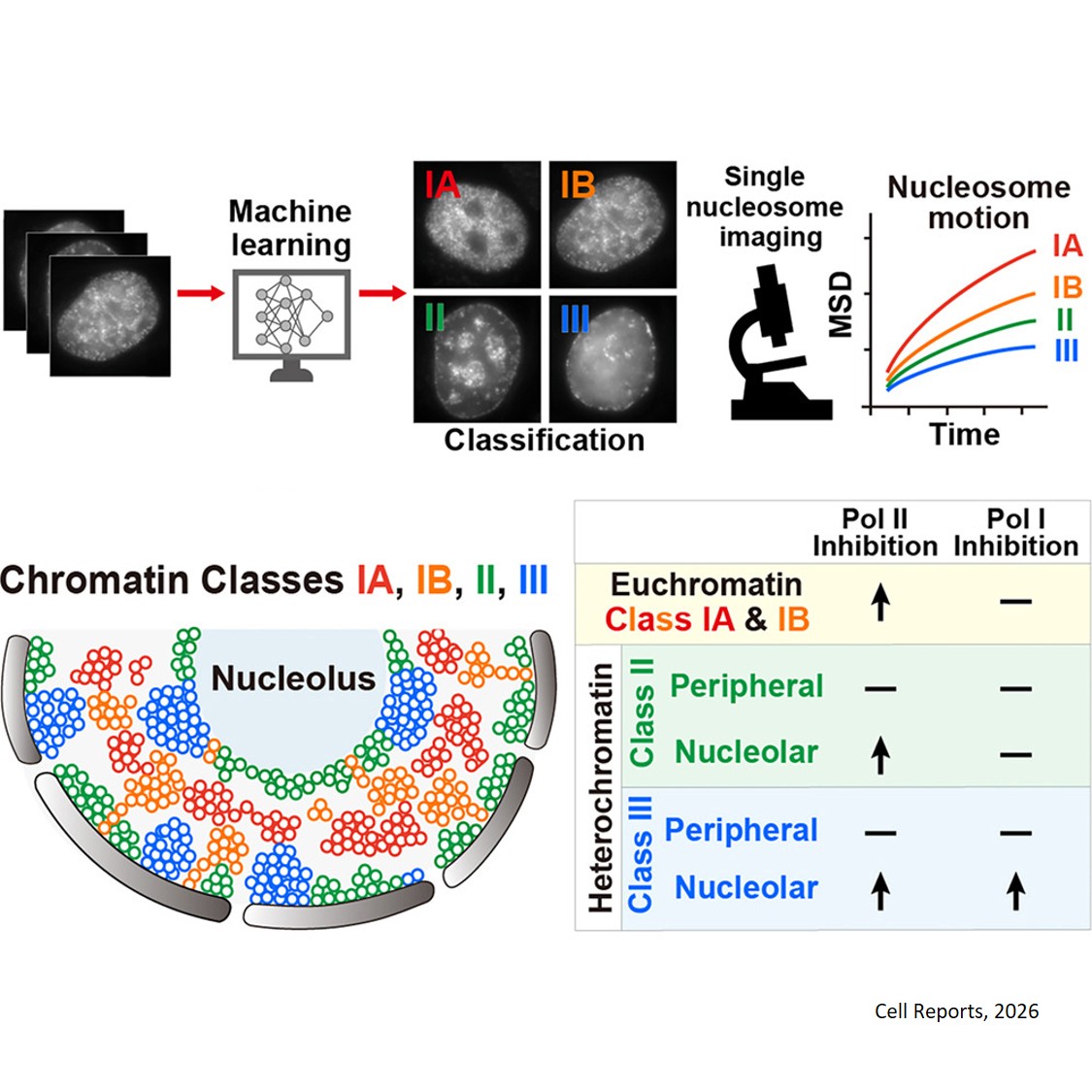
Inside the cell nucleus, DNA is wrapped around histone proteins to form nucleosomes, which are further organized into chromatin. Chromatin has traditionally been divided into transcriptionally active euchromatin and relatively inactive heterochromatin. However, chromatin is not a fixed structure. Nucleosomes continuously move within the nucleus, and this motion is closely related to the physical organization and function of the genome.
Previous studies have shown that transcription can influence chromatin motion, but whether this effect is the same throughout the nucleus has remained unclear.
An international research team has now investigated how different transcription systems affect the motion of distinct chromatin regions in living human cells.
The researchers combined two technologies. The first was Repli-Histo labeling, a method previously developed by the group that distinguishes four chromatin classes, ranging from euchromatin (Classes IA and IB) to heterochromatin (Classes II and III). They further developed a machine-learning classifier to identify these chromatin classes objectively. The second technique was single-nucleosome imaging, which allowed the team to directly track the movement of individual nucleosomes in living cells. This combination revealed that nucleosome motion becomes progressively more constrained from euchromatin toward heterochromatin. More importantly, the researchers found that transcription does not constrain chromatin uniformly throughout the nucleus.
When RNA polymerase II (Pol II), which transcribes most protein-coding genes, was inhibited using three different inhibitors, nucleosome motion increased in euchromatin (Classes IA and IB). Surprisingly, increased motion was also observed in heterochromatin around nucleoli. In contrast, heterochromatin at the nuclear periphery showed little change. The team then examined RNA polymerase I (Pol I), which produces the major ribosomal RNAs inside nucleoli. Inhibition of Pol I produced a different response. Rather than broadly affecting chromatin, it selectively increased nucleosome motion in a late-replicating Class III heterochromatin population associated with nucleoli.
“Developing the machine-learning classifier allowed us to distinguish the four Repli-Histo chromatin classes objectively and reproducibly,” says the author. “These results show that transcription does not simply make chromatin more or less dynamic throughout the nucleus,” says another author. “Different transcription systems appear to impose physical constraints on different chromatin regions, depending on both their chromatin state and where they are located in the nucleus,” says another author.
The findings also highlight the special environment surrounding nucleoli. Both Pol II and Pol I transcription influence chromatin motion in this region, but they affect different chromatin classes. This suggests that nucleolus-associated chromatin is physically heterogeneous and is shaped by multiple transcription-dependent mechanisms.
The study provides a new way to examine how genome function is coupled to the physical behavior of chromatin in living cells. By combining Repli-Histo labeling, machine learning, and single-nucleosome imaging, the approach can distinguish how different nuclear processes act on specific chromatin environments rather than treating the genome as a uniform polymer.
https://www.cell.com/cell-reports/fulltext/S2211-1247(26)01314-8