



AI to retrace the gene regulation evolution in human cerebellum
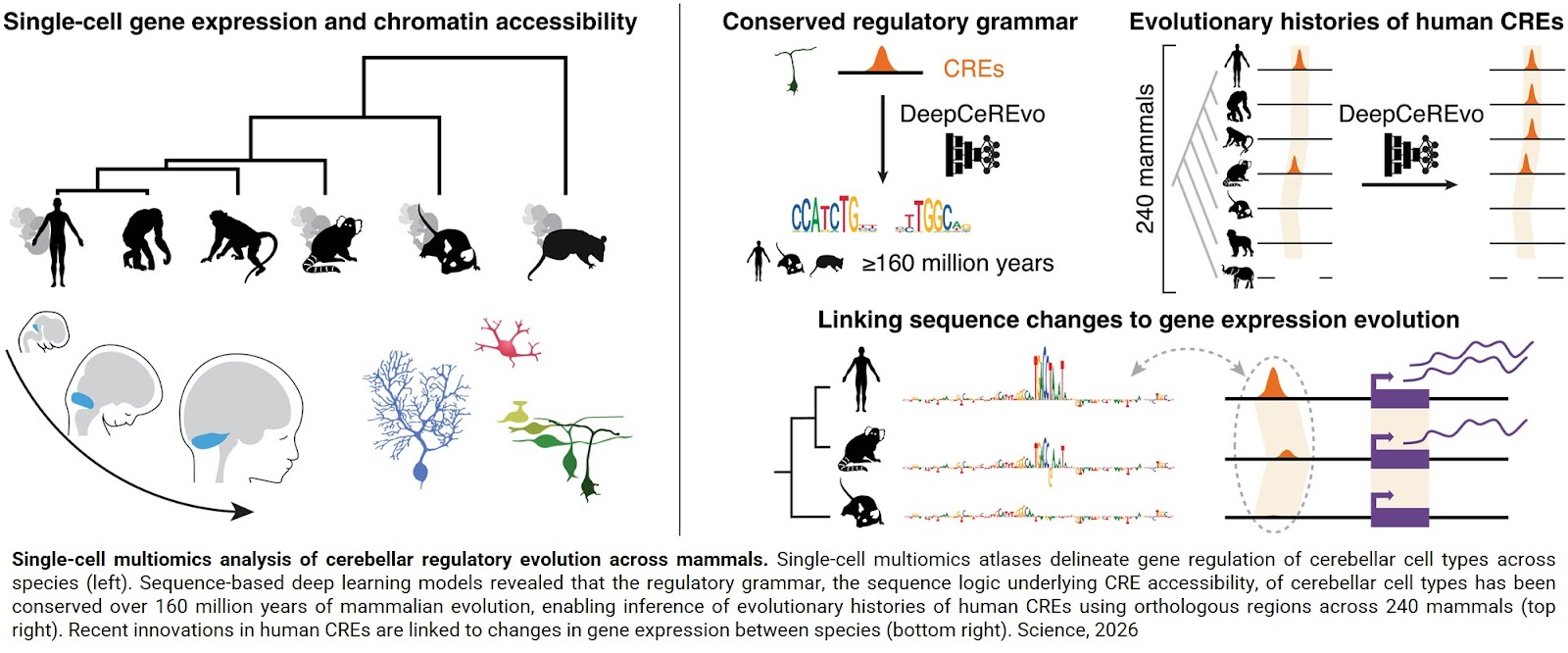
Artificial intelligence allows tracing the evolution of genetic control elements in the developing mammalian cerebellum. An international research team has now developed advanced AI models that can predict the activity of these elements based solely on their DNA sequence. Using these models, the scientists were able to retrace the evolutionary changes in the control programs, also identifying those that are specific to the human lineage.
Genetic control elements are DNA sequences that determine where and when genes are switched on. Changes in the activity of these elements can drive evolutionary innovations – such as the expansion of the brain. One brain region that notably expanded during human evolution is the cerebellum, which, beyond its role in movement and balance, also contributes to cognition, emotion, and language.
“Tracing the evolution of genetic control elements has long been challenging due to their rapid evolutionary turnover and our limited understanding of how their activity is encoded in their DNA sequence,” explains a research group leader.
To close this knowledge gap, the researchers made use of advances in artificial intelligence. “Customized tools for the AI-based analysis of comprehensive and complex datasets in the life sciences have allowed us to decode the sequence grammar and hence the genetically coded activity profiles of these control elements,” states a co-lead.
The researchers used modern sequencing technologies to map the activity of these elements in individual cells in the developing cerebellum of human, bonobo, macaque, marmoset, mouse, and opossum. Using this unique dataset, they trained models based on machine learning in order to be able to predict control element activity directly from the respective DNA sequence. These AI models were not only able to model the activity of these elements in the six species studied, but also to accurately predict the activity across other mammals.
“This goes to show that the sequence rules that define genetic control elements in cerebellar cell types have been highly conserved throughout mammalian evolution,” explains a co-first author of a paper.
Building on these findings, the scientists leveraged the AI models’ ability to recognize conserved sequence rules to predict the activity of control elements in 240 mammalian species. For every human element, the researchers succeeded in identifying whether the corresponding sequence is active in other mammals. This allowed them to reconstruct the evolutionary history of human regulatory programs at high resolution and identify those that likely contributed to key evolutionary innovations in the human cerebellum. For example, they discovered a new control element near the gene THRB, which encodes a thyroid hormone receptor found in all vertebrates. This new element has enabled this gene to also operate in cerebellar stem cells.
According to the author, this could have contributed to the evolutionary expansion of the human cerebellum. “That an evolutionarily ancient gene can be repurposed for novel functions is a key mechanism by which evolution drives innovation,” emphasizes the Heidelberg molecular biologist.