
Key cancer-related receptor is regulated by glycan interactions on cell surfaces
When proteins and lipids interact at the cell surface, they kick off essential cellular signaling pathways that play a role in physiological processes throughout the body. When these interactions and signaling pathways are disrupted, it can create conditions where cells can grow out of control and turn into tumors or other diseases. Therefore, understanding how these molecules interact at the cell surface may help inform the development of more targeted therapies in the future. Beyond proteins and lipids, polymers made of sugars called glycans that form a layer on the cell surface also seem to play a similarly important role that has yet to be completely understood.
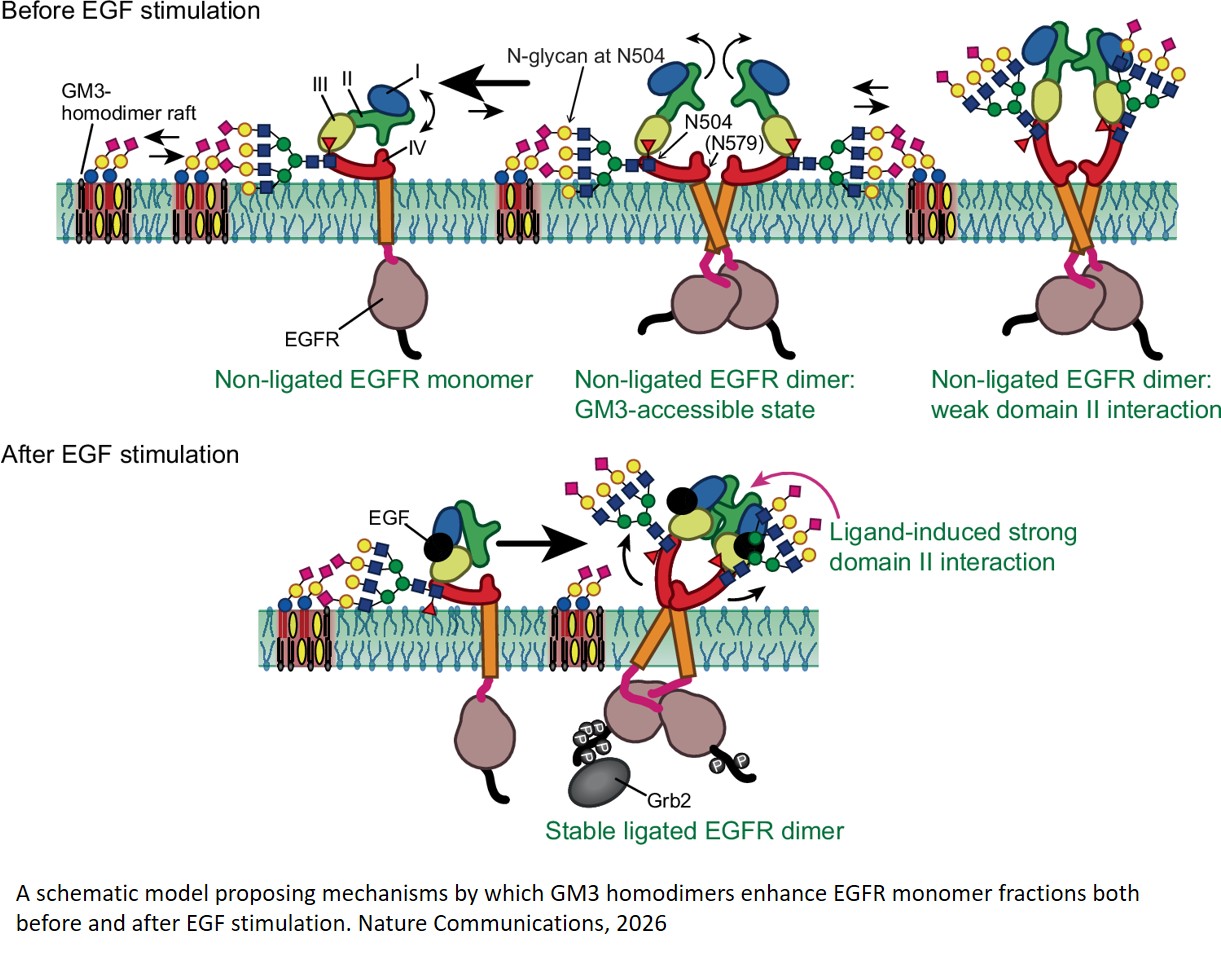
Now, researchers have documented glycan-glycan interactions between gangliosides — lipids in the cell membrane that carry glycans — and how they impact EGF receptor (EGFR) dimerization and activation, affecting important signaling pathways. As EGFR plays a role in cell growth for many cancers, investigators hope this will lead to drug discovery research targeting glycan interactions. The data was published in Nature Communications.
“Using single-molecule imaging, we directly observed ‘cis-glycan interactions’ on the membranes of living cells. These are weak, transient interactions between glycan chains. Furthermore, we revealed that these interactions form small membrane nanodomains and that the interaction between GM3 and EGFR glycan chains suppresses EGFR dimerization and activation,” said the senior author.
Scientists have long suspected that carbohydrate-carbohydrate interactions, like interactions between glycan sugar chains, play an important role in molecular recognition, but these interactions happen very quickly and do not last long. Cell membranes are also crowded spaces, with many different interactions happening at once. Because of this, it has been difficult to document cis-glycan interactions and prove exactly how they impact cellular signaling.
“Although the cell surface is covered with a wide variety of glycan chains, for many years, there was no direct evidence to show whether these sugar chains interact directly with one another on the same cell membrane or regulate membrane structure and signal transduction. This question has remained unresolved,” said the author.
To observe these interactions, researchers chemically synthesized 39 fluorescent ganglioside probes and incorporated them into the plasma membranes of living cells. The synthesized gangliosides functioned like real gangliosides but with added fluorescence to make the gangliosides and their behavior visible. The examined gangliosides displayed consistent transient homo-colocalization, which is when two molecules of the same type are found close to each other. This behavior was observed enough that researchers determined that it was not accidental or incidental, and control experiments ruled out interference from the fluorescent dyes.
Among the gangliosides examined, GM3 formed particularly long-lived transient pairs with other GM3 gangliosides through a process called homodimerization. These pairs formed structures called rafts that were then observed in living cells, in close association with EGFR. Though GM3-EGFR interactions had previously been suspected, researchers visualized them for the first time and observed how glycans within both the GM3 ganglioside and EGFR bind together, suppressing EGFR dimerization and activation.
This GM3-EGFR interaction is a critical research finding. EGFR signaling plays an important role in the growth of several types of cancer, and understanding new mechanisms that regulate EGFR may have implications for future cancer research.
“The discovery of a new mechanism regulating EGFR activity may provide a basis for future drug discovery research targeting glycan chains. We would like to verify whether the regulation of EGFR activity through glycan interactions, as elucidated in this study, also applies to other receptors and to investigate its universality,” said the author.
https://www.nature.com/articles/s41467-026-76857-x
https://sciencemission.com/glycan%E2%80%93glycan-interactions