




Evaluating gut microbial and host proteins in health and disease
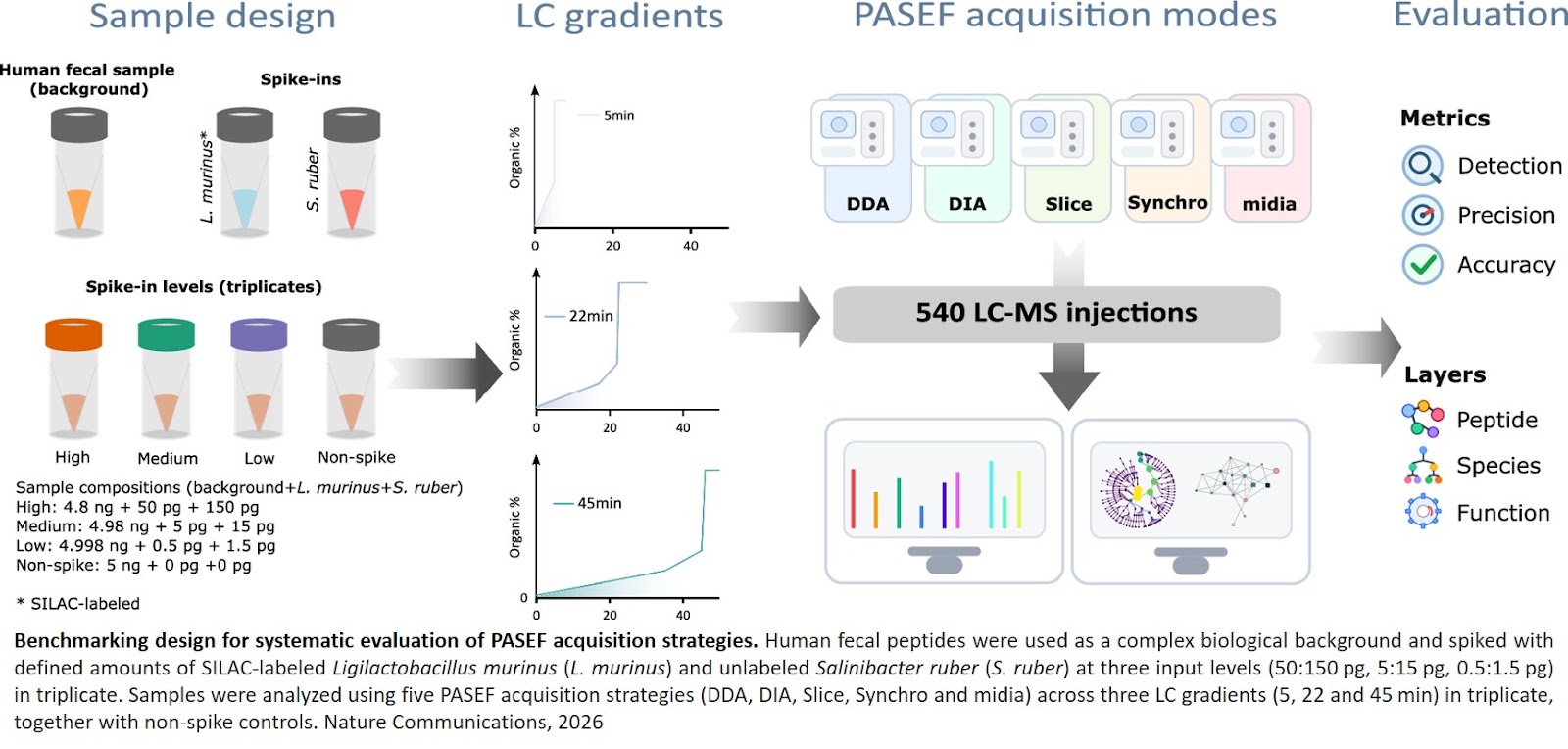
The trillions of microorganisms living in our intestine influence our health, from digestion and metabolism to immunity. Yet scientists still struggle to understand how these microbes shape these important physiological functions because gut microbiomes are extraordinarily complex, redundant, and dynamic. New technologies are therefore essential for advancing microbiome research. Researchers have now reported effective strategies for simultaneously measuring thousands of microbial and host proteins. The findings have been published in Nature Communications.
Microorganisms are essential to the health of ecosystems across the planet, including the human body. Modern DNA sequencing has transformed microbiome research by revealing which microorganisms are present and which functions they could potentially perform. This is similar to identifying the musicians in an orchestra and the pieces they can play. However, DNA alone cannot tell us which piece is actually being performed.
Proteins provide this missing information. They reveal which microbial functions are active, how different microbiome members contribute, and importantly, how the host responds. In the orchestra analogy, proteins show not only which musicians are present, but also which piece they are playing and how the audience – the host – reacts.
In the new study, the researchers systematically compared five state-of-the-art mass spectrometry approaches using human fecal samples. Ultimately, they identified methodological strategies that provide high sensitivity, reproducibility, and functional insight.
"Metaproteomics allows us to see what microbial communities are actually doing, rather than simply which microbes are present," says the first author of the study. "By identifying the most suitable analytical strategies, we hope to make future microbiome research more sensitive, reproducible, and accessible across medicine, environmental science, and biotechnology."
The researchers tested if the new analytical strategies also perform robustly in a biologically relevant setting. They measured microbial and host proteins throughout disease progression and recovery, revealing coordinated changes in microbial functions alongside the host repair response. The best-performing methods captured highly concordant host and microbial responses during the onset and recovery of intestinal inflammation, showing that technological improvements can translate into robust biological insights.
"Developing better technologies is essential if we want to answer the next generation of questions in microbiome research," says the senior author. "Only by listening to the music script played by microbes can we begin to understand why the audience – the host – responds in a particular way. This will transform our understanding of the microbiome's role in human health. We are already applying these advances in international clinical collaborations to study the involvement of microbiomes in neurological, metabolic and autoimmune diseases."
Summary
· The gut microbiome cannot be fully understood by knowing which microbes are present; researchers must also determine what they are doing by analysing their proteins.
· Metaproteomics can reveal microbial activity by measuring thousands of proteins, but complex gut samples are technically difficult to analyse.
· The study shows that the choice of mass spectrometry acquisition strategy strongly affects sensitivity, reproducibility, and functional interpretation. The researchers provide practical guidance for selecting the most suitable method.
· The best-performing methods captured coordinated host and microbial responses during the onset and recovery of intestinal inflammation.
· These technologies provide a robust foundation for future clinical studies investigating how microbiomes contribute to human health and disease.
https://www.nature.com/articles/s41467-026-75845-5
https://sciencemission.com/ASEF-acquisition-strategies