


The neural basis of laughter
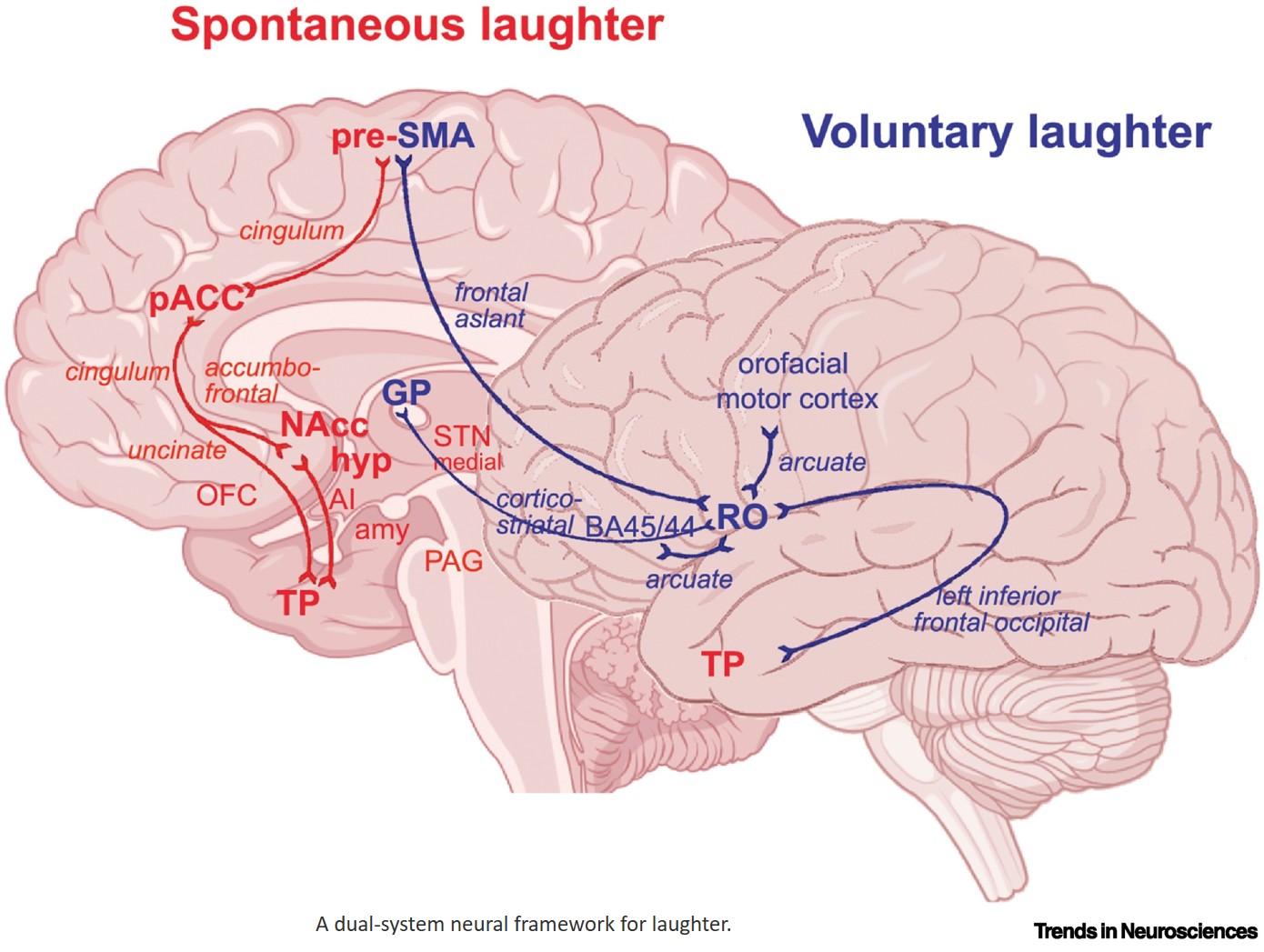
Behavioral and clinical evidence distinguish two major forms of human laughter: spontaneous, emotionally driven vocalizations and volitional expressions used in social communication.
Progress in the neuroscience of laughter has been limited by the difficulty of capturing spontaneous, natural signals in laboratory settings. Invasive investigations in humans, such as direct electrical stimulation, have provided a unique causal window into its underlying circuitry.
Evidence supports a dual-system framework, in which an evolutionarily ancient cingulo-temporal network drives spontaneous laughter and its social bonding and analgesic functions, while a lateral motor-opercular system co-opts speech networks for volitional expression used in social negotiation and conversation.
https://www.cell.com/trends/neurosciences/fulltext/S0166-2236(26)00099-8