

Assembly of protein degradation complex
Researchers have unraveled the stepwise assembly of a central molecular machine responsible for protein degradation in cells – the eukaryotic proteasome. With the help of high-resolution cryo-electron microscopy, they were able to track the individual steps of their biogenesis. Their findings published in “Nature Communications” challenge long-standing assumptions in the field and are important for research into aging processes and diseases, as well as for drug development.
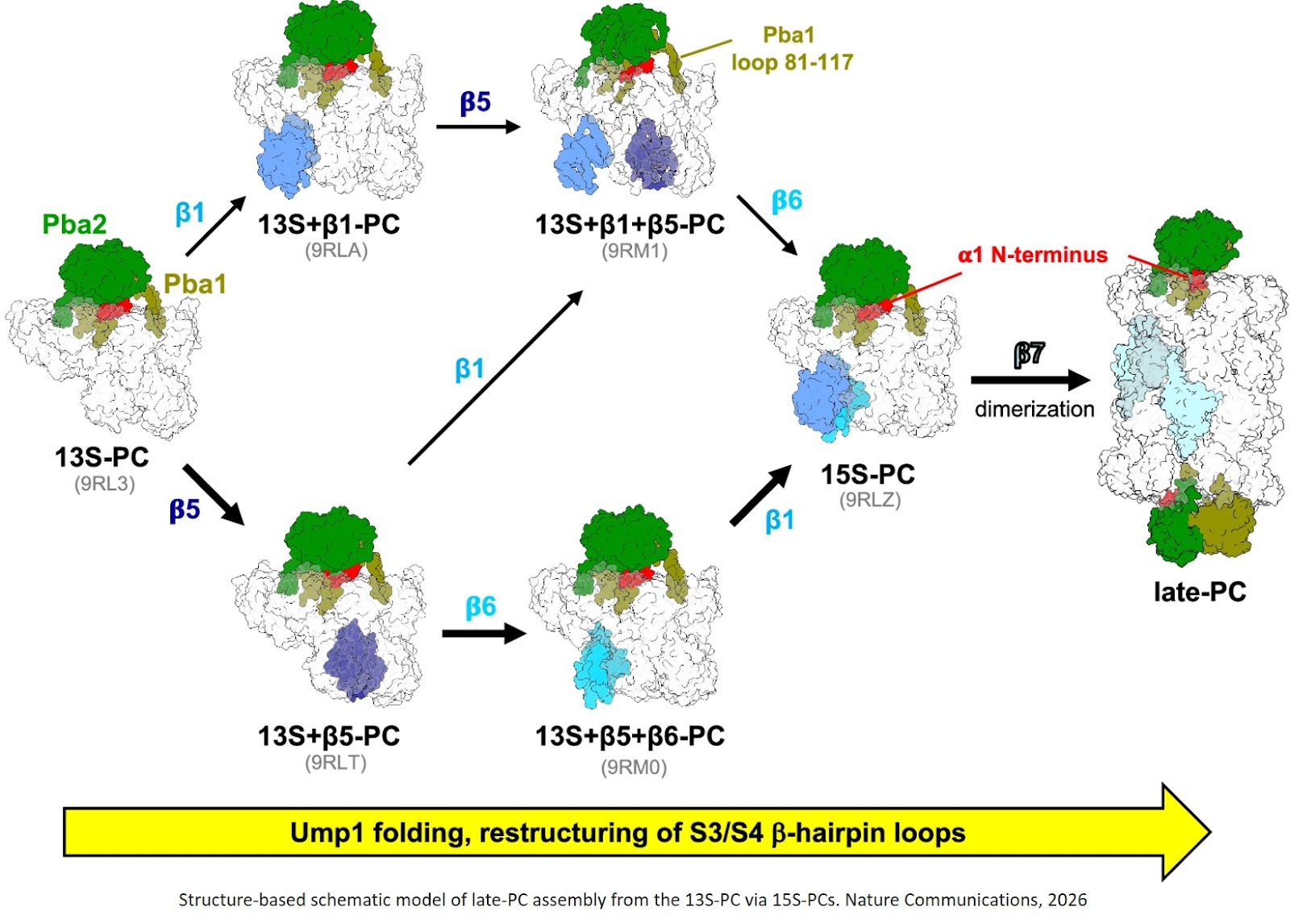
Proteasomes are vital protein complexes that break down damaged or no longer needed proteins in cells. Using high-resolution cryo-electron microscopy (cryo-EM), a research team captured the structures of six early proteasome precursor complexes in yeast — including previously unknown intermediate states.
The new data show that the proteasome can assemble via two distinct routes, which differ in the order of the built-in beta subunits. Contrary to previous hypotheses, the assembly of this essential complex is not a rigid, linear process, but instead proceeds through multiple alternative pathways.
“This was a surprise,” says the senior author. “An active proteasome is composed of 28 individual proteins. We were able to demonstrate that the activity-mediating subunits beta 1 and beta 5 can enter the complex independently of one another – a clear indication of flexibility in proteasome biogenesis which was not expected.”
The study also reveals how chaperone proteins guide the assembly process. The term chaperone refers to a specific type of proteins that support the maturation of other proteins, prevents unwanted interactions, and corrects errors. They play an important role in the development and aging of cells. This work shows that at the molecular level, a previously unknown chaperone segment keeps the central pore of the nascent proteasome open. This loop is only released after the final maturation step, ensuring that the complex is not activated prematurely.
„Proteasome assembly is a precisely choreographed process,” explains the author. „Our work demonstrates how structural changes in chaperones and proteasomal subunits are tightly coordinated to ensure that the complex is assembled correctly and only activated once all components are in place.”
These insights have broad implications for understanding cellular protein quality control, aging, and diseases such as cancer and neurodegenerative disorders. They also open new avenues for developing targeted therapies that modulate proteasome biogenesis.
https://www.nature.com/articles/s41467-026-70525-w
https://sciencemission.com/assembly-of-proteasome