




Reducing Nursing Workload: The Growing Role of AI Scribes in SNFs
Discover how AI medical scribes are reducing documentation burden and helping SNF nurses focus more on resident care.
Skilled Nursing Facilities (SNFs) run on two things: clinical care and documentation. Every shift, nurses juggle assessments, vitals, wound notes, medication updates, progress notes, and care plan revisions—all while trying to give residents the attention they deserve.
But the reality is simple: documentation takes too much time, and it often steals minutes that nurses wish they could spend at the bedside.
This is where the AI medical scribe is starting to make a noticeable impact across SNFs. Not as a fancy tech tool. Not as a replacement for staff.
But as a practical, everyday helper.
This blog explores how AI medical scribes are quietly reshaping skilled nursing, easing the load on nurses, and improving the care experience for everyone—staff, residents, and administrators.
Why Documentation Feels Heavier in SNFs
Documentation in SNFs is different from hospitals or outpatient clinics.
Nurses aren't just writing a note about a single encounter—they're documenting ongoing, 24/7 care across multiple domains.
Multiple Assessments Each Shift
SNF nurses handle:
-
Daily progress notes
-
Wound checks
-
Pain reassessments
-
Fall risk updates
-
Behavioral monitoring
-
ADL tracking
-
Medication documentation
Each of these requires accurate, timely entries.
Imagine a nurse spending 10 minutes writing a detailed progress note. Multiply that across 20–25 residents, and documentation alone can take 3–4 hours of a shift.
Compliance Pressure
Surveyors, auditors, and interdisciplinary teams rely on accurate notes.
A single missed detail—even a phrase—can impact:
-
MDS scoring
-
Reimbursement
-
Quality measures
-
Legal standing
-
Care plans
This pressure adds another layer of stress on already busy nursing teams.
High Resident Caseload
Most SNFs run with fewer nurses per resident compared to hospitals. So the workload isn’t just high—it's constant. Documentation feels like a second full-time job.
Enter the AI Medical Scribe—A Helper Built for Real-Life Nursing Workflows
AI medical scribes in SNFs aren’t just “voice-to-text” apps. They work like a digital assistant that listens, understands, and converts clinical conversations or nurse dictations into clear, structured notes.
At the simplest level:
A nurse talks → AI listens → AI writes the note → nurse reviews & approves.
But the real value comes from how well it fits into the natural flow of SNF care.
How AI Scribes Actually Reduce Workload
Below are real-world examples that show how the AI medical scribe helps nurses save time without feeling like extra tech overhead.
1. Documenting While Walking With a Resident
Scenario:
A nurse walks with Mrs. Thompson (post-stroke) to assess gait progress.
Instead of carrying a clipboard or waiting until later, the nurse says quietly:
“Resident tolerated 30 feet ambulation with a rolling walker. Mild fatigue noted. Required verbal cues for balance. No pain reported.”
By the time they return to the nursing station, the AI medical scribe has already created a complete progress note, formatted and ready for review.
What previously took 5–7 minutes now takes seconds.
2. Faster Wound Documentation
Wound care is one of the most documentation-heavy tasks in SNFs.
Before AI:
Nurse evaluates a wound → takes measurements → documents drainage → describes edges → uploads a photo → writes a note from scratch.
With an AI medical scribe:
The nurse describes the wound verbally while assessing it:
“Stage 3 pressure injury on left heel. Measures 3.1 by 2.4 cm, depth 0.4 cm. Moderate serous drainage. No odor. Surrounding skin intact. Dressing changed.”
The AI automatically creates:
-
A structured wound note
-
Measurement fields
-
Dressing change documentation
-
A resident status update
Result:
A 10-minute task becomes 3 minutes.
3. Behavioral Monitoring Notes Without Rewriting the Same Format
SNF nurses often write:
-
Aggression notes
-
Wandering episodes
-
Redirection notes
-
Mood changes
-
Safety interventions
Instead of typing every detail, nurses simply speak naturally:
“At 2:45 PM, the resident became anxious and attempted to exit the room. Required redirection for safety. No physical aggression. Behavior resolved within 5 minutes after reassurance.”
The AI produces a clean, structured behavioral note in the preferred facility format.
Real-Time Documentation After Med Pass Issues
If a resident refuses medication or reports side effects, nurses must document it immediately.
With AI:
“Resident refused evening dose of Lisinopril. Educated on purpose and risks. Will reattempt in 30 minutes. Provider will be notified if refusal continues.”
The AI instantly formats it into a legible MAR-related note.
No extra typing. No delays.
5. Easier Interdisciplinary Communication
When communicating with PT/OT, dieticians, or providers, the scribe can produce summaries:
-
“Provider update sent.”
-
“Change in mobility status documented.”
-
“Nutritional concern flagged."
The AI generates clean follow-up notes that match SNF documentation styles.
How AI Scribes Support Quality of Care
AI medical scribes don’t just save time—they indirectly improve care.
Nurses Spend More Time With Residents
Every minute saved from typing is a minute gained for:
-
Talking with a resident
-
Performing assessments earlier
-
Helping during meals
-
Responding to call bells faster
Even a 30-minute saving per shift changes the pace of care.
More Accurate Documentation
When nurses document as they care, memory errors shrink.
Notes become:
-
More detailed
-
More human
-
More clinically accurate
This strengthens care plans and provider communication.
Better Consistency Across Staff
Different nurses have different writing styles. AI scribes standardize structure, making records easier to review.
Administrators appreciate this more than they admit.
Improved Staff Satisfaction
Many nurses say documentation is their most exhausting task. When AI helps, burnout lowers. Job satisfaction rises.
Some SNFs using AI scribes report:
-
25–40% reduction in documentation time
-
Higher completion accuracy
-
Fewer late entries
-
Better overall morale
Do AI Scribes Replace Nurses? Absolutely not.
There is often a fear that new technology will replace clinical staff.
AI medical scribes do the opposite.
They support nurses by removing repetitive typing—not clinical judgment, assessment skills, or decision-making.
A scribe can write the note. Only a nurse can provide the care.
What Nurses Say About Using AI Scribes in SNFs
Nurses describe their experience with AI scribes using phrases like
-
“It feels like I finally got my time back.”
-
“This helps me focus on residents instead of the computer.”
-
“For the first time, I finished all notes before the shift ended.”
-
“My notes look clearer than ever.”
When technology "gets out of the way," clinicians feel supported—not replaced.
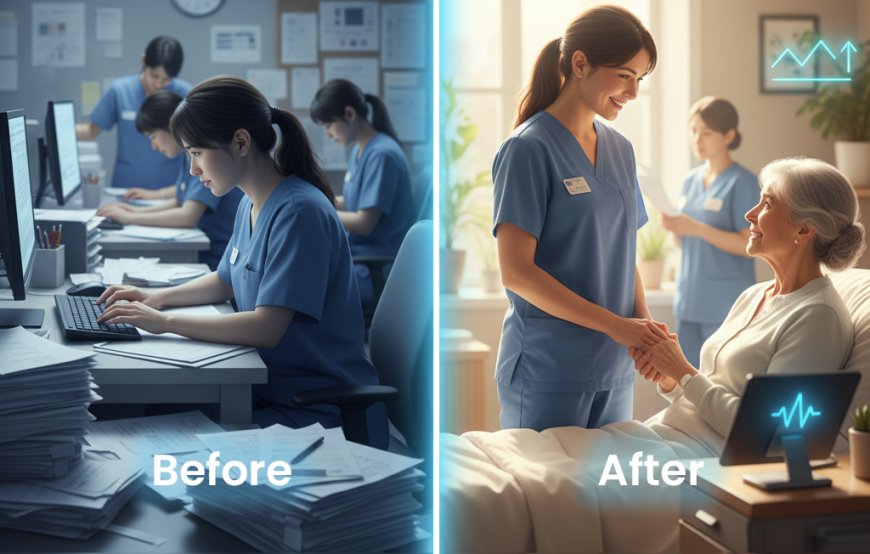
A Simple Example of How a Shift Changes With AI
Before AI Scribe
-
3 hours documenting
-
5–7 delayed notes
-
Rushed assessments
-
Stress at shift-end
-
Less one-on-one resident time
After AI Scribe
-
1.5 hours documenting
-
Most notes completed in real time
-
More complete assessments
-
Clearer communication with providers
-
Calmer, smoother workflow
The difference isn’t subtle—it’s life-changing for many nurses.
Future of AI Medical Scribes in Skilled Nursing
AI scribes are growing fast in SNFs because they fit the environment perfectly.
In the coming years, we might see:
-
Automatic care plan suggestions
-
Real-time alerts for abnormal findings
-
Integration with vitals machines
-
Better wound tracking prediction
-
Voice-activated MDS assistance
But even today, the core benefit stands strong: AI scribes give SNF nurses their time back.
Conclusion
Documentation will always be essential in skilled nursing, but it doesn’t have to feel overwhelming. AI medical scribes offer a practical, everyday solution that eases workloads and elevates the quality of care.
For SNF nurses, it means:
-
More hands-on care
-
Less computer time
-
More accurate documentation
-
Better shift flow
-
Reduced stress
And for residents, it means more attention from the people who matter most—the caregivers at their side.
If your SNF is looking for a way to support nurses, improve documentation, and enhance resident care, an AI medical scribe may be the simplest and most powerful change you can make.