











A skin fungus hides in hair follicles!
Since its discovery in Japan in 2009, a deadly fungus has emerged in hospitals around the world. The pathogen, known as Candida auris, lives silently on the skin. But it can be deadly if it reaches the bloodstream, and kills about 3,000 patients in hospitals and long-term care facilities a year in the U.S.
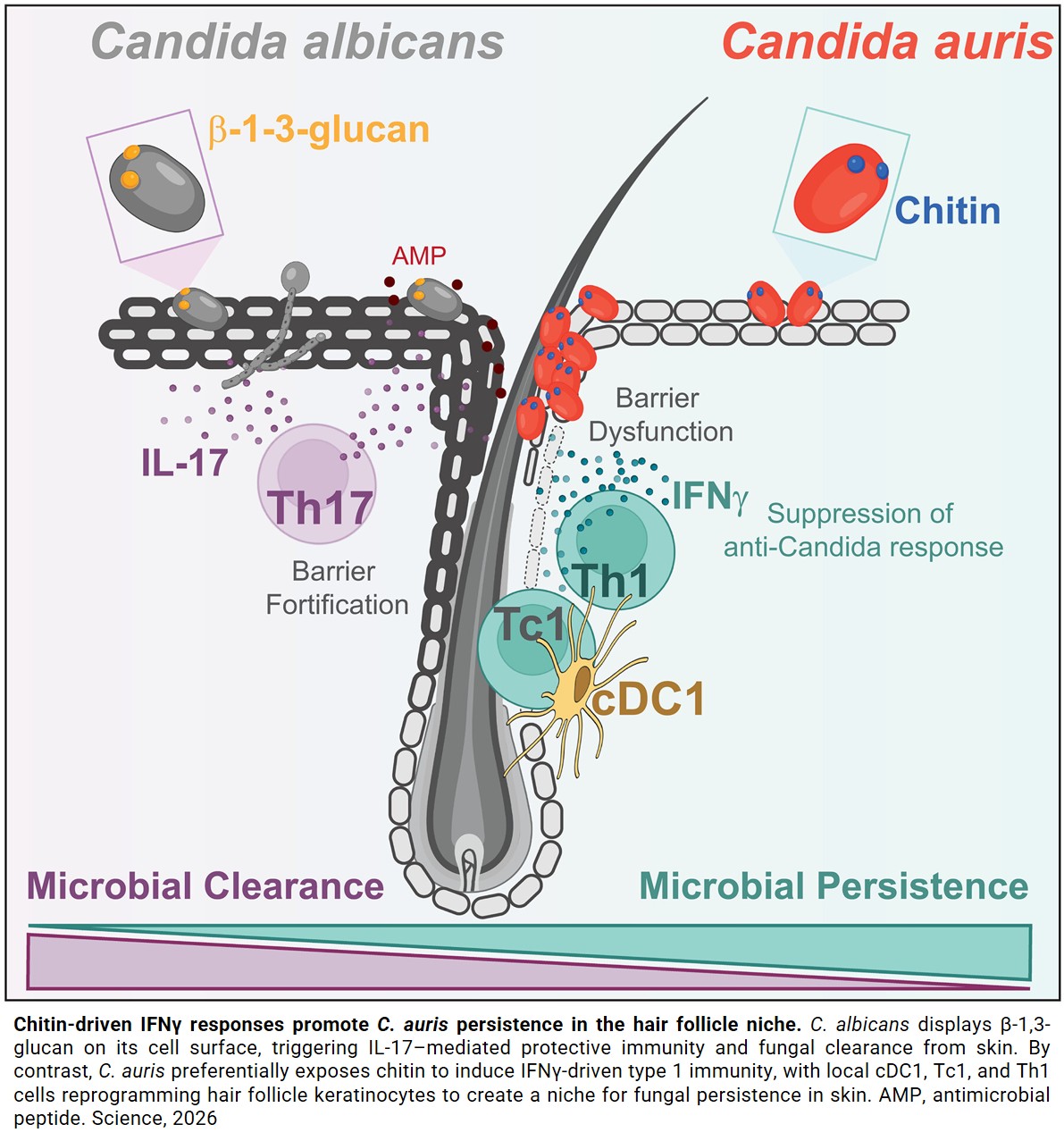
A new study explains why. To understand what allows C. auris to persist on the skin, unlike other fungi, researchers compared it with Candida albicans, a common skin fungus that the immune system normally clears quickly. In mice, C. albicans disappeared within days, but C. auris persisted, taking refuge in hair follicles.
“Candida auris colonizes skin way better than most other fungi, setting it up to invade once the immune system is weakened,” said the first author of the study, which appears in Science. “The big clinical problem is that we have no effective way to remove it from the skin.”
The researchers discovered that the two fungi produced very different immune responses. C. albicans triggered an immune signal called IL-17, which renewed the skin's surface and boosted antifungal defenses, clearing the infection. But C. auris triggered interferon gamma, a signal more commonly linked to viral infections.
It did this by remodeling its exterior cell wall to expose more of a molecule called chitin, which spurred immune cells to release interferon gamma around the hair follicle. The interferon gamma blocked the skin's antifungal defenses, including IL-17. It also slowed the natural replacement of hair follicle cells, leading to a buildup of older, damaged cells — a niche where C. auris could flourish.
“Chitin is widespread in nature, so it’s not like the human skin never encounters it, but we were surprised to see that C. auris actively uses its chitin to turn the skin into a perfect nest,” said a co-senior author of the paper.
The findings reveal potential targets for preventing C. auris from persisting on the skin.
One approach could involve drugs that tilt the immune system away from interferon gamma signals and toward IL-17, which drives the skin’s normal antifungal clearing process. Or perhaps drugs that block chitin could prevent the fungus from amplifying the interferon gamma signals, according to Merrill.
More broadly, the researchers say the work offers a new way to think about how microbes can quietly coexist with us before becoming dangerous.
“For most people, Candida auris hangs out on the skin and doesn't cause any problems. It's only when it reaches deeper tissues in medically vulnerable patients that it becomes dangerous,” said the other co-senior author of the paper. “Understanding how it survives on the skin may help explain how it eventually causes serious infections.”