

Mechanism of water-use efficiency and growth in plants
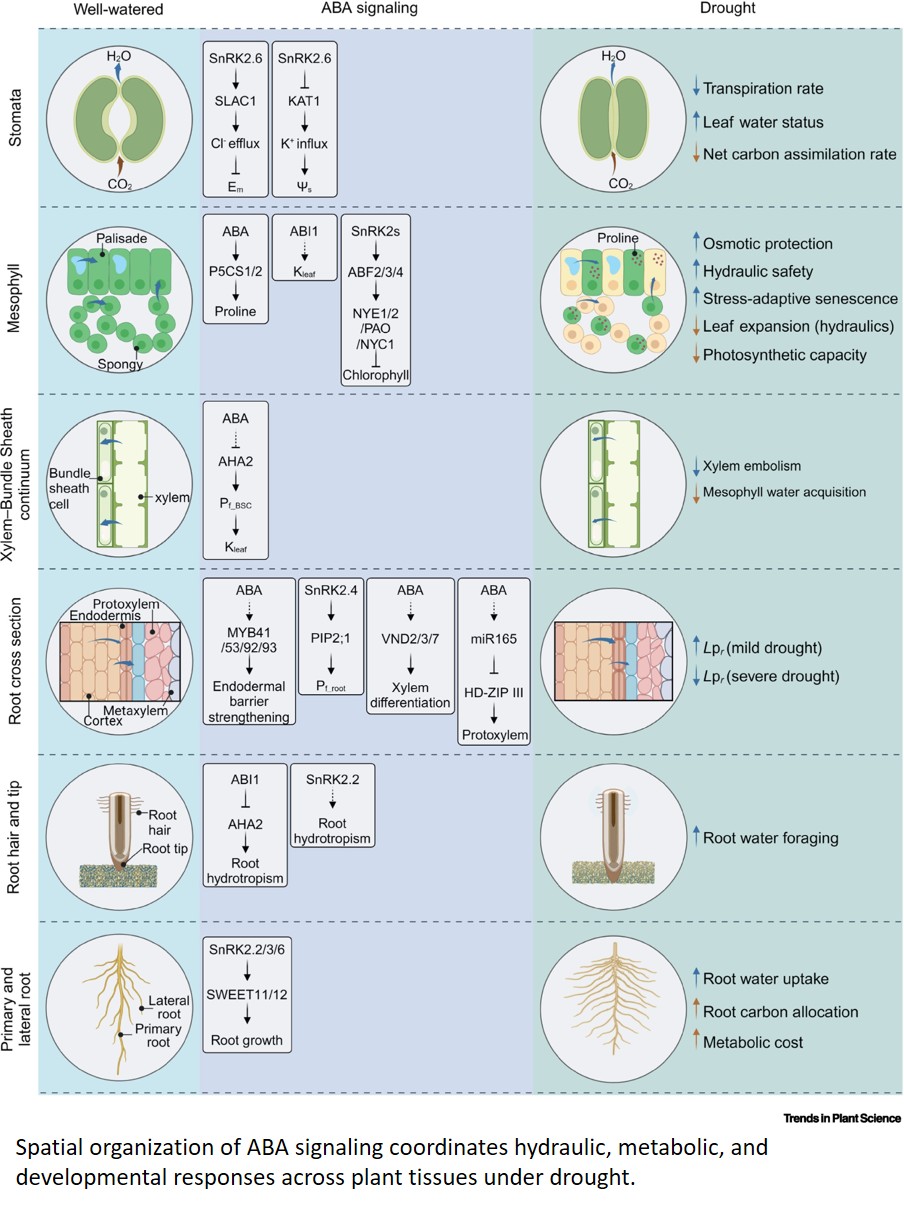
A prevailing view holds that abscisic acid-induced stomatal closure enhances water-use efficiency by reducing transpiration but concomitantly limits the net carbon assimilation rate and growth.
Emerging evidence indicates that guard cell abscisic acid signaling reduces transpiration and the net carbon assimilation rate without necessarily constraining leaf growth.
Reduced transpiration can improve leaf water status and promote the expansion of photosynthetically active leaves.
The growth-limiting effects of abscisic acid may largely originate from its activation in non-guard-cell tissues.
Spatial differences in abscisic acid responsiveness may help explain whether gains in water-use efficiency incur growth penalties.
https://www.cell.com/trends/plant-science/fulltext/S1360-1385(26)00338-9