



FGF21 helps cells cope with protein folding stress
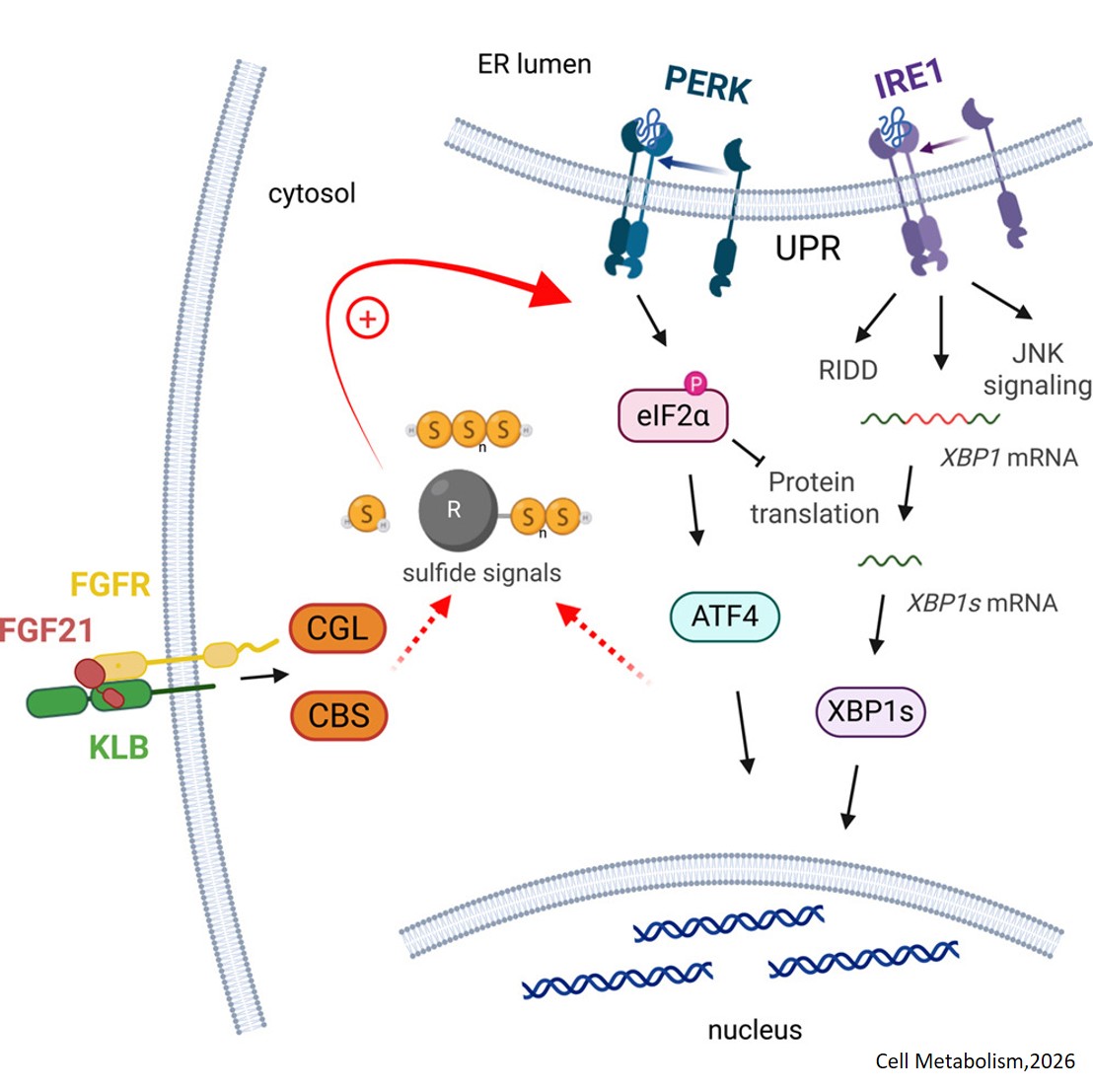
Proteins must be folded precisely in order to function properly. When protein folding goes awry, misfolded proteins accumulate in the endoplasmic reticulum (ER), an important site for the folding and quality control of many proteins. Cells respond by activating protective mechanisms such as the Unfolded Protein Response (UPR) and the Integrated Stress Response (ISR). These pathways help limit the burden on the cell and stabilize protein processing. According to the new findings, this is precisely where FGF21 comes into play.
“Until now, FGF21 has primarily been viewed as a hormone of energy metabolism,” says the senior author of the study. “Our results now show that FGF21 can also amplify the cellular response to protein folding stress.”
To investigate the mechanism in more detail, the team analyzed the molecular environment of the FGF21 receptor β-klotho. This revealed that FGF21 is linked to protein folding, the ER stress response, and sulfide signaling. Particularly striking was its proximity to enzymes involved in generating sulfide signals. Further experiments showed that FGF21 induces enzymatic sulfide production and thereby supports both the UPR and the ISR.
A key point is that FGF21 does not trigger this stress response itself. Instead, it amplifies the response under conditions of cellular stress. When the enzymatic production of sulfide signals is inhibited, FGF21 largely loses its effect; conversely, its action can be partially mimicked by a compound that releases hydrogen sulfide.
“Our data point to a new signaling pathway through which FGF21 supports the cellular stress response,” says the first author of the publication. “The study shows not only that FGF21 is linked to cellular stress, but above all by which mechanism this occurs. This gives us a better understanding of how metabolic regulation and cellular protective programs interact.”
The team observed these effects in cell cultures, liver tissue, and mouse models. At the same time, the researchers found that FGF21 depends on the receptor β-klotho for its action. Without this receptor, its influence on the stress response was lost. Overall, the study expands our understanding of FGF21: not only as a metabolic hormone, but also as a modulator of cellular stress adaptation.
“Our study is basic and preclinical research,” the senior author emphasizes. “It does not provide direct clinical evidence for new therapies. However, FGF21 has long been regarded as an interesting target in metabolic research, including in the context of metabolic liver disease. Our new findings provide additional mechanistic support and may help guide translational approaches more precisely in the future.”
https://www.cell.com/cell-metabolism/fulltext/S1550-4131(26)00221-4