


How adult sympathetic neurons survive?
During embryonic development, immature neurons rely heavily on target-derived neurotrophic factors to survive, but they gradually outgrow this dependency as they mature. This paper solves a fundamental mystery in neurobiology by proving that mature neurons still require dedicated survival signals into adulthood, which shift from traditional organ targets to local blood vessels.
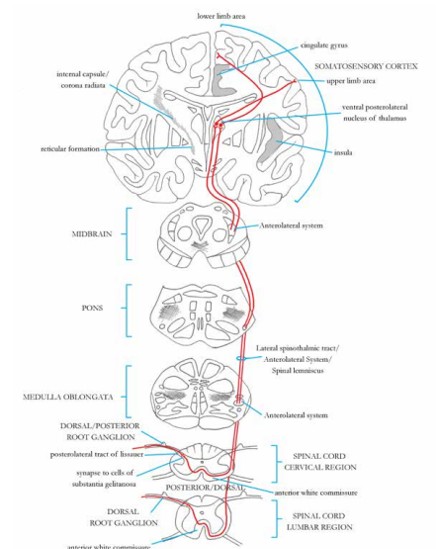
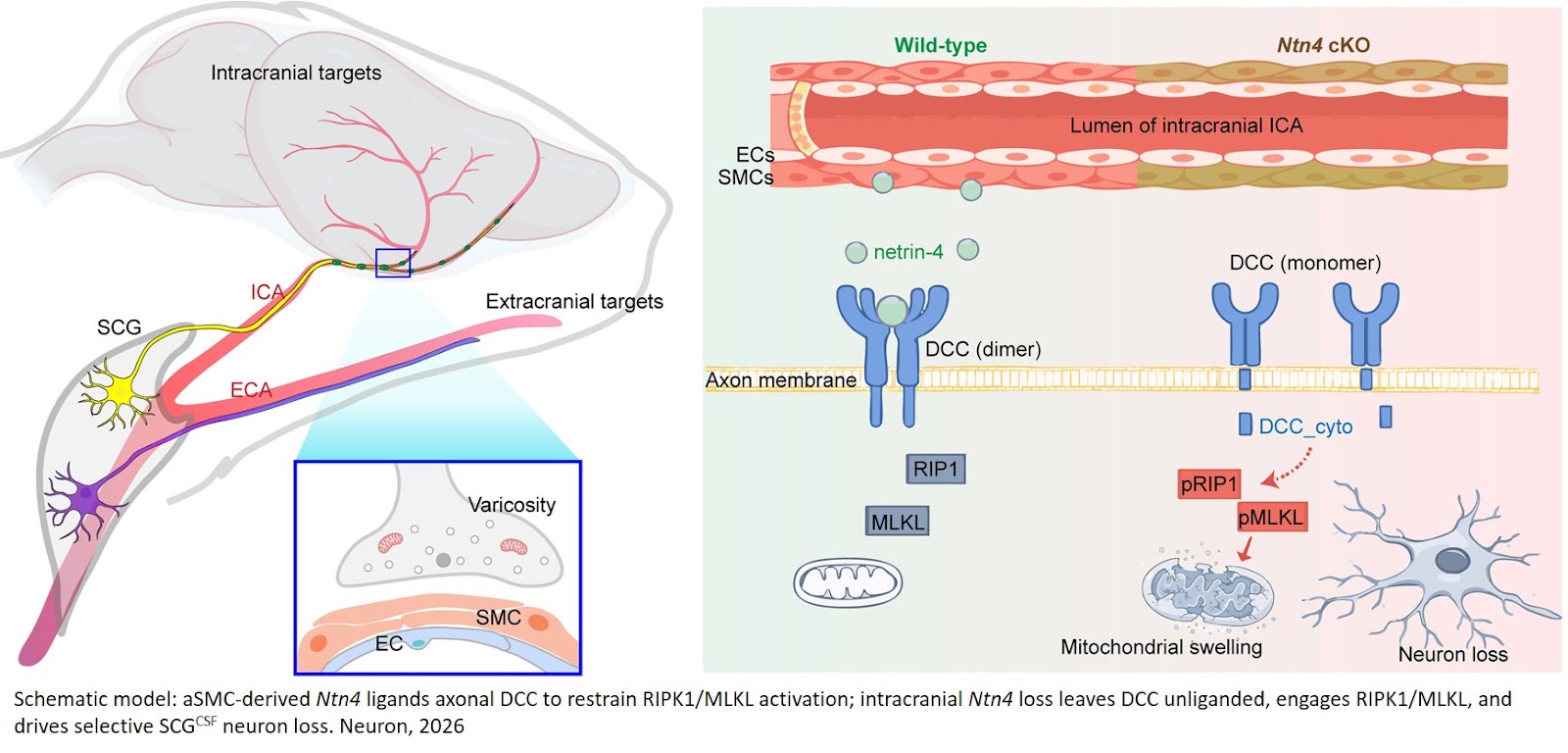
The authors identified a unique anatomical coupling in mice between the peripheral nervous system and the brain's blood supply: They show thatpPostganglionic sympathetic nerve terminals originating in the Superior Cervical Ganglion (SCG) travel up to wrap around major intracranial arteries (such as the internal carotid artery). These terminals form specialized, synapse-like contact zones termed neurosmooth muscular junctions (NsMJs) directly with arterial smooth muscle cells (aSMCs).
Rather than acting purely to contract blood vessels, these aSMCs actively manufacture and secrete Netrin-4 (Ntn4) directly into the junction, which is then internalized by the nerve terminal and retrogradely transported back to the neuronal soma.
By selectively knocking out Ntn4 strictly within adult arterial smooth muscle cells, the team unveiled a highly localized neurodegenerative cascade. The loss of vascular Ntn4 did not kill all sympathetic cells; instead, it selectively targeted the rostral, intracranial-projecting SCG neurons. Deprived of Ntn4, these neurons undergo severe vacuolization and die, resulting in the structural denervation of the brain's arterial plexus.
Netrin-4 acts as a survival brake by binding to the dependence receptor DCC (Deleted in Colorectal Cancer). When Ntn4 is withdrawn, unliganded DCC shifts into a deadly signaling conformation. Instead of initiating traditional apoptosis, unliganded DCC triggers a caspase-independent necroptosis program driven by RIPK1 (receptor-interacting serine/threonine kinase 1) and MLKL (mixed lineage kinase domain-like pseudokinase). Knocking out Dcc or administering RIPK1 inhibitors fully protected the vulnerable adult neurons from death.
The study demonstrated that arterial Ntn4 production naturally declines starting in young adulthood, leading to a spontaneous attrition of intracranial sympathetic neurons by midlife. By engineered overexpressing Ntn4 inside aging aSMCs, or micro-injecting recombinant Ntn4 directly into the SCG, the researchers successfully halted this age-associated neural decay.