





How hunger affects mood
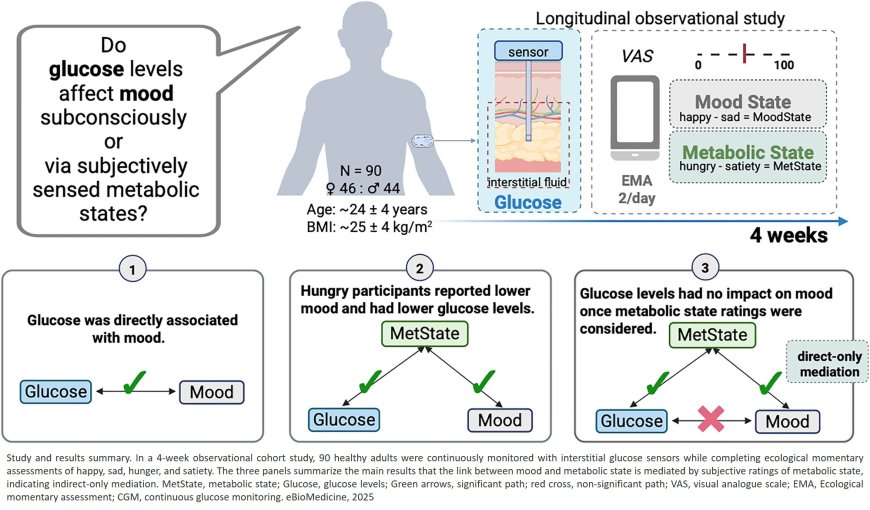
When we are hungry, our mood often drops – a phenomenon colloquially known as “hangry.” A new study now shows that this connection is not caused by unconscious metabolic processes. Rather, the decisive factor is that the lack of energy is consciously perceived as hunger – it is this conscious feeling of hunger that leads to a worse mood. The results have now been published in the journal eBioMedicine.
In the study, the researchers examined how glucose levels, feelings of hunger, and mood influence each other in 90 healthy adults over a period of four weeks. The participants wore continuous glucose monitors (CGM), as used in diabetes care, and regularly answered questions about their current hunger, satiety, and mood (Ecological Momentary Assessment, EMA) via a smartphone app.
“When glucose levels drop, mood also deteriorates. But this effect only occurs because people then feel hungrier,” explains the first author. “In other words, it is not the glucose level itself that raises or lowers mood, but rather how strongly we consciously perceive this lack of energy.”
The study thus provides new evidence for the importance of interoception—the conscious perception of internal bodily states—in the regulation of emotions. People who were particularly sensitive to changes in their glucose levels also showed fewer mood swings.
“Our results suggest that consciously feeling your own body can act as a kind of buffer for your mood,” adds the corresponding author. “A good sense of the body's own signals seems to help maintain emotional stability – even when energy levels fluctuate.”
The researchers also see this as an important basis for future studies in patients with metabolic or mental disorders.
“Many diseases such as depression or obesity are associated with altered metabolic processes,” says the author. “A better understanding of how body perception and mood are related can help improve therapeutic approaches in the long term – for example, through targeted training of interoception or non-invasive stimulation of the vagus nerve, which connects the organs to the brain and influences interoception.”
The results underscore the close connection between metabolic and mental health—and show that conscious perception of one's own body is a central mechanism through which metabolic processes affect mood.
https://www.thelancet.com/journals/ebiom/article/PIIS2352-3964(25)00479-7/fulltext
https://sciencemission.com/Glucose-levels-are-associated-with-mood