

Synaptic potentiation by monomeric CaMKII!
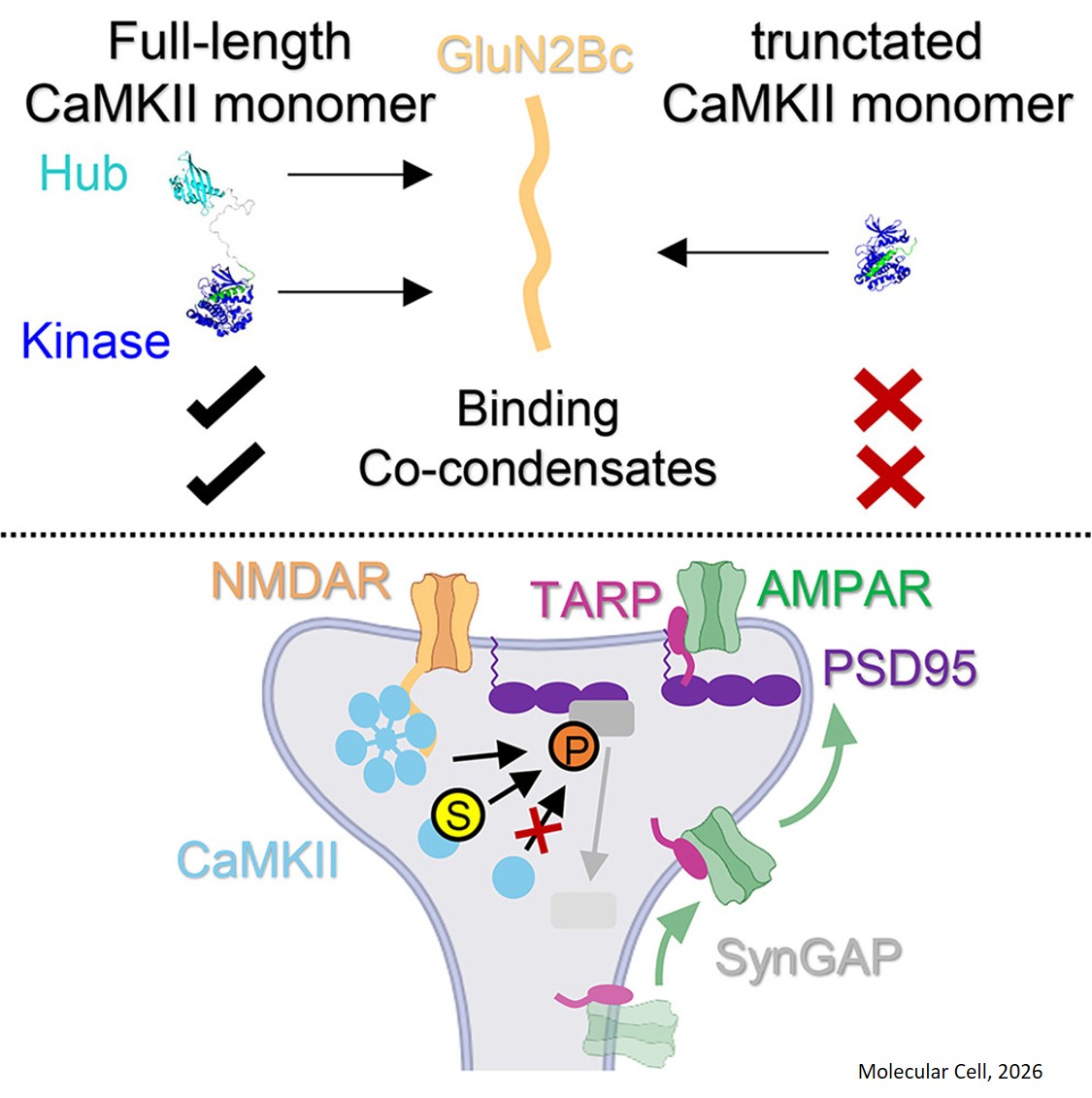
The study upends a long-held dogma in synaptic plasticity. Traditionally, it was believed that the 12-meric holoenzyme structure of Ca2+/CaM-dependent protein kinase II (CaMKII) was absolutely required to bind the NMDA receptor subunit GluN2B, drive liquid-liquid phase separation (co-condensation) at the postsynaptic density, and trigger long-term potentiation (LTP).
This study demonstrates that CaMKII’s large oligomeric structure is not required for GluN2B binding and synaptic potentiation. The authors demonstrate that full-length but not truncated monomers (which completely lack the C-terminal hub domain) bind to GluN2B or form condensates in cellular environments.
The truncated monomers could still induce synaptic potentiation but only after making them artificially autonomous in a phosphatase insensitive manner, which is normally achieved by GluN2B binding. While normal autophosphorylation at Threonine 286 (T286) is easily reversed by intracellular phosphatases, artificially shielding their activity using thio-autophosphorylation allows truncated monomers to potentiate synapses independently of GluN2B.
https://www.cell.com/molecular-cell/fulltext/S1097-2765(26)00618-0