

How does brain listen during human sleep?
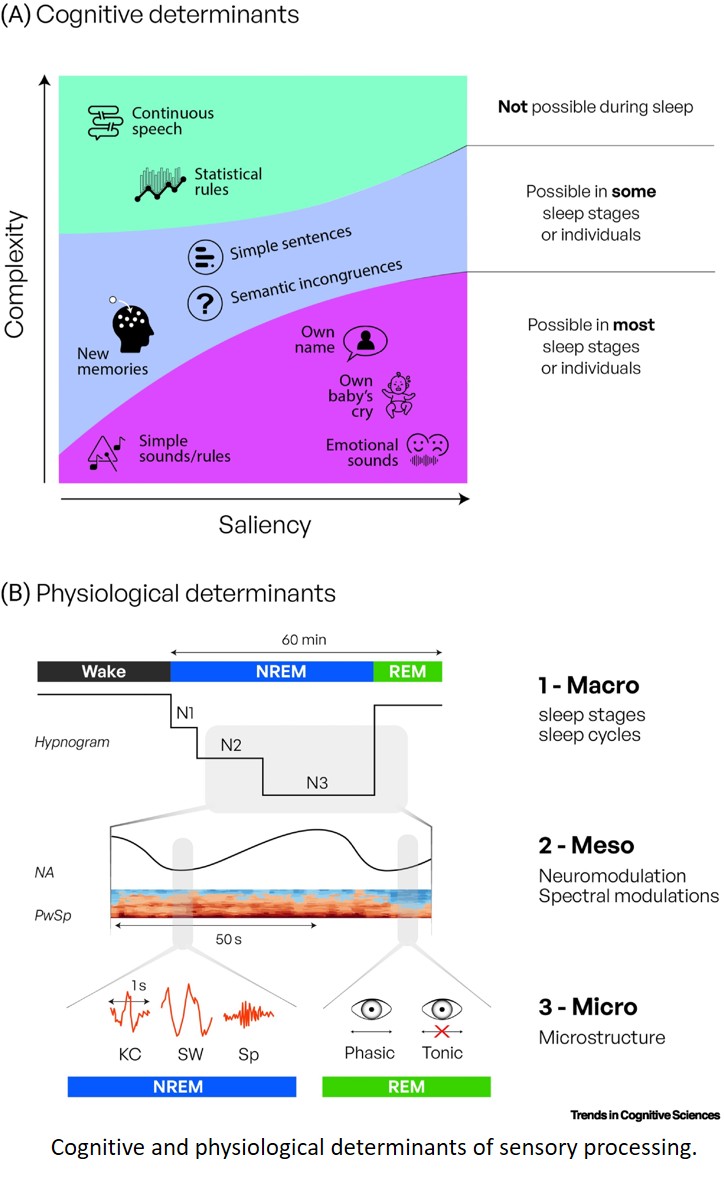
Auditory stimuli can be processed up to semantic level during sleep, modulate subsequent waking cognition, and sometimes trigger behavioral responses, challenging the notion of complete unresponsiveness.
Processing depth varies with stimulus attributes (salience, novelty, and acoustic features) and on the brain’s state at stimulus onset (sleep stage, spectral power, infraslow oscillations, and microevents such as slow waves or spindles).
The authors propose a sensory-coupling continuum: full disconnection favors memory consolidation and restorative functions; high connectivity supports threat detection but can compromise restoration.
The optimal balance likely differs across species, development, and individuals; its dysregulation may underlie sleep disorders (excessive coupling in insomnia, excessive isolation in idiopathic hypersomnia).
https://www.cell.com/trends/cognitive-sciences/fulltext/S1364-6613(26)00214-7
https://sciencemission.com/sound-asleep-yet-still-listening-auditory-processing-during-human-sleep