
How obesity enhances breast cancer risk?
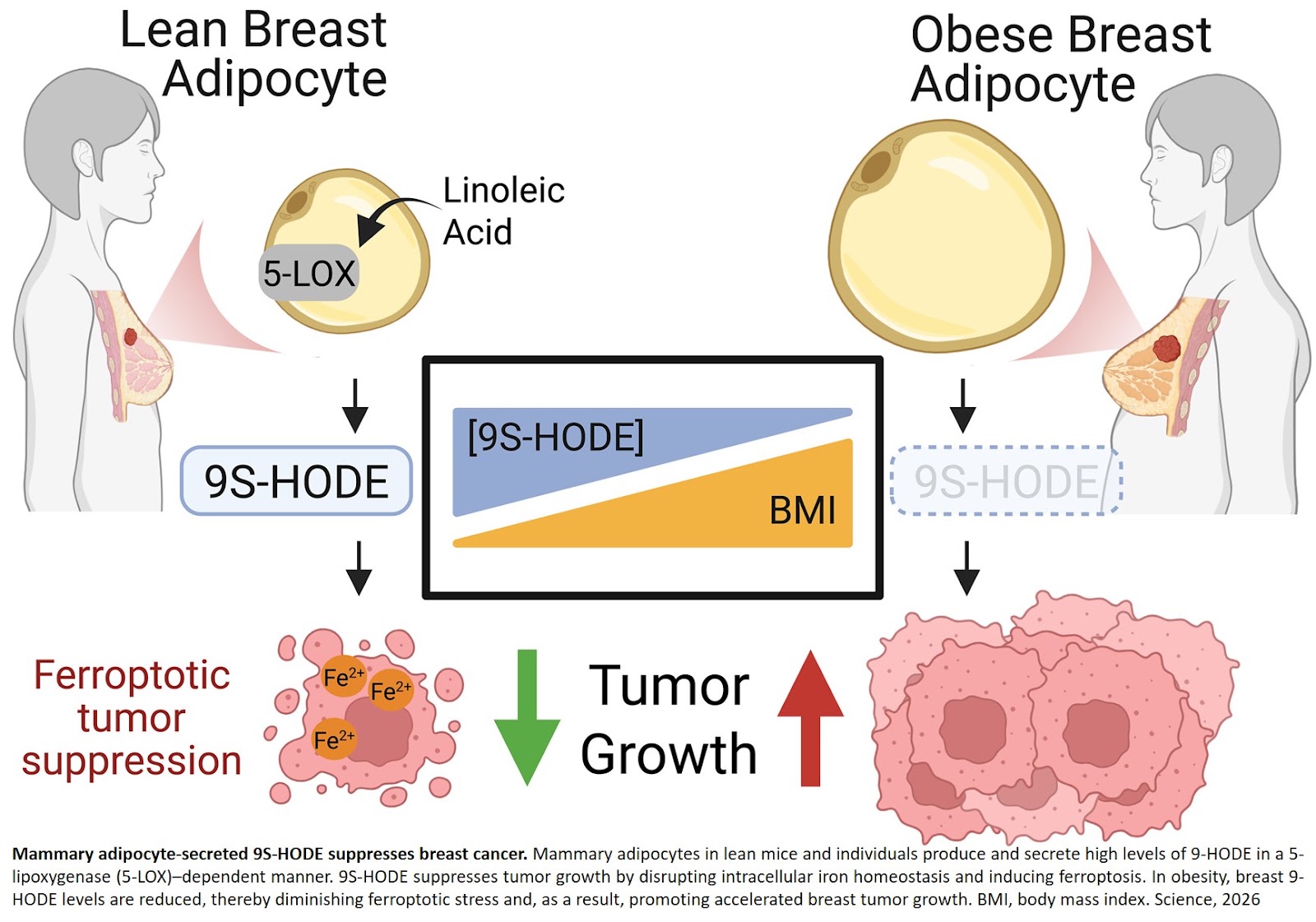
A research team has found that obesity prevents a biological process that kills cancerous cells, revealing a possible reason why obesity is a risk factor for breast cancer.
“We uncovered the role of a molecule that normally appears in lean tissue that restrains breast cancer growth but is less present with obesity,” says the senior author of the study. “We know obesity is often a driver of breast cancer, and researchers in our field usually consider how obesity is promoting the disease. But we hadn’t really considered that obesity could also be the loss of something that naturally protects us.”
Breasts are mostly composed of fat, particularly fat cells called adipocytes. These adipocytes are different depending on a person’s weight and can be lean or obese. In obesity, adipocytes are larger than in their lean counterparts. The senior author also says that the two types of adipocytes generate distinctive microenvironments for cancer cells.
In preclinical models, including breast tissues from donors, the authors found that one of those key differences is the production of a lipid, or fatty acid, known as 9S-HODE.
9S-HODE plays an important role in promoting cell death, particularly a kind of cell death called ferroptosis. This is one way the body purges old and damaged cells, including cells that could be cancerous.
“We found that the lean adipocytes produce much more 9S-HODE than obese ones. This means that cancerous cells die more readily in lean tissue,” says the lead author. “By producing more 9S-HODE, our bodies are actively protecting us, under lean circumstances, in a way it cannot with obesity.”
In their preclinical mouse models, the researchers found that increasing the amount of 9S-HODE in obese adipocytes suppressed breast cancer tumor growth. They believe this new understanding could lead to better therapies.
“From a clinical perspective, this discovery is incredibly empowering. Because 9S-HODE is naturally present in the body but is lost with obesity, we may be able to restore this protection by putting it back,” says the senior author. “That could become a very feasible therapeutic approach to slow breast cancer growth.”
The authors recognize that obesity is just one factor that contributes to breast cancer and that the disease can develop for other reasons. They also say that 9S-HODE seems to be primarily produced by fat cells in the breast, though other fat cells throughout the body may have a similar protective function that will require more research.
“We believe this shift in the understanding of the roles of lean and obese adipocytes is the start of something. This is just one discovery, and it’s not the end of the road,” says the lead author. “This opened our eyes to new ways to think about science, and hopefully we can harness what our bodies are already doing to make progress against this disease.”
https://www.science.org/doi/10.1126/science.aea4287