

APOE allele switching improves Alzheimer’s in mice
Type of apolipoprotein E (APOE) allele carried by individuals is a major risk factor in Alzheimer’s disease (AD). For example, compared to individuals carrying two copies of the APOE ε4 allele, ε2 homozygotes have an approximate 99% reduction in late-onset Alzheimer’s disease (AD) risk.
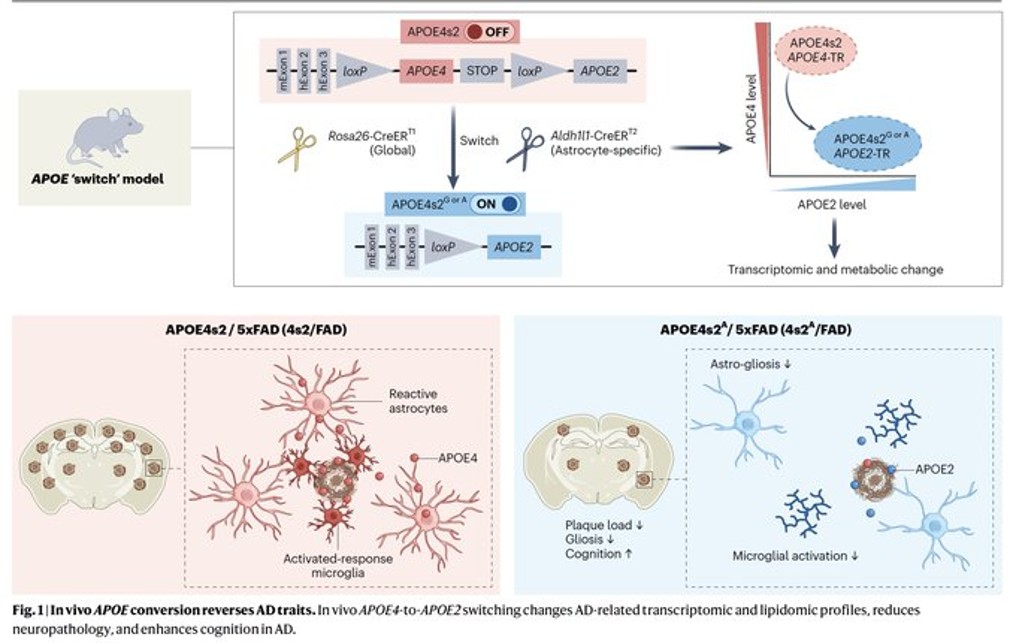
The authors in this study developed a knock-in mouse model that allows for an inducible ‘switch’ between risk and protective alleles (APOE4s2). These mice synthesize E4 at baseline and E2 after tamoxifen administration.
A whole-body allelic switch resulted in a metabolic profile resembling E2/E2 humans and drives AD-relevant alterations in the lipidome and single-cell transcriptome, particularly in astrocytes.
E4 to E2 switching improved cognition, decreased amyloid pathology, lowered gliosis and reduced plaque-associated apolipoprotein E.
Thus, APOE replacement may be a viable strategy for future gene editing approaches to simultaneously reduce multiple AD-associated pathologies.