


Intermittent fasting shows promise in slowing Huntington’s disease progression
A simple change in when people eat may offer a promising new approach for Huntington’s disease, according to a new research.
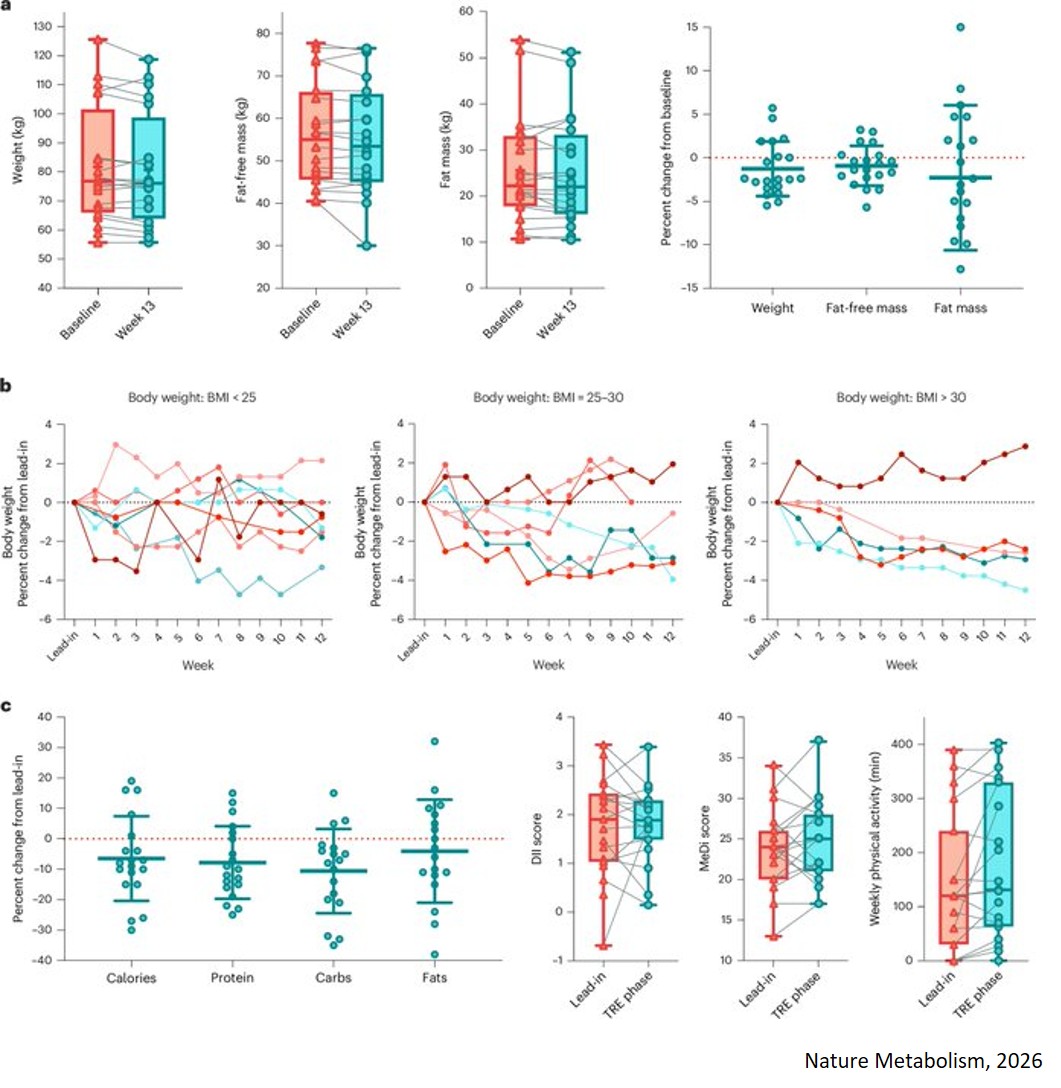
In a 12-week pilot study, researchers found that people with early-stage Huntington’s disease were able to safely follow a form of intermittent fasting known as time-restricted eating, limiting food consumption to a six-to-eight-hour window each day. Participants avoided unintended weight loss and showed improvements in measures of disease severity; in a blood biomarker linked to nerve cell damage; and in cellular energy production.
The findings, published today in Nature Metabolism, represent the first clinical study to test time-restricted eating in people with Huntington’s disease.
“This is the first time this approach has been formally studied in people with Huntington’s disease,” said the lead author of the study. “We found that participants were able to follow the eating schedule, maintain their weight and show encouraging improvements in clinical and biological measures that are important in Huntington’s disease. These results suggest time-restricted eating deserves further study in a larger clinical trial.”
Huntington’s disease is a rare, inherited neurological disease that gradually damages nerve cells responsible for movement, cognitive and emotional regulation.
The condition affects about 41,000 Americans, while more than 200,000 others are at risk because they have a family history of the disease, according to the Huntington’s Disease Society of America. Each child of a parent with Huntington's disease has a 50% chance of inheriting the gene mutation that causes the disorder. Symptoms typically begin between ages 30 and 50 and worsen over 10 to 25 years.
Although researchers have known the genetic cause of the disease for decades, no treatments have been approved that slow or stop its progression.
The idea for the study grew out of earlier research in animal models showing that intermittent fasting can activate cellular pathways that help protect brain cells. Yet researchers were unsure whether the approach would be safe for people with Huntington’s disease because unintended weight loss is already a concern.
The study enrolled 20 adults with early-stage Huntington’s disease. Participants selected an eating window that fit their daily routine, typically between late morning and early evening, and followed it for 12 weeks. Researchers encouraged participants to maintain their normal calorie intake and monitored weight and safety throughout the study.
The approach appeared well-tolerated. Participants followed the eating schedule on average more than five days per week; reported few side effects; and maintained both body weight and lean muscle mass. Most adapted to the schedule within the first one to two weeks.
Participants used a smartphone app to document their first meal of the day with a photo and timestamp.
Researchers found encouraging signals that the dietary intervention could influence disease progression.
Participants experienced an average improvement of 0.5 points on a widely used Huntington’s disease severity scale known as the composite Unified Huntington’s Disease Rating Scale, or cUHDRS. The score typically declines by about one point annually in people with early-stage disease.
In addition, blood levels of neurofilament light, a biomarker released when nerve cells are damaged, fell by an average of 13%. In Huntington’s disease, those levels usually increase over time as the disease progresses.
“We saw a reversal of the trend we would normally expect,” the author said. “Neurofilament light typically rises as neurodegeneration continues, but after three months we observed a significant decrease. For a pilot study, that was a remarkable finding.”
The research team also examined mitochondrial function in participants’ blood cells. Mitochondria generate energy for cells, and impaired energy production is a hallmark of Huntington’s disease.
Researchers found improvements in several measures of mitochondrial activity after the intervention.
“One theory is that fasting acts as a mild stressor that prompts cells to become more efficient,” the author said. “If cells, including brain cells, become better at producing energy and handling stress, they may be more resilient to the disease process.”
Because the study was small and did not include a comparison group, researchers caution that the findings should not be considered proof that time-restricted eating slows Huntington’s disease. Larger, randomized controlled trials will be needed to determine whether the benefits are real and sustained over time.
Still, researchers say the results are especially promising because the intervention is relatively simple and could be accessible to many people.
“We do not currently have any disease-modifying treatments for Huntington’s disease,” the author said. “If future studies confirm these findings, this could become an approach available to people regardless of where they live or their financial resources. That makes it particularly exciting.”
The team is currently pursuing funding for a larger, randomized clinical trial that would compare time-restricted eating with standard dietary habits.