

Re-evaluation of Genotype-Phenotype Correlations in D-Bifunctional Protein Deficiency in a Phenotypically Diverse Cohort of 27 Natural History Study Participants
Annual Clinical Genetics Meeting, March 2026
Nancy E. Braverman, MD, MGC, FACMG, Professor, McGill University, Roan Blakeley, Roan Blakeley, Hongda Li, MDCM, Mahmoud Moustafa, MDCM, Evren Gumus, MD, Hermine Djimoudi, MSc, Evelyn Zavacky, MSc, Christine Yergeau, MSc, Yasmin D'Souza, PhD, MGC
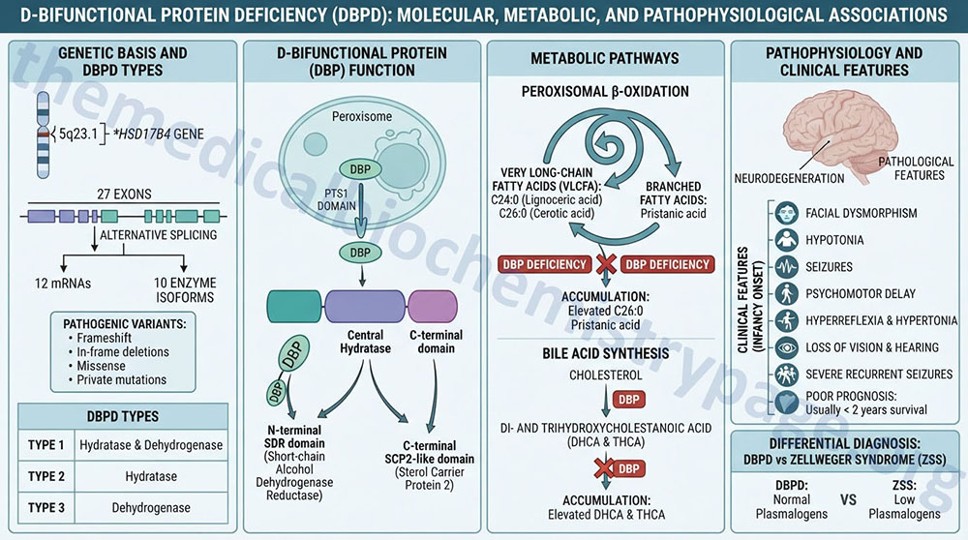
Introduction: D-bifunctional protein deficiency (DBPD, OMIM#261515) is an autosomal recessive peroxisomal disorder caused by pathogenic variants in the HSD17β4 gene (HGNC:5213), which encode the D-bifunctional protein (DBP). DBP catalyzes steps 2 and 3 of peroxisomal β-oxidation of very long-chain (VLCFAs) and branched-chain fatty acids (BCFAs) through its hydratase (H2) and dehydrogenase (DH) subunits, respectively. DBPD causes accumulation of these fatty acids and a multi-system disorder. Severe forms typically present clinically in the neonate with profound hypotonia, intractable seizures, failure to meet milestones, and lifespan of under two years. Moderate forms can overlap the severe phenotype, but live longer. Milder forms present later, with various neurocognitive abnormalities, vision and hearing loss, and variable lifespans. Disease severity has also been related to the effect of the variants on the DH or H2 subunits, and categorized into four subtypes. However, phenotypic variability remains within these categories, and it is unclear how well these categories hold up in clinical practice. To improve prognostic accuracy of this model, we combined clinical data from our participant cohort with structural modeling of their missense variants and propose an expanded genotype–phenotype correlation.
Methods: We extracted medical data from 27 (24 unrelated) participants with a genetic diagnosis of DBPD enrolled in our Natural History Study on Peroxisome Disorders (ClinicalTrials.gov Identifier: NCT01668186). Data was reviewed by affected systems (neurology, audiology, ophthalmology, gastroenterology, psychomotor development, VLCFA levels, and when available, DBP residual enzyme activity). Missense variants were mapped on UCSF ChimeraX using AlphaFold predictions and the human crystal structure for each DBP enzyme subunit and the sterol carrier domain (PDB #1BZQ (DH), #1S9C (H2), and #6Z1W (SCP-2L)). We classified the variants as “major” or “minor” disruptors based on their effects on hydrophobicity, steric clashes, interactions, dimerization, catalytic activity and overall protein structure
Results: Severe cases (n=9) had neonatal seizures, hypotonia and early onset of vision and hearing loss (6 had polymicrogyria (PM)). Lifespans were 0 to 3 years. The moderate cohort (n=14) also had neonatal seizures and hypotonia (but without evident PM), typically could be weaned from anticonvulsants, and some reached early milestones (i.e. holding up head, nonverbal communication, assisted standing). The milder cohort (n=4) manifested in childhood, had normal or moderate cognitive disability, and progressive cerebellar atrophy. VLCFA and enzymatic activity levels were correlated with severity. We used structural analysis to evaluate 17 unique missense variants (13 in the DH subunit, 4 in the H2 unit), of which 5 were novel. Results showed:
- Two major disruptors in either the DH or H2 subunit causes a severe (n=8) or severe-moderate-borderline phenotype (n=1)
- A major disruptor and a minor disruptor in either the DH or H2 subunit primarily causes a moderate phenotype (n=8), but can also cause a severe (n=1) or mild phenotype (n=1)
- Two minor disruptors in the either the DH or H2 subunit causes a moderate phenotype (n=5)
- A minor disruptor in the DH in trans with a minor disruptor in the H2 subunit causes a milder phenotype (n=3)
Conclusion: We propose a model in which phenotypic severity in DBPD is associated with variant location, major or minor disruption of the modeled DBP protein, VLCFA levels, and enzymatic activity. This model indicates that there is more variation within DBPD subtypes than previously proposed. Our findings further elucidate genotype-phenotype correlation in DBPD and improve description of the evolving DBPD clinical spectrum, especially in regards to individuals in the moderate category. This will help better inform care management and provide knowledge of the molecular pathology of DBPD that is valuable for the development of targeted therapy.