

Rapid reactivation of gene expression after thermal stress
Researchers find that CLK1 is dephosphorylated by PP1 and rephosphorylated by RIOK2 to regulate its localization to nuclear stress bodies during thermal stress and recovery
If you want to beat the heat of the summer sun, slowing down and doing less is a good strategy. However, researchers have long asked whether the same occurs at the cellular level. While the stress responses of cells have been repeatedly studied, the impact of the environment on these responses remains relatively unknown.
Now, researchers from Japan report an elegant mechanism by which cells shut down certain nonessential functions when they get too hot. In a study recently published in Molecular Cell, researchers have revealed how nuclear stress bodies sense temperature to regulate survival during and recovery from thermal stress.
When cells are stressed by environmental conditions, they change how their genes are expressed to protect themselves and conserve resources. For example, in response to high heat, cells modulate pre-mRNA splicing, a key step in producing functional proteins; but when temperatures cool down again, this process needs to be restored to its normal levels.
“Nuclear stress bodies are membrane-free organelles that regulate the splicing of more than 400 pre-mRNAs during recovery from thermal stress,” says lead author. “However, it remains unclear how these bodies recruit key regulators in response to changing temperatures.”
To explore this, the researchers focused on the CLK1 protein, which is known to associate with nuclear stress bodies during recovery from heat stress. Using both cells and cell-free systems, they investigated the interactions of CLK1 with other proteins at different temperatures.
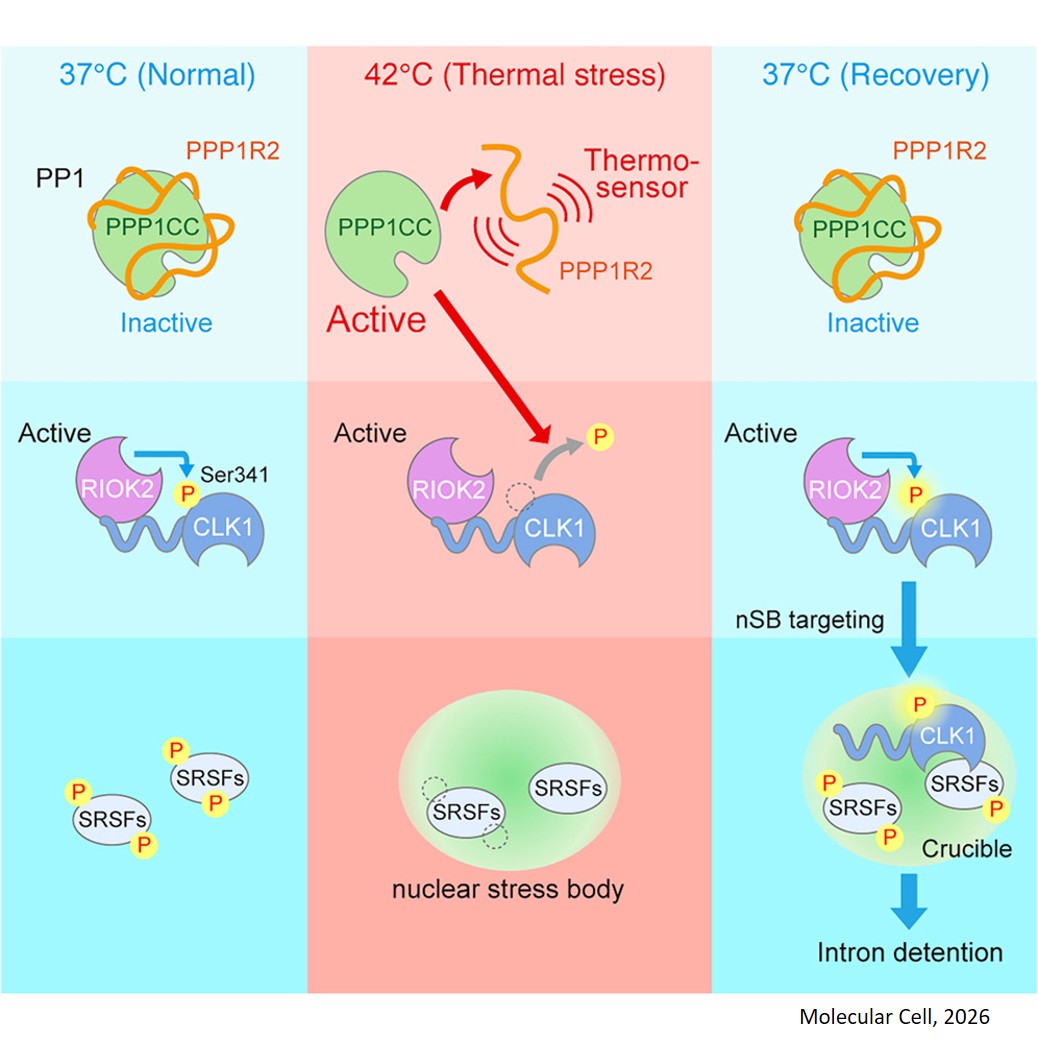
“The results revealed a simple and elegant regulatory system,” explains the senior author. “CLK1 is phosphorylated at a specific serine residue under normal conditions, dephosphorylated during heat stress, and rephosphorylated during recovery; these changes control whether CLK1 is excluded from or recruited to nuclear stress bodies.”
Dephosphorylation of CLK1 is carried out by the PP1 protein, while CLK1 rephosphorylation is performed by RIOK2, ensuring that CLK1 joins nuclear stress bodies to activate splicing only during recovery. PPP1R2, an intrinsically disordered subunit of PP1, acts as a reversible thermosensor to activate PP1 when cells are stressed.
“Our findings show that a multi-component heat-sensing mechanism coordinates CLK1 localization to nuclear stress bodies to coordinate temperature-dependent pre-mRNA splicing,” says the author.
This observation demonstrates how heat stress induces spatial coordination of opposing enzymatic activities to enable rapid and reversible control of pre-mRNA splicing in response to changing environmental conditions. The new insight could be useful for investigating the mechanisms of stress-related diseases.
https://www.cell.com/molecular-cell/fulltext/S1097-2765(26)00423-5