



Prevalence and Tumor Characteristics of Patients with TMEM127 Pathogenic Variants in a Large, Pan-Cancer Cohort
Annual Clinical Genetics Meeting, March 2026
Eva Vailionis, Genetic Counselor, Eva Vailionis, Elise Fiala, MS, CGC, Ciyu Yang, PhD, David Lin, MSc, Anita Bowman, MS, Diana Mandelker, MD, PhD, Yelena Kemel, MS, Mohammad A. Abbass, MD, MPH, Lauren Banaszak, MD, Jada G. Hamilton, PhD, MPH, Chimene Kesserwan, MD, Alicia J. Latham, MS, MD, Ying Liu, MD, Yonina R. Murciano-Goroff, MD, MSc, MS, DPhil, Kenneth Offit, MD, Mark Robson, MD, Robert Sidlow, MD, MBA, Zsofia Stadler, MD, Maria Carlo, MD
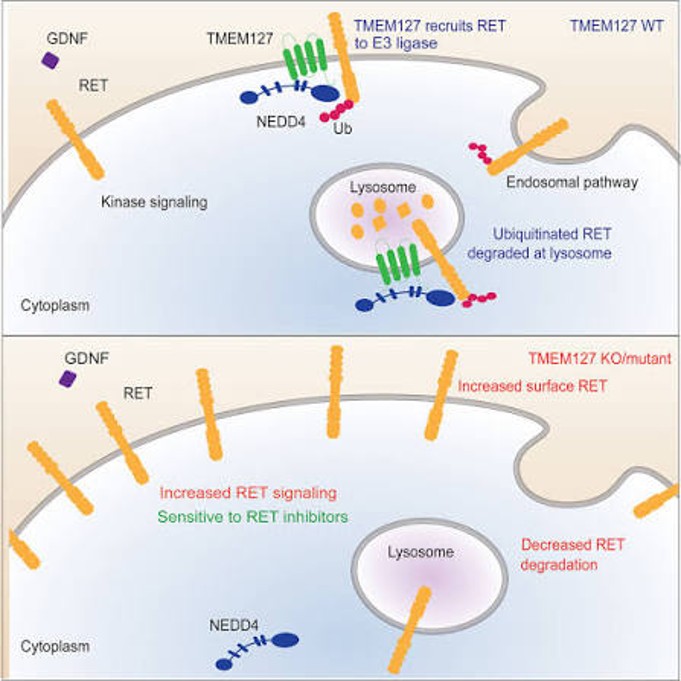
Introduction: Germline pathogenic/likely pathogenic (P/LP) variants in the transmembrane protein 127 (TMEM127) gene are a rare cause of autosomal dominant hereditary paraganglioma (PGL), accounting for approximately 5% of familial PGL syndromes. It is primarily associated with pheochromocytoma (PCC) rather than extra-adrenal PGLs, making it distinct from other PGL/PCC predisposition genes. More common genes that predispose to PGL and PCC are the succinate dehydrogenase complex genes, including, in order of prevalence, SDHB, SDHD, SDHC, and SDHA. Studies of SDHA have demonstrated its reduced penetrance compared to other hereditary causes of PGL/PCC syndrome.
Recent studies have suggested TMEM127 may behave similarly to SDHA with respect to lower penetrance for PGL/PCC; however, data are limited. We sought to describe the prevalence of TMEM127 P/LP variants in a large, pan-cancer cohort and characterize the tumor profile of patients with these variants.
Methods: We queried an institutional database of patients consented to germline genetic testing under MSK-IMPACT, a paired tumor/normal next-generation sequencing platform, from 1/2015 – 10/2025 to identify individuals with germline TMEM127 P/LP variants. Clinical and tumor data were abstracted for tumor type, somatic TMEM127 loss of heterozygosity (LOH), and family history.
Results: Of 50,947 patients who underwent germline genetic testing, including 59 patients with PGL/PCC, we identified 9 patients with germline TMEM127 P/LP variants. Three (33%) were female and 6 (67%) were male. The median age at cancer diagnosis was 51 years (range 12-72 years). Tumor types included: colon adenocarcinoma (n = 2); Ewing sarcoma (n = 2); neuroendocrine tumor of the stomach (n = 1); pancreatic adenocarcinoma (n = 1); epithelioid-type pleural mesothelioma (n = 1); non-small cell lung cancer (n = 1); and vaginal squamous cell carcinoma (n = 1). One patient had a history of multiple primary cancers; the patient diagnosed with non-small cell lung cancer also had a history of testicular cancer, basal cell carcinoma, and melanoma.
Among the 9 TMEM127 P/LP variant carriers, no patients with PGL/PCC were identified. LOH data were available for all 9 tumors. One tumor demonstrated TMEM127 LOH, a neuroendocrine tumor of the stomach diagnosed in a 40-year-old male. However, this represented loss of the mutant TMEM127 allele, rather than loss of the wild-type allele. This pattern suggests that the germline TMEM127 variant in this case was unlikely to be a driver of tumor development. The 8 remaining tumors demonstrated retention of heterozygosity for TMEM127.
Six patients had formal genetic counseling sessions where a 3-generation pedigree was collected. For the remaining 3 patients, available family history was ascertained from chart review. For all 9 patients, there was no reported family history of PGL/PCC.
Conclusion: Current research regarding the role of TMEM127 in hereditary cancer predisposition focuses on its prevalence in cohorts of patients with the expected PGL/PCC tumor types. In this study, we describe a large, pan-cancer patient population and note the overall rarity of TMEM127 P/LP variants in this cohort. These data also suggest a reduced penetrance of TMEM127 for PGL/PCC, given the lack of personal or family history of these tumors in TMEM127 P/LP variant carriers. No tumors in the identified patients demonstrated meaningful LOH to indicate that the germline TMEM127 P/LP variant drove tumorigenesis. Nonetheless, the study is limited by the low number of PGL/PCC in the cohort, which contributes to the rarity of TMEM127 P/LP variants. Despite these limitations, our data suggest that TMEM127 may behave like SDHA in the hereditary PGL/PCC spectrum and therefore its risk for tumor development may be lower than that of other hereditary PGL/PCC genes.