

A molecular linchpin for muscle health identified!
The researchers have published new findings about how muscles form, why certain muscle diseases develop and why symptoms may not appear until years after muscle degeneration begins.
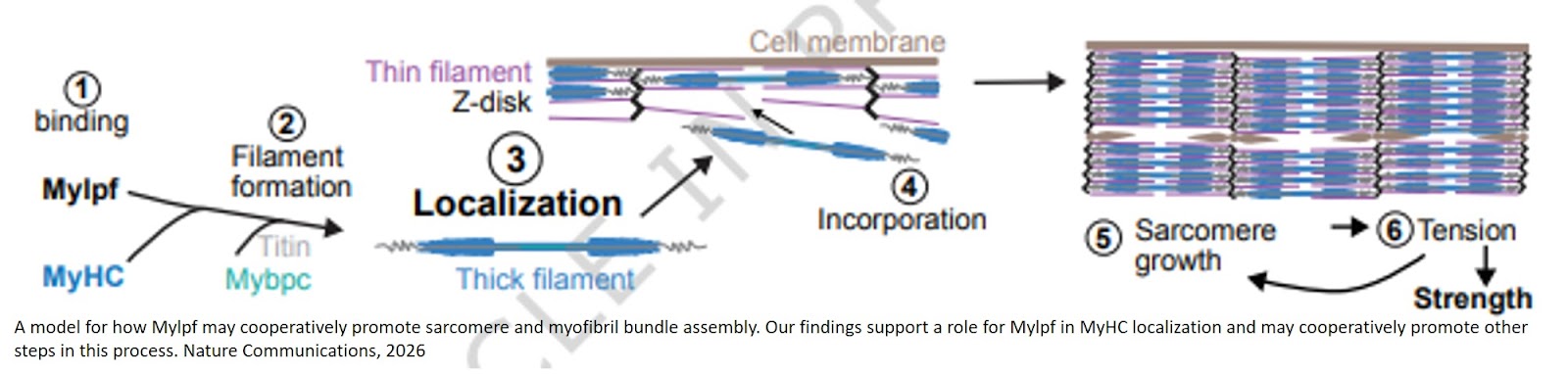
The study, published in Nature Communications, focuses on a protein called Mylpf that is essential for the development of fast-twitch muscle fibers, which propel rapid, powerful movements like sprinting and lifting heavy weights. When Mylpf does not form correctly, muscles completely lose their ability to contract.
“Mylpf is sort of the linchpin that makes the whole muscle fiber work,” said the principal investigator.
Using zebrafish as a model organism, the team measured how Mylpf protein levels corresponded to muscle development, revealing a surprisingly sensitive relationship between protein levels and muscle health.
When Mylpf function was eliminated, fast-twitch muscles failed to build the structures they needed to contract or generate force. Crucially, the severity of this defect tracked closely with how much protein was present: animals with moderately reduced Mylpf had moderately impaired muscles, while those with none had no functional fast-twitch muscle at all. By testing many combinations of gene doses in a single study, the team was able to model the protein's effects with unusual mathematical rigor.
The researchers also found that a human version of the Mylpf gene could fully restore normal muscle development in mutant fish, suggesting the protein plays a similar fundamental role across bony vertebrates, including humans.
"That finding tells us this isn't just a zebrafish story. Most of what we know about ourselves are insights drawn from other creatures,” the author said. “This study helps us learn the rules of how the muscle builds itself. Once you know those rules, it is far easier to develop drug treatments that could help people with muscle disorders.”
The team then tested a version of the gene linked to Distal Arthrogryposis, a congenital disorder characterized by joint contractures and muscle weakness. Unlike the normal human gene, this disease-associated version could not restore muscle development in the zebrafish model. People with Distal Arthrogryposis typically carry only one defective copy of the gene; the other copy is normal, yet they still develop the disease. Together, these findings suggest that even a partial reduction in Mylpf function is enough to hinder muscle formation and cause the disorder.
One of the study's most significant findings concerns how the body compensates for muscle loss, and what that may mean for understanding delayed disease onset. When fast-twitch muscles failed to form properly, slow-twitch muscles — normally a minor player in zebrafish movement — grew larger and became more active. This allowed the mutant fish to travel just as far as their healthy relatives in some tests.
The researchers believe this compensatory mechanism may help explain why patients with diseases like muscular dystrophy can appear healthy for years, even as muscle degeneration is already underway. When one muscle system compensates for another, the damage may go unnoticed until the reserve is exhausted.
https://www.nature.com/articles/s41467-026-73861-z
https://sciencemission.com/Myosin-light-chain