



Defining the degradability capability of protein degraders
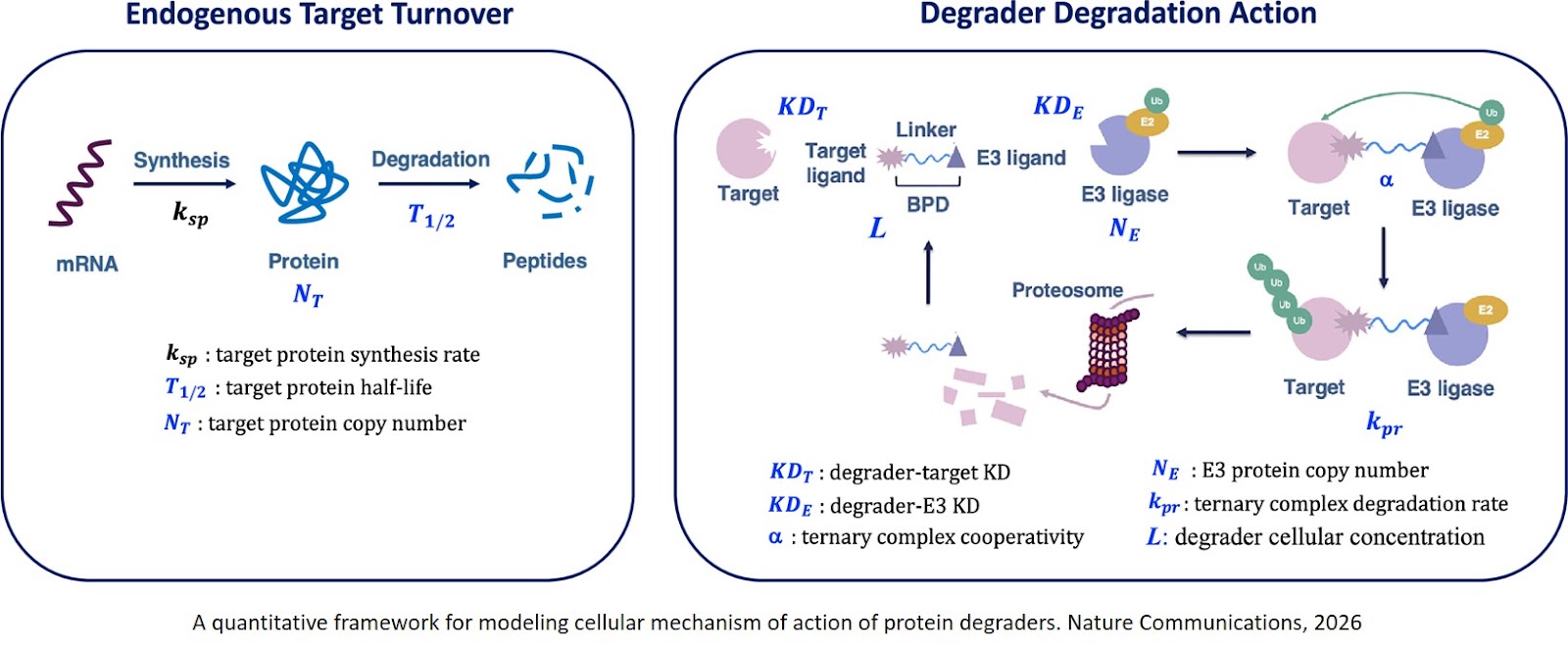
A research team has developed a computer model that will help scientists more efficiently develop protein-destroying therapies, a newer type of treatment that is particularly promising for cancer. The study was published in Nature Communications.
Most drugs use a small molecule to render disease-causing proteins harmless, but protein-degrader therapies aim to destroy the target protein altogether. Eliminating proteins, for example, those with cancer-causing mutations, or proteins produced in harmful excess quantities may offer advantages over disabling a protein. The new model could potentially shave years off the process of developing a new protein degrader therapy.
“Targeted protein degradation leverages the machinery that already exists in your cells to eliminate unwanted proteins and redirects it to target a disease-causing protein,” said the senior author . “We developed a framework for determining how to most effectively design a degrader that would destroy the target protein.”
Protein degraders work by binding to the target protein and to the cellular protein degradation machinery, using a linking molecule to hold the two together. Until now, the process of developing protein degraders relied on repeated trial and error to determine what works, a time- and resource-intensive process. But the lead author developed a mathematical model to streamline the process. It allows scientists to identify proteins that would make good targets for a degrader, and map the most cost-effective route for degrader optimization. The senior author explained that the model uses easily obtained laboratory measurements and allows scientists to observe how the degrader would function in a computer model of a cell.
“We showed that for protein targets with slow turnover, even relatively weak degrader binding affinity can result in potent degradation,” the author said. “We also generated a list of potential targets with high value for degrader development.”
Protein degraders could be a particularly useful tool to eliminate proteins with cancer-causing mutations, the senior author noted. For example, a protein that has 200 copies in a normal cell may suddenly have 2,000 due to a cancer-linked mutation. In that case, it is not enough to turn off the protein; it may need to be eliminated or least reduce the excess protein to normal level to prevent damage to organs and tissues caused by excess protein build up.
The author noted that for many diseases as diverse treatment modalities become available, including gene and mRNA therapies, protein degraders and antibody drug conjugates, it will be important for scientists and clinicians to have mathematical modeling tools that can help them select the best approach for a patient.
The team has previously published a study describing a model that helps predict the safety of degraders or other drugs before they are tested in clinical trials. They hope to continue working on methods to make the design and testing of therapies more efficient, helping advance precision, personalized therapies that target the multiple specific mutations causing an individual patient’s cancer.
“This is one step toward our goal, which is not to design a drug that is supposed to work for a million patients or a thousand patients, but to design one that is customized to one unique patient,” the senior author said.
https://www.nature.com/articles/s41467-026-75591-8
https://sciencemission.com/degradability-landscape-of-protein-degraders