


Growth Outcomes and Safety of Navepegritide in Children with Achondroplasia: Results of the ApproaCH Trial Open Label Extension
Annual Clinical Genetics Meeting, March 2026
Ravi Savarirayan, Murdoch Children’s Research Institute, Parkville, Australia, Carlos A. Bacino, MD, FACMG, Ciara M. McDonnell, MD, FRCPI, Hanne Hove, MD, DMSc, Philippe M. Campeau, MD, Paul L. Hofman, MbChB, Dip Obs, FRACP, Janet M. Legare, MD, Daniel Hoernschemeyer, MD, Josep Maria de Bergua Domingo, MD, M. Jennifer Abuzzahab, MD, FAAP, Bart Degreve, PhD, Lærke Clement Freiberg, MD, Helle Hartvig, MS, Michael S. Ominsky, MS, PhD, Allison S. Komirenko, PharmD, Aimee D. Shu, Ravi Savarirayan
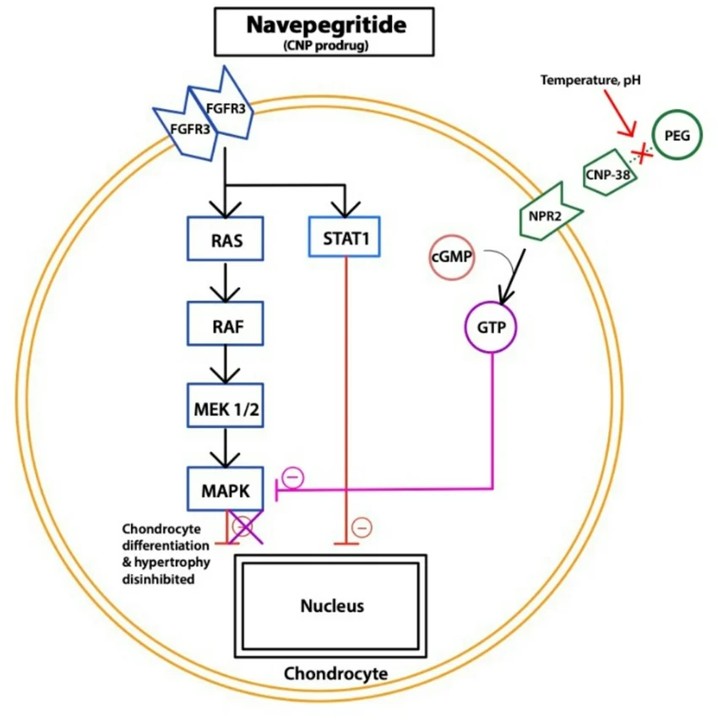
Introduction: In children with achondroplasia, constitutive activation of fibroblast growth factor receptor 3 (FGFR3), which is found throughout the body, results in skeletal dysplasia, disproportionate short stature, and other serious medical complications which can negatively impact quality of life. Navepegritide is an investigational prodrug of C-type natriuretic peptide (CNP) administered once-weekly by subcutaneous injection and designed to provide sustained release and continuous exposure of active CNP to counteract the constitutively active FGFR3. Here we report growth and safety outcomes at Week 104 from the ApproaCH trial.
Methods: ApproaCH was a pivotal, randomized, double-blind, placebo-controlled trial; the 52-week double-blind (DB) period was followed by a 52-week open-label extension (OLE) period through Week 104. Eligible participants (children aged 2-11 years with achondroplasia, N=84) were randomized 2:1 to treatment with once-weekly navepegritide (100 µg/kg/week; n=57) or placebo (n=27) for 52 weeks; all participants were treated with once-weekly navepegritide in the OLE. The primary endpoint was annualized growth velocity (AGV) at 52 weeks. Secondary endpoints included changes in achondroplasia-specific and CDC-based height Z-scores. Safety and tolerability assessments included treatment-emergent adverse events (AEs), including hypotension and injection site reactions (ISRs), and bone age.
Results: Previously reported results from the DB period demonstrated superiority of navepegritide over placebo for the primary endpoint of AGV at 52 weeks (LS mean difference 1.49 cm/year, p<0.0001). All children who completed the DB period continued to the OLE (navepegritide/navepegritide group, n=55; placebo/navepegritide group, n=27); 53 children in the navepegritide/navepegritide group and 27 children in the placebo/navepegritide group completed the trial. In the navepegritide/navepegritide group, observed mean AGV increased from baseline in the DB period and was maintained from Week 52 (5.95 cm/year) through Week 104 (5.65 cm/year). Similarly, the initial 52 weeks of treatment with navepegritide in the OLE resulted in increased mean AGV in the placebo/navepegritide group at Week 104 (5.42 cm/year).
Children treated with navepegritide in the DB period showed greater improvement in achondroplasia-specific height Z-score compared with children receiving placebo. At Week 104 achondroplasia-specific height Z-score was increased in both groups (mean change from Week 52 was equal to 0.27 for the navepegritide/navepegritide group, and 0.28 for the placebo/navepegritide group). The mean change in CDC-based height Z-score from Week 52 to Week 104 was 0.28 for each group. In the OLE, both groups exhibited numeric improvement in upper-to-lower body segment ratio, indicating lengthened lower versus upper body segment and promotion of proportional growth.
The AE profile in the OLE was similar to the DB period, with the majority of AEs graded mild or moderate. There were no treatment-related serious AEs, no deaths, and no AEs that led to treatment discontinuation or withdrawal from the trial. ISRs occurred in 7 children in the OLE, and all were mild, for an overall rate of 0.31 events per person year of exposure. No participants experienced symptomatic hypotension through Week 104 of the trial. Mean bone age remained slightly below chronological age at Week 104 in both groups, indicating bone maturation did not accelerate with navepegritide treatment.
Conclusion: During the OLE of the ApproaCH trial, children continuing treatment with once-weekly navepegritide maintained increased AGV through 104 weeks. Children who switched from placebo to navepegritide at Week 52 demonstrated increased AGV at Week 104, similar to children who were treated with navepegritide in the DB period. The improvements in achondroplasia-specific and CDC-based height Z-scores in the OLE were consistent with improvements observed with navepegritide in the DB period. Navepegritide was generally well-tolerated through up to 2 years of treatment.