

Role of Vitamin B12 in spliceosomopathy
Splicing is the process by which messenger RNA is further processed before it is used to build proteins. During this process, unnecessary sections are removed and the remaining sections are correctly assembled. Disruption to this process can have far-reaching consequences for the cell, and changes to the genes involved in splicing can cause rare developmental disorders in humans, such as Verheij syndrome. Children affected by this syndrome exhibit developmental delays, growth disorders and short stature.
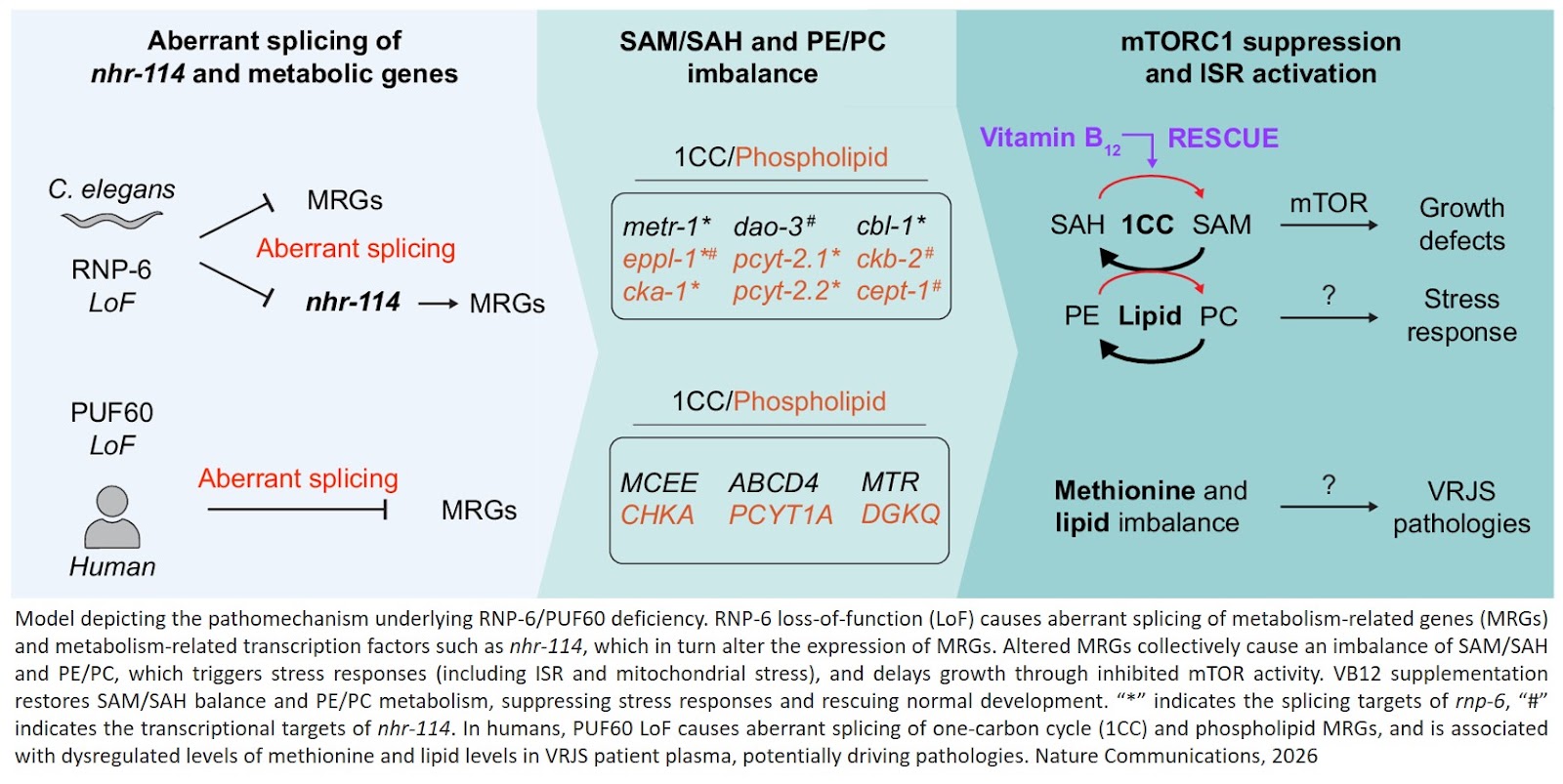
The study began with experiments in the nematode C. elegans aimed at identifying novel genes that influence lifespan. In the course of this work, the researchers focused on a mutation in a gene that plays an important role in splicing (splicing factor PUF60) and is linked to Verheij syndrome in humans. Worms carrying this mutation showed characteristics that reflect key features of the disease: they grew more slowly and remained smaller.
Genetic screens and metabolic analyses revealed that metabolic pathways in the mutated worms were altered. The researchers demonstrate that RNP-6/PUF60 deficiency disrupts splicing of genes governing one-carbon metabolism and phospholipid remodeling, impairing S-adenosylmethionine/S-adenosylhomocysteine cycling and phosphatidylcholine synthesis. These pathways rely on vitamin B12 and are important for growth and cell function. Administering vitamin B12 normalised these key metabolic processes and corrected the Verheij-like developmental defects in the mutated worms. Vitamin B12 supplementation restores metabolic balance by reactivating S-adenosylmethionine-dependent phospholipid remodeling and mTORC1 activity, effectively rescuing Verheij-like phenotypes. Similar responses arise from perturbing another splicing factor, PRP-19.
“We were surprised to find that a change in a fundamental process of RNA processing had such a targeted effect on vitamin B12-dependent metabolism,” says the first author of the study. “Even more exciting was that we were able to largely correct the consequences of this change in the worm model using vitamin B12.”
The researchers also found evidence of related metabolic changes in human data. To this end, the team analysed publicly available data from human cells and obtain blood samples from patients with Verheij syndrome. The results suggest that the metabolic pathways identified in the worm model may also be relevant in humans.
Future studies will need to determine whether vitamin B12 can also help patients with Verheij syndrome. However, the results suggest that metabolic changes may play a more significant role in disorders involving splicing defects than previously thought. The study could therefore provide new avenues for research into potential therapies beyond Verheij syndrome.
“Our study is a good example of how basic research on model organisms can provide new insights into human diseases,” says the lead author of the study. “A fundamental biological question can thus give rise to a new approach that could also become medically relevant in the long term.”
https://www.nature.com/articles/s41467-026-76295-9
https://sciencemission.com/Vitamin-B12-alleviates-spliceosomopathy