

How bacteria use circadian clocks to colonize
Research has revealed how bacteria rely on circadian clocks to control the spread of their multi-cellular colonies.
The findings provide important clues as to how we might improve soil health and plant growth. They may also help to explain how some bacteria spread hospital-acquired infections.
Researchers made the discovery while studying the widespread soil bacterium Bacillus subtilis.
Circadian clocks, or circadian rhythms, align biological processes with the 24-hour solar cycle of life on earth. The circadian clock regulates much of our physiology and behaviour, for instance determining if we sleep earlier or later than others.
The European consortium discovered that circadian clocks exist in B. subtilis, which is one of the first examples of these cellular timepieces being found in a non-photosynthetic bacterium. Labs in the USA and Argentina discovered clocks in bacteria that associate with humans, indicating that circadian clocks are found broadly in this ancient and diverse class of organisms.
Despite these breakthroughs, little was known about how the circadian clock worked to organise colonies of bacteria.
In research appearing in Nature Communications, the team used a range of experiments which strongly support the theory that the circadian clock acts as a master regulator controlling expression of diverse genes and the rate at which the bacterial colonies expand. Gene expression across colonies shows similarities with circadian control of multi-cellular organisms such as plants and animals.
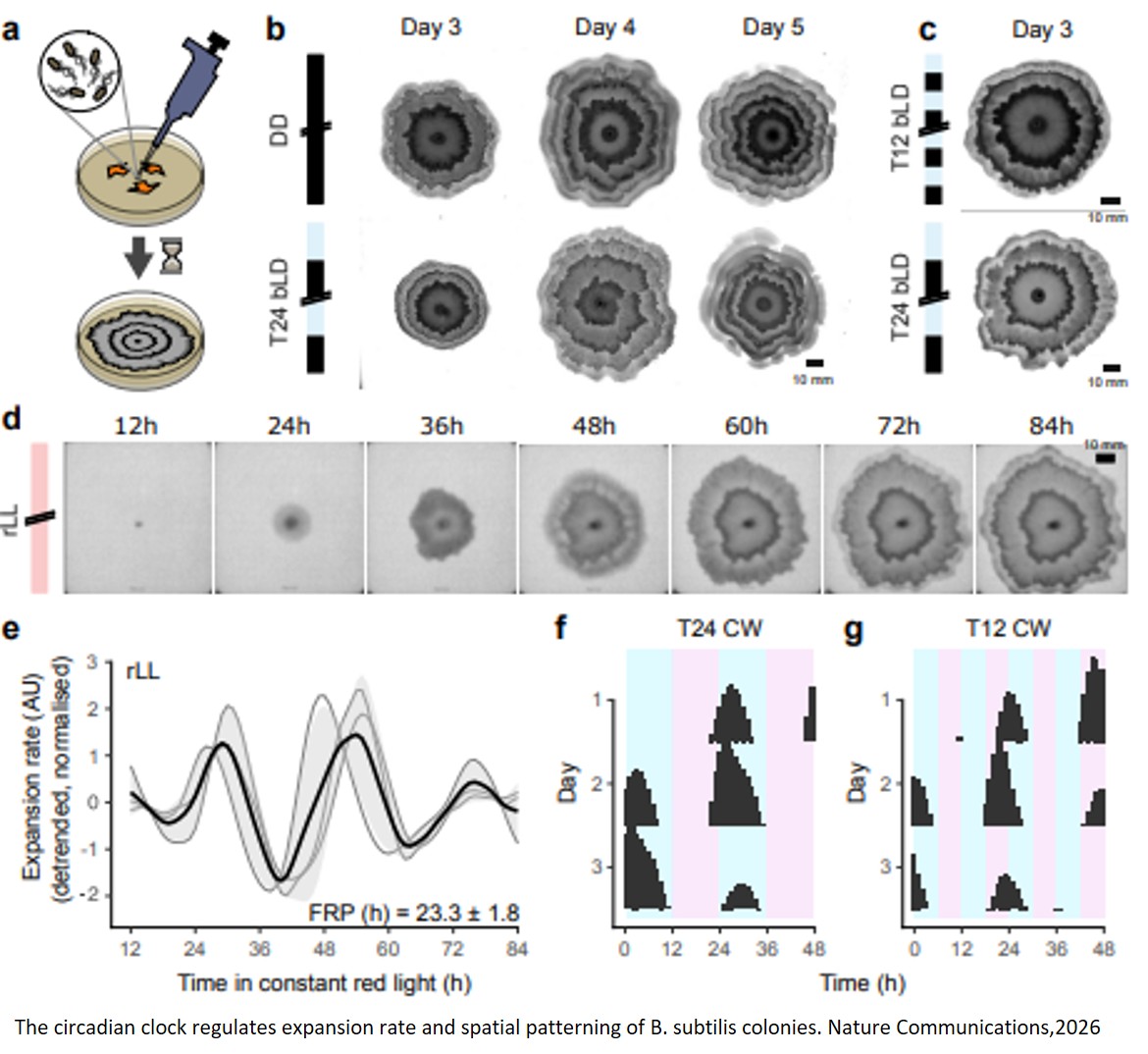
To make this discovery, the team analysed colonies of B. subtilis expanding across plates of agar gel. They had noticed that B. subtilis forms concentric rings as it spreads on petri dishes, resembling the rings of decay caused by fungi on autumn apples.
In constant conditions, the team observed that the bacterial colony spread at the rate of one ring over each period of 24 hours.
They devised a set of experiments which alter environmental conditions such as light wavelength (blue and red light) and temperature. This allowed them to test if the pattern of bacterial development and gene expression might change in response to these external stimuli or if it maintains a 24-hour cycle – indicative of a self-sustained and internally driven clock.
The team observed that concentric rings formed at the edge of the colony about once a day under all sets of conditions, consistent with circadian timing.
In further experiments, the team used a luciferase reporting technique, involving a bioluminescent enzyme, that enables tracking of gene expression over time and space.
Imaging of bioluminescence showed that genes involved in the formation of biofilms, the slimy material that binds communities of bacteria together, were clearly expressed at very specific and individual times of day over a 24-hour period, as were genes involved in sporulation, a process where cells enter dormancy.
“We found that the clock organises the Bacillus subtilis colonies, the rate at which the colony spreads across petri dishes, and it structures patterns of gene expression according to the time of day,” said the first author of the study.
“Bacillus subtilis is a soil bacterium that is also associated with plants. We think that bacterial circadian clocks organise the ecology of soil microorganisms and could have roles in supporting plant growth,” the author added.
The evolutionary distance between B. subtillis and the two species of human-associated bacteria reported to have clocks (Klebsiella aerogenes and Acinetobacter baumanii) suggests that circadian clocks could be widespread amongst non-photosynthetic bacteria and the biological domain of the prokaryotes.
This opens a new field of exploration for the field of chronobiology with benefits for biotech and human medicine.
The senior author said, “Our aim is to describe the ‘how’s’ and ‘why’s’ of the circadian clock in this bacterium so that others will be able to more easily find circadian clocks in the thousands of other bacteria. We do not think that Bacillus is alone with their rhythms!”
In addition to the longer-term applications, this study has helped to change perceptions of how bacteria survive and thrive in the world around us, explains the author
“People tend to think of bacteria as these single cells that float around, but microbiologists know that they are part of a matrix held within a biofilm. Once you know this you can see bacteria as a multi-cellular structure and, thanks to this work, we have in Bacillus subtilis a scientific model for the study of circadian clocks across multi-cellular life.”
https://www.nature.com/articles/s41467-026-74082-0
https://sciencemission.com/Bacillus-subtilis-circadian-clock