

Abnormal differentiation of fetal neural progenitor cells causes autistic-like behavior
Developmental disorders, including autism, entail challenges in social life; as the number of affected individuals has risen, this has become a significant societal concern. Using a mouse model, the researchers demonstrate that a mutation in CHD8, a gene associated with autism spectrum disorder, causes abnormal differentiation of ventral progenitor cells, leading to autistic-like behavior in adulthood. This should lead to the elucidation of mechanisms underlying autism onset during brain development and to the advancement of therapeutics.
Autism spectrum disorder (hereafter, autism) is a developmental disorder characterized by difficulties with social-interaction and by restricted interests and repetitive behaviors. It has attracted significant attention due to its high prevalence, affecting approximately one in every 36 persons, and symptoms that interfere with daily life. In recent years, genetic mutation analysis targeting individuals with autism has revealed that CHD8, a chromatin remodeler, is one of the most frequently mutated genes associated with autism, attracting significant attention.
CHD8 is known to be involved in the differentiation and maturation of diverse cells in the brain. It was unknown, however, at which stage of brain development and in which types of cells mutations in the CHD8 gene exert their effects to cause autistic-like behavior.
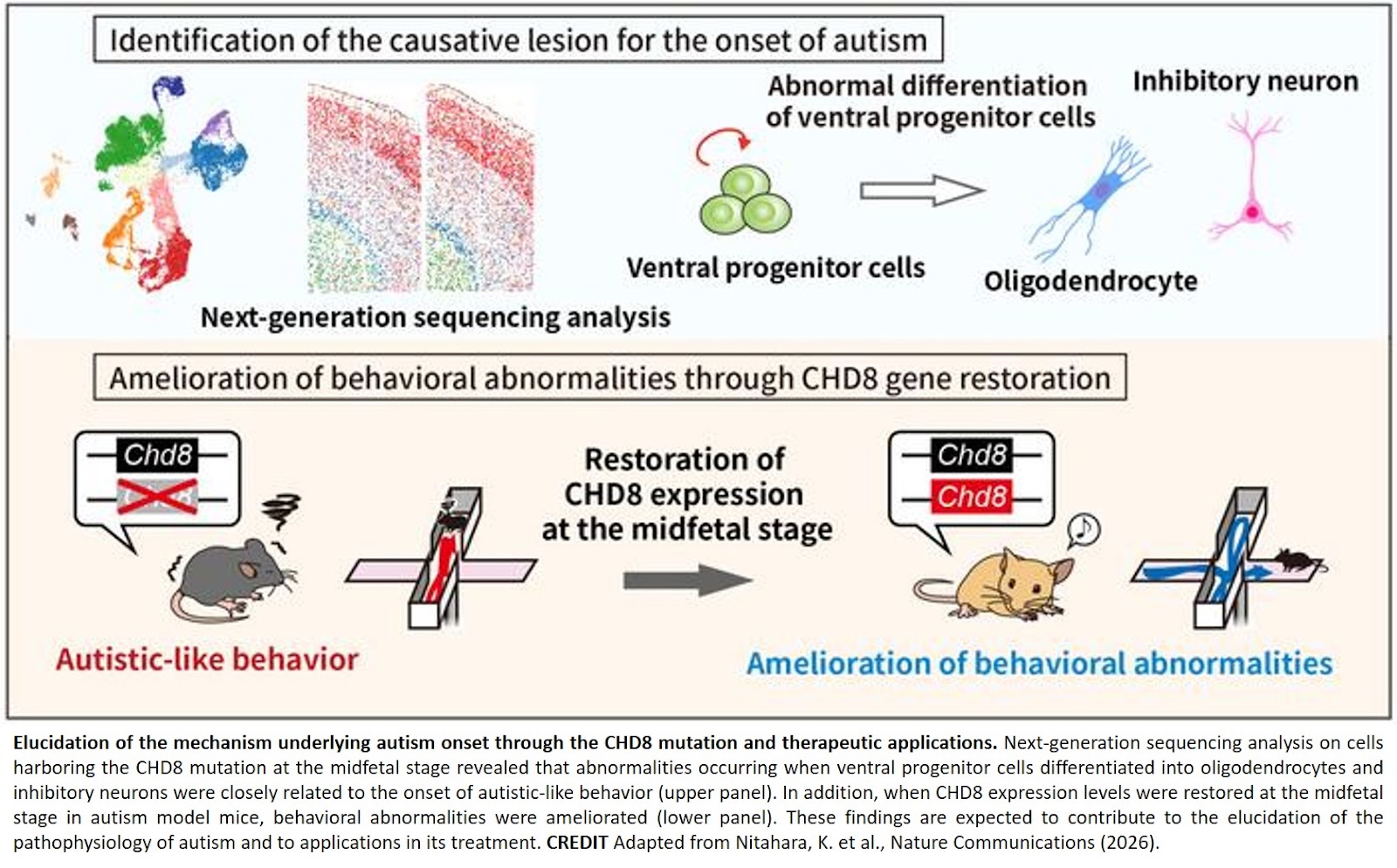
First, the researchers succeeded in generating mice in which the expression level of CHD8 could be reduced at a specific developmental stage, using gene-editing technology. As a result, it was revealed that mice with reduced CHD8 expression at the midfetal stage (embryonic day 14.5) exhibited autistic-like behavior, such as abnormal social-interaction and anxiety-like behavior, while such behavioral abnormalities were not observed in mice with reduced CHD8 expression at a late fetal stage (embryonic day 17.5) onwards.
Furthermore, through gene expression analysis and histological analysis of the brain, they determined that CHD8 mutation at the midfetal stage excessively promoted the differentiation of ventral progenitor cells, thereby causing developmental abnormalities in inhibitory neurons and oligodendrocyte-lineage cells.
In addition, using spatial transcriptomics and in vivo neural circuit functional analysis, they revealed that changes in inhibitory neurons associated with CHD8 mutation led to functional abnormalities in neural circuits in the adult brain.
While CHD8 has attracted attention as a major autism-associated gene, it remained unclear when, where, and in which cell types it contributes to the behavioral abnormalities underlying the core symptoms of autism.
The present study revealed that the neurodevelopmental differences at the root of the behavioral abnormalities stem from aberrant differentiation of ventral progenitor cells at the midfetal stage.
The present findings are expected to significantly advance our understanding of the mechanism underlying the onset of autism and pave the way for the development of new therapeutic strategies targeting specific neurodevelopmental stages or cell types.
https://www.nature.com/articles/s41467-026-73416-2
https://sciencemission.com/neurogenesis-due-to-midfetal-Chd8-mutation