
Why some misfolded proteins do not undergo proteasomal degradation
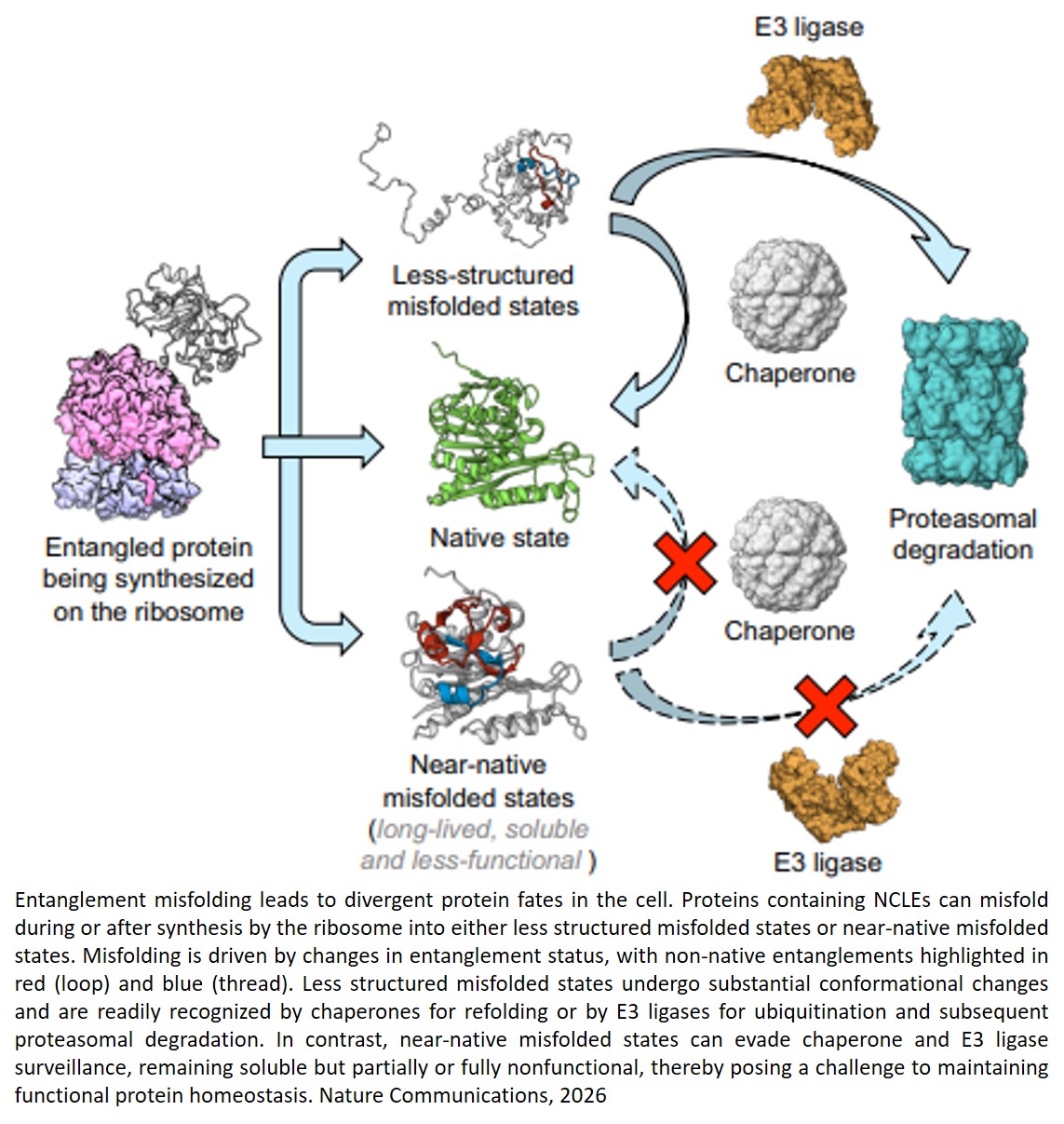
As proteins are made in a cell, they are folded into the 3-D structure that allows them to work, but sometimes this process can go wrong. When it does, the misfolded proteins lose some or all of their function and usually get tagged by the cell’s quality assurance and maintenance crews, which try to repair the proteins or, if they can’t, strip them to recycle their parts.
A new study shows that proteins that contain a certain type of structure are more likely to misfold and be targeted for removal, yet nearly half still manage to evade the cellular maintenance crew. The misfolded proteins that persist could accumulate in cells, disrupting the balance of protein production and recycling and potentially contributing to aging and disease, according to the researchers.
A paper describing the study was recently published in the journal Nature Communications.
“Like a tiny factory, cells make proteins,” said the research team lead. “And like a factory, cells have quality control mechanisms to catch any errors on the production line. We’ve recently identified a new class of protein misfolding, and we were interested in if it had any impact on how the cellular quality control system maintains a balance of protein production, repair and recycling — protein homeostasis. Additionally, protein misfolding is known to contribute to diseases like Alzheimer’s and Huntington’s. Therefore, increasing our understanding of the basic biology underlying this novel class of misfolding could lead to the identification of new disease origins and treatments.”
The new class of misfolding occurs through a change in the entanglement of a segment of the protein. The string of amino acids that make proteins can form a loop and the end of the string can thread through the loop, forming a knot-like structure. Misfolding can occur either by this type of entanglement forming where it shouldn’t or by failing to form when it is part of a protein’s natural structure.
“We focused on proteins that have an entanglement as part of their native structure because we have shown in the past that they are more likely to misfold,” said the first author of the paper. “We used an existing database of proteins that have been tagged with a marker for degradation in human fibroblast cells and cross-referenced it with a database of protein structures so we could see the proportion of proteins with the entanglement that were marked by the cellular quality control mechanism.”
The team found that proteins that contain an entanglement as part of their native structure were 93% more likely to be tagged for degradation and removed by cellular maintenance crews than proteins without an entanglement. They were also able to estimate how quickly the proteins get tagged for removal. They found that recently made, or young, proteins were already tagged, some even while they were still in the process of being made.
“We also used computer simulations to show that tagged proteins that have an entanglement as part of their structure are four times more likely to misfold than untagged proteins without an entanglement,” said the author. “This suggests that the failure to form an entanglement increases the likelihood of a protein being tagged for degradation.”
The researchers also showed that about a third of proteins with an entanglement are not tagged for degradation, despite their high rate of misfolding.
“Sometimes a misfolded entanglement can be hidden deep within the structure of a protein, so that it isn’t visible to the quality control system,” the first author said. “These proteins may therefore evade degradation and persist in the cell despite being non-functional. Eventually, these misfolded proteins can accumulate in a cell disrupting protein homeostasis and potentially contributing to aging and disease by gumming up the cellular works.”