

Ameliorating fibrosis in cancer via senescence-directed nanotherapy
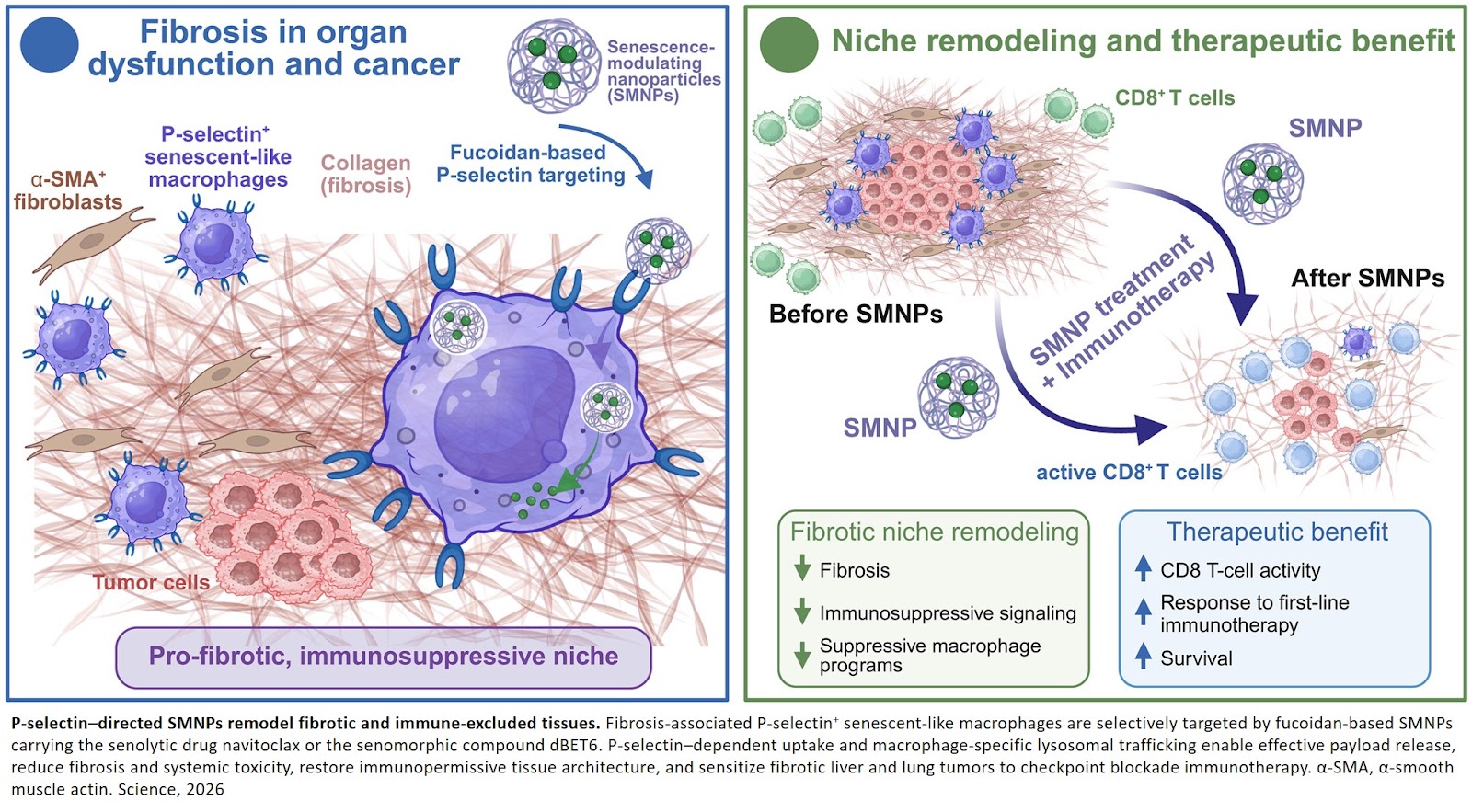
Many liver and lung cancers arise in tissue that’s already been scarred by chronic disease — such as hepatitis, cirrhosis, or long-term lung damage. That scarring creates an environment that suppresses nearby immune cells, so by the time a tumor takes hold, it’s often already shielded from the immune system and immunotherapy.
Now, scientists have developed a new approach to breaking down this barrier. They engineered nanoparticles — tiny particles about 1,000 times smaller than the width of a human hair — that can be loaded with drugs and directed at specific cells in the body. By selectively eliminating a small population of immune cells found to drive fibrosis, the approach could make immunotherapy work for more patients with minimal toxicity to healthy cells.
The laboratory findings, published in Science, potentially pave the way for new approaches against immunotherapy-resistant tumors, as well as for a host of other fibrotic and inflammatory diseases.
“Immunotherapy can elicit amazing therapy responses — but right now it doesn’t work for the vast majority of patients,” says a co-corresponding author of the study. “So anything we can do to make it work better and for more people is worth pursuing.”
In this research, the team observed that within a group of immune cells called macrophages, a small number express the protein P-selectin as well as multiple features of senescence.
“What was striking was how consistently we found this specific population of macrophages in fibrotic tissue,” the author says. “They had all the hallmarks of senescence, and their presence was a strong signal that the local immune environment had been compromised.”
These cells — dubbed MΦP+sen+ (meaning a macrophage that is P-selectin positive and senescence positive) — are prevalent in the fibrotic tumor niches found in liver and lung cancers, as well as in other heavily scarred liver and lung tissue. And their presence is linked to poorer immunotherapy responses in patients.
Along with contributing to the fibrosis that creates a physical barrier, these macrophages also actively dampen the response of other immune cells, creating an immunosuppressive environment around the tumor.
“These cells aren’t just bystanders in the tumor environment,” the author says. “By sending out profibrotic and immunosuppressive signals, they essentially put up a wall that keeps the immune system from being able to do its job.”
The study was conducted in mouse models of liver and lung fibrosis, and fibrotic liver and lung cancers. The team validated key findings in tumor samples from lung cancer patients treated at MSK, and using human lung and liver cancer datasets.
“These key macrophages make up just 3% to 5% of fibrotic tissue, but our experiments showed that selectively killing them or silencing their signals had a profound effect on fibrosis,” says the lead author.
Eliminating or disabling the MΦP+sen+ cells had two effects: The scar tissue protecting the tumor started to dissolve. The suppression of other immune cells was reduced.
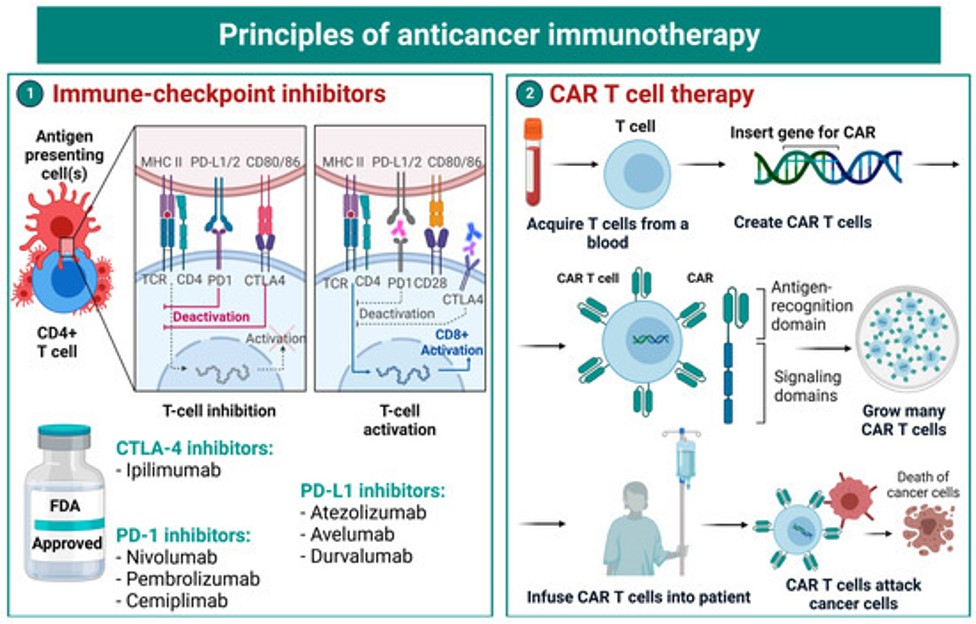
This allowed checkpoint inhibitor immunotherapy to work in the mice, shrinking tumors that had previously been resistant to treatment.
Precisely targeting this small-but-critical subpopulation of macrophages, however, wasn’t an easy task.
To accomplish it, the Lab used nanoparticle platform with new drugs and a new goal.
“When they identified this important population of P-selectin-positive senescent macrophages, we thought they’d be good candidates to target with our nanoparticles,” the author says.
The two drugs tested in the study — Navitoclax and a BET inhibitor called dBET6 — have powerful effects against senescent cells, but their use in the clinic has been held back because they cause side effects in patients when the therapies are given conventionally.
The nanoparticles attempt to solve this issue by delivering a small dose of the drug directly and selectively to the problem cells driving the fibrosis.
The drugs are packaged using a naturally occurring sugar molecule called fucoidan, which is found in brown seaweed and commonly sold as an anti-inflammatory supplement. Fucoidan naturally binds to P-selectin.
“Macrophages are specialized immune cells that track down, swallow, and destroy germs and debris,” the author says. “The key is that our nanoparticles are coated with fucoidan, which specifically binds to P-selectin — so it’s not just any macrophage that takes up the drug, but the precise subset driving the fibrosis.”
When the macrophages ingest and break down a nanoparticle, the drug is released — like soldiers springing from the inside of the Trojan Horse to launch a precision attack on the MΦP+sen+ cells in the tumors.
The two tested drug cargoes in the nanoparticles work in different ways:
· Navitoclax targets a trick that the stressed senescent cells use to block a natural self-destruct mechanism — causing them to die.
· dBET6, on the other hand, silences inflammatory signals that senescent cells broadcast into surrounding tissues. With the alarm turned off, the cells stop sending the signals that drive fibrosis and immune suppression.
Both drugs have shown promise against cellular senescence in the lab but failed in clinical trials because they also cause a lot of damage to healthy cells and tissues when administered broadly. Here, the nanoparticle appeared safe compared to the unpackaged drugs and did not produce the same toxicity in mice. Therefore, the nanoparticle delivery method could potentially give both drugs a second chance, the researchers say.
In a large database of immune cell profiles, the researchers found the same harmful macrophages associated with breast and colon cancer, as well as chronic inflammatory diseases like osteoarthritis and rheumatoid arthritis.
If MΦP+sen+ cells turn out to be a common culprit across a range of diseases, the nanoparticle platform might be adapted to treat them, the author says.
“This subset of macrophages also shares important features with a type of cell called lipid-associated macrophages — which are found, for example, in the atherosclerotic plaques that cause heart disease,” another author adds. “This approach might help to selectively deliver drugs to them.”
The work also exemplifies a broader strategy of undermining cancer by targeting key cells that directly support and protect tumors — what scientists call the cancer ecosystem.
https://www.science.org/doi/10.1126/science.aeg4791